The Many Names of the One
In the Ancient Egyptian Mystery Schools, unity was never conceived as isolation, nor plurality as division. The cosmos was understood as a living articulation of a singular, inexhaustible source. That source was not diminished by its expressions; rather, it was revealed through them.
Thus the Neteru, the divine principles of Egyptian cosmology, were not separate gods competing for devotion. They were luminous differentiations of the One reality, each expressing a distinct mode of its intelligence, power, or order.
To misunderstand this is to mistake differentiation for fragmentation.
The initiatic teaching affirms: the One is not reduced by its names; it is made perceptible through them.
The Neteru as Functional Expressions of Unity
In Kemetic cosmology, the Neteru are not personalities in the modern psychological sense. They are principles of operation within the living totality.
- Ra expresses radiant consciousness.
- Ptah expresses formative intelligence.
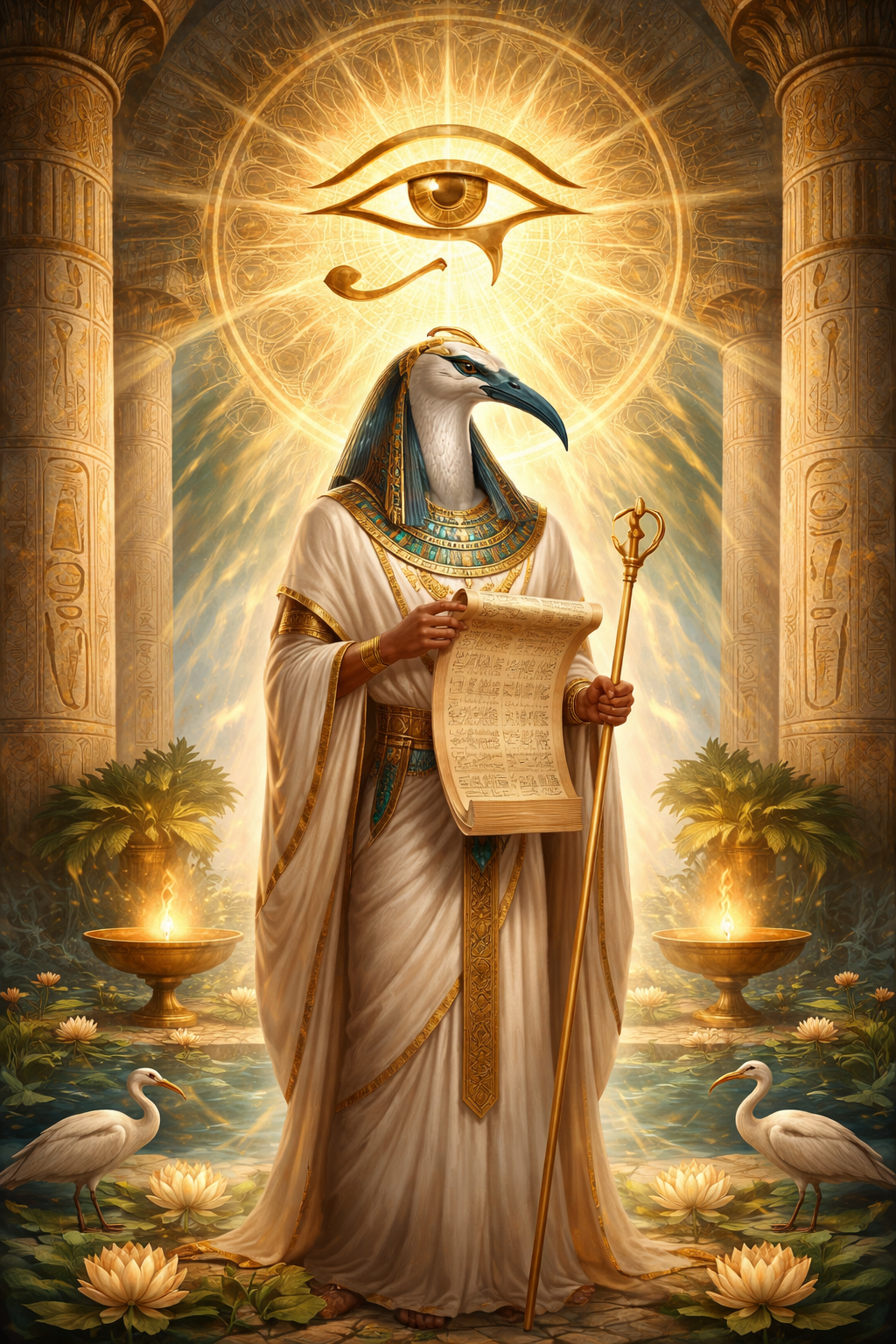
- Tehuti expresses measure, articulation, and sacred order.
- Ma’at expresses equilibrium and truth.
These are not separate beings existing apart from one another; they are distinct functions within a unified field of existence.
Just as light refracts into colors without ceasing to be light, the One refracts into divine principles without losing its indivisibility.
Plurality, therefore, is not a fall from unity. It is unity made intelligible.
Why Divine Plurality Does Not Contradict Non-Duality
Modern interpretations often assume that unity must eliminate multiplicity. From this assumption arises confusion: how can a non-dual cosmology contain many deities?
The answer lies in initiatic perception.
Non-duality in the Egyptian sense does not deny distinction; it denies separation. Distinction is the means through which the mind can perceive order. Separation is the error that imagines those distinctions to exist independently.
The Neteru are not separate powers. They are differentiated currents of a single living totality.
The temple sciences trained the initiate to perceive this simultaneously:
-
To recognize the distinct function of each Neter.
-
To perceive the indivisible source from which all arise.
This double vision is not contradiction; it is completeness.
The Error of Literalism
When divine plurality is interpreted literally and externally, the teaching fractures into polytheism in the modern sense. When unity is interpreted abstractly and conceptually, it dissolves into formless philosophy.
The Mystery Schools avoided both distortions.
They preserved symbolic precision. Each Neter had form, iconography, mythic narrative, and temple cult; yet these were never intended as ultimate separations. They were sacred lenses.
Through devotion, ritual, and contemplation, the initiate learned to move from form to principle, from principle to source.
The many names led back to the One.
Initiation as the Restoration of Integrated Vision
The untrained mind oscillates between extremes:
-
It sees only multiplicity and forgets unity.
-
Or it seeks unity and rejects multiplicity.
The initiatic path resolves this oscillation.
In mature perception, the heart recognizes the One expressing itself through countless modes without division. Every Neter becomes a doorway; every function becomes revelation.
The cosmos is no longer fragmented into competing forces. It is experienced as a symphony of differentiated harmonies, arising from a single inexhaustible ground.
To know the many without losing the One is wisdom.
To know the One without denying the many is balance.
This is the science preserved in the temples.
Living the Teaching
This understanding is not merely theological. It is practical.
When one perceives others as fundamentally separate, conflict multiplies. When one denies distinction in the name of unity, discernment collapses.
But when one sees distinction within unity, relationship becomes sacred rather than adversarial.
Every encounter becomes an expression of the same underlying source. Every difference becomes a mode of revelation rather than a threat.
Thus divine plurality is not mythology alone; it is a mirror of lived reality.
Conclusion: The Names Return to Silence
The Neteru are names; the One is beyond name.
Yet without the names, the human mind cannot approach the nameless. Without the differentiated forms, consciousness cannot awaken to the undivided ground.
The Mystery Schools therefore preserved plurality as a sacred necessity. Through the many, the initiate returns to the One; through articulation, silence is rediscovered.
The many names do not divide the source.
They unveil it.