Lord of Divine Measure — Tehuti and the Architecture of Cosmic Order
In the unfolding of creation, the emergence of intelligence must be followed by measurement. Thought alone cannot structure a world; it must be translated into proportion, rhythm, and law. In the sacred vision of Kemet, this work belongs to Tehuti, the Neter who embodies divine mathematics, cosmic proportion, and the subtle architecture that sustains all existence.
To call Tehuti the Lord of Divine Measure is to acknowledge him as the one through whom the cosmos receives shape, order, and harmony. Through number, time, geometry, language, and natural law, he inscribes the blueprint of creation upon the fabric of reality.
The Principle of Measure in Egyptian Thought
In ancient Egypt, measure was not a mechanical process. It was a sacred act, the means by which life and cosmos remained in balance. The term for measure, maat in its broader sense, signifies alignment with the eternal pattern. Thus, measurement was the act of discerning the correct proportion between all things, ensuring that each element occupied its rightful place.
In this sense, the work of Tehuti is the work of sustaining cosmic equilibrium through wisdom, number, and truth.
Tehuti and Sacred Mathematics
Tehuti presides over the origin and use of mathematics in both the physical and spiritual realms. Egyptian texts attribute to him:
- the invention of numbers
- the calculation of time and cycles
- the measurement of the earth and heavens
- the ordering of temples according to cosmic proportion
Mathematics, in Tehuti’s domain, is not abstraction but sacred insight, the recognition of patterns that reflect universal intelligence. Every ratio, sequence, or geometric form expresses the harmony of creation. Thus, number becomes a language of divine truth.
Geometry and the Form of the World
Geometry, literally “earth-measure,” was regarded as a divine gift of Tehuti. It reveals the relationships that bind creation together. In Egyptian temple design, the proportions of walls, pylons, courts, and sanctuaries mirror celestial patterns, the movements of stars, the cycles of planets, and the rhythms of the moon.
The architects of Kemet worked under the guidance of Tehuti, aligning their structures with the patterns he established in the heavens. In this way, terrestrial temples became reflections of the cosmic temple.
The Measurement of Time
Tehuti is also the keeper of time. His lunar nature aligns him with the cycles of months and years. Egyptian calendars, civil, lunar, and ritual, all bear traces of Tehuti’s influence. He governs:
- the phases of the moon
- the counting of days
- the marking of sacred festivals
- the “opening of the year”
Time, under Tehuti’s guidance, becomes not merely a sequence of moments, but the pulse of the cosmos reflected in the pulse of human life.
Tehuti as Architect of the Heavens
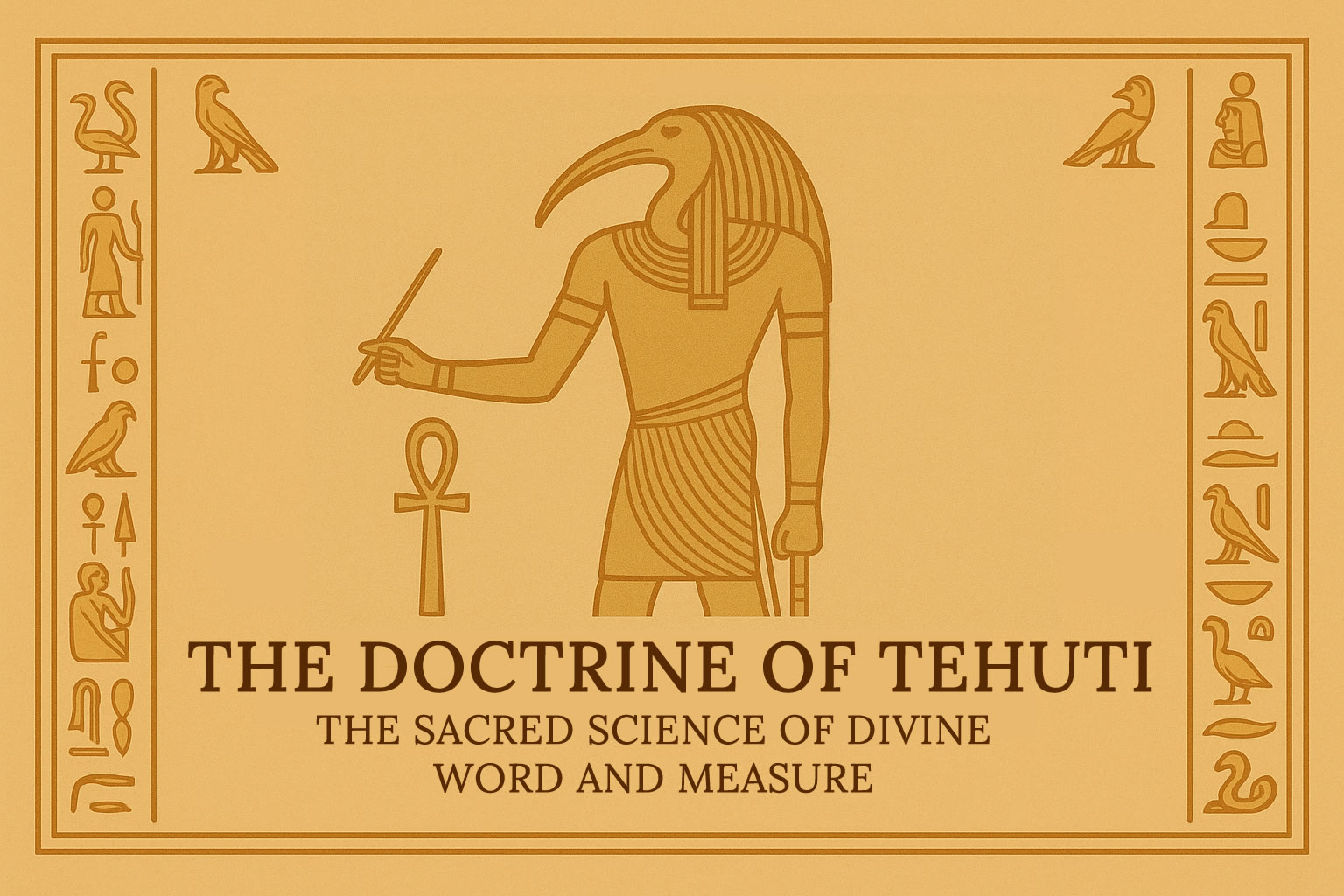
In the cosmological texts, Tehuti is described as the one who measures the heavens “with a perfect reckoning.” He calculates the courses of the stars, ensuring that celestial bodies move in harmony with the divine will of Ra. He is depicted with instruments of measurement, not as symbols of technical skill, but of cosmic responsibility.
The inscriptions declare:
“He sets the order of the stars; he balances the sky with his wisdom.”
Thus, astronomy, astrology, and sacred timekeeping all belong to his domain.
The Architecture of Divine Speech
Measurement in Egypt extends beyond physical things. It includes the architecture of speech. Since utterance has creative power, it must be structured with precision. Tehuti governs the grammar, proportion, and internal geometry of language. Words, when aligned with his measure, become instruments of healing and creation.
Thus, Tehuti’s role as the Scribe of the Gods is inseparable from his role as measurer. Every divine decree he records must reflect perfect balance, for speech is the foundation of the world.
Measurement and Maʽat
Tehuti’s work cannot be separated from Maʽat (truth, balance, cosmic order). Measure without truth becomes distortion; truth without measure remains unspoken. In this sacred partnership, Tehuti gives form to Maʽat, ensuring that divine order is expressed with elegance and accuracy throughout creation.
Thus, the texts speak of Tehuti as:
- “Companion of Maʽat”
- “He who writes Maʽat”
- “He who reckons Maʽat for all beings”
Measure is the means by which truth becomes manifest.
The Human Mind as Microcosm of Measure
Just as Tehuti measures the cosmos, human consciousness is called to measure the self. The heart becomes the scale; thought becomes the instrument; speech becomes the expression. When the individual acts with clarity, discipline, and insight, they mirror the work of Tehuti within their own sphere.
This is the foundation of intellectual and spiritual maturity, the ability to discern proportion, choose with wisdom, and align one’s actions with divine order.
Conclusion: The Divine Architect
Tehuti stands as the intelligence that shapes the world with precision and harmony. Through him, creation becomes an ordered temple, sustained by the laws of truth, number, time, and proportion. To know Tehuti in this aspect is to understand the beauty of a universe crafted by wisdom, a cosmos measured with compassion and clarity.
“Through measure, the cosmos becomes form; through Tehuti, form becomes wisdom.”
Continue to Part IV: The Science of Sacred Word — Hu, Heka, and the Voice of Tehuti.