The Birth of Divine Intelligence — Tehuti in the Cosmologies of Kemet
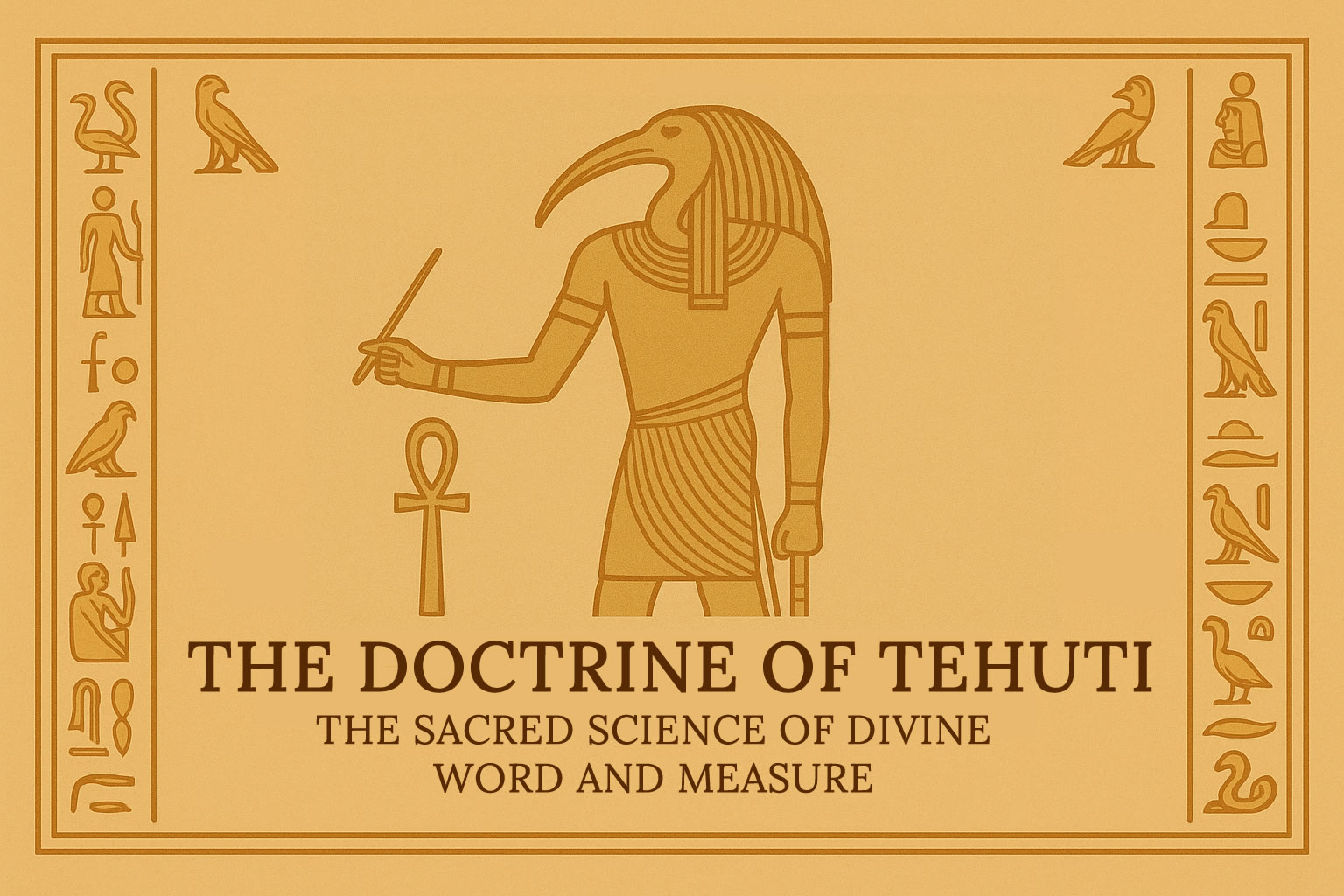
Before the first dawn, before the sun rose upon the horizon of eternity, consciousness stirred within the primordial waters of Nun. From this boundless depth emerged the first movements of light, intention, and measure. In the sacred cosmologies of Kemet, these early stirrings of awareness are personified in Tehuti, the Neter of divine intelligence, sacred utterance, and the precise ordering of creation.
To understand Tehuti is to understand how the cosmos came to know itself. His presence marks the moment awareness becomes articulate, when the unformed becomes intelligible, and when the silent potential of being is expressed through thought and word.
Tehuti in the Hermopolitan Cosmology
One of the oldest accounts of creation, preserved in Hermopolis (Khemenu, “City of the Eight”), describes the formation of the world through the Ogdoad, eight primordial principles, paired as male and female, representing the hidden qualities of existence. They are:
- Nun and Naunet — the primeval waters
- Heh and Hehet — infinite space
- Kek and Keket — darkness or the hidden
- Amun and Amaunet — the concealed essence
From the interplay of these principles arose a surge of luminous order. In this cosmology, Tehuti emerges as the first organizing consciousness, the intelligence that perceives, names, and measures the unfolding of creation.
Thus, Hermopolis attributes to Tehuti the role of divine mind at the threshold of existence. He is the one who “makes clear what was hidden” and “brings forth light from the deep.”
The Word That Awakens Creation
Tehuti’s role in creation is inseparable from sacred utterance. In Egyptian thought, speech is not a symbolic act but a creative force. The universe is spoken into being through the interplay of Hu (authoritative utterance) and Heka (creative potency). Tehuti is the master of this sacred word, the one through whom the first articulation of order is made manifest.
The texts proclaim:
“He spoke, and the world became.”
This does not imply creation ex nihilo but rather the transition from potential to form. Tehuti gives structure to the unformed, naming each element of existence so that it may take its rightful place within the cosmic design.
Tehuti as the Heart and Tongue of Ra
In the Heliopolitan tradition, creation begins with Ra-Atum rising from the waters of Nun. From him emanate the first divine principles. Yet even in this solar cosmology, Tehuti occupies a central role. The texts describe him as:
- “The heart of Ra” — the seat of thought and intention
- “The tongue of Ra” — the mechanism of articulation
The meaning is profound. In Egyptian theology, the heart (ib) is the locus of thought, while the tongue symbolizes expression. Tehuti is thus presented as the intelligence of the divine will, the faculty through which the mind of Ra becomes audible and effective.
This establishes him as the mediator between pure consciousness and the manifested world, the bridge through which divine thought becomes cosmic architecture.
The Moon as Symbol of Ordered Mind
Tehuti’s lunar dimension is essential for understanding his cosmic birth. The moon, with its consistent cycles and gentle illumination, signifies:
- rhythm — the regulated unfolding of time
- clarity — light in darkness, discernment amid the unknown
- reflection — the mind that perceives without distortion
Just as the moon reflects the sun, Tehuti reflects the mind of Ra. His light does not overpower but reveals; it illuminates the hidden and measures the passing of sacred time. In this sense, the birth of Tehuti is the birth of intelligence that sees clearly, intelligence that measures, discerns, and balances.
Tehuti and the Principle of Measure
In all cosmologies, Tehuti appears not as creator in a material sense but as the measurer of creation. He determines:
- the length of days and months
- the paths of the stars
- the proportions of sacred forms
- the laws governing speech, writing, number, and symbol
This role is expressed in the epithet:
“Lord of Divine Measure.”
Measure, in Egyptian thought, is not mechanical calculation but cosmic proportion, the alignment of all things with living order. Thus, Tehuti’s birth is the emergence of cosmic reason, the principle that ensures harmony within the whole.
The Birth of Divine Intelligence Within Humanity
Just as Tehuti arises at the dawn of creation, he also arises within the human mind. Egyptian teachings emphasize that the same intelligence that orders the stars orders the heart. Tehuti thus becomes:
- the guide of intuition
- the patron of wisdom
- the awakener of inner clarity
His birth within the individual marks the beginning of discernment, the ability to perceive truth, articulate insight, and act with balanced intention.
Conclusion: The Mind at the First Dawn
In the cosmologies of Kemet, the appearance of Tehuti is the appearance of intelligence itself. He is the first clarity in the primordial deep, the first utterance of truth, the first measure of time, and the first articulation of cosmic order. Through him, the universe becomes intelligible, and through him, humanity gains the power to think, speak, and create in harmony with the divine.
“When Tehuti arises, the cosmos awakens; thought becomes light, and order takes form.”
Continue the journey with Part III: Lord of Divine Measure — Tehuti and the Architecture of Cosmic Order.