The Name Tehuti — Origins, Hieroglyphs, and Etymology of the Divine Scribe
The name Tehuti, preserved in the ancient Egyptian form Ḏḥwty (commonly rendered Djehuty), is among the most sacred designations in the legacy of Kemet. It carries within it the essence of divine intelligence, lunar measure, sacred utterance, and the consciousness that shapes creation through word and number. To study this name is to enter the threshold of the Mystery of Thought itself, the luminous faculty through which order becomes manifest.
This teaching begins with the origins of the name, its hieroglyphic composition, and its earliest recorded appearances. In doing so, we uncover the profound symbolism encoded within the identity of the one called the Lord of Divine Measure and Scribe of the Gods.
The Ancient Name Ḏḥwty (Djehuty)
The original Egyptian name is written as Ḏḥwty, often transliterated as Djehuty. It is composed of glyphs associated with Djehut or Djehuty, a place or concept linked to the sacred ibis. Thus the name is commonly interpreted as:
“He of Djehut” or “The One Belonging to the Ibis-Domain.”
This designation reflects the symbolic connection between Tehuti and the ibis, a bird associated with lunar observation, rhythmic precision, and the ability to discern subtle distinctions in flowing waters. These traits mirror the spiritual functions of Tehuti: perception, measurement, articulation, and knowledge.
The Hieroglyphic Components
The name Ḏḥwty appears in various hieroglyphic forms throughout Egyptian history. While slight variations exist, most renderings include the following elements:
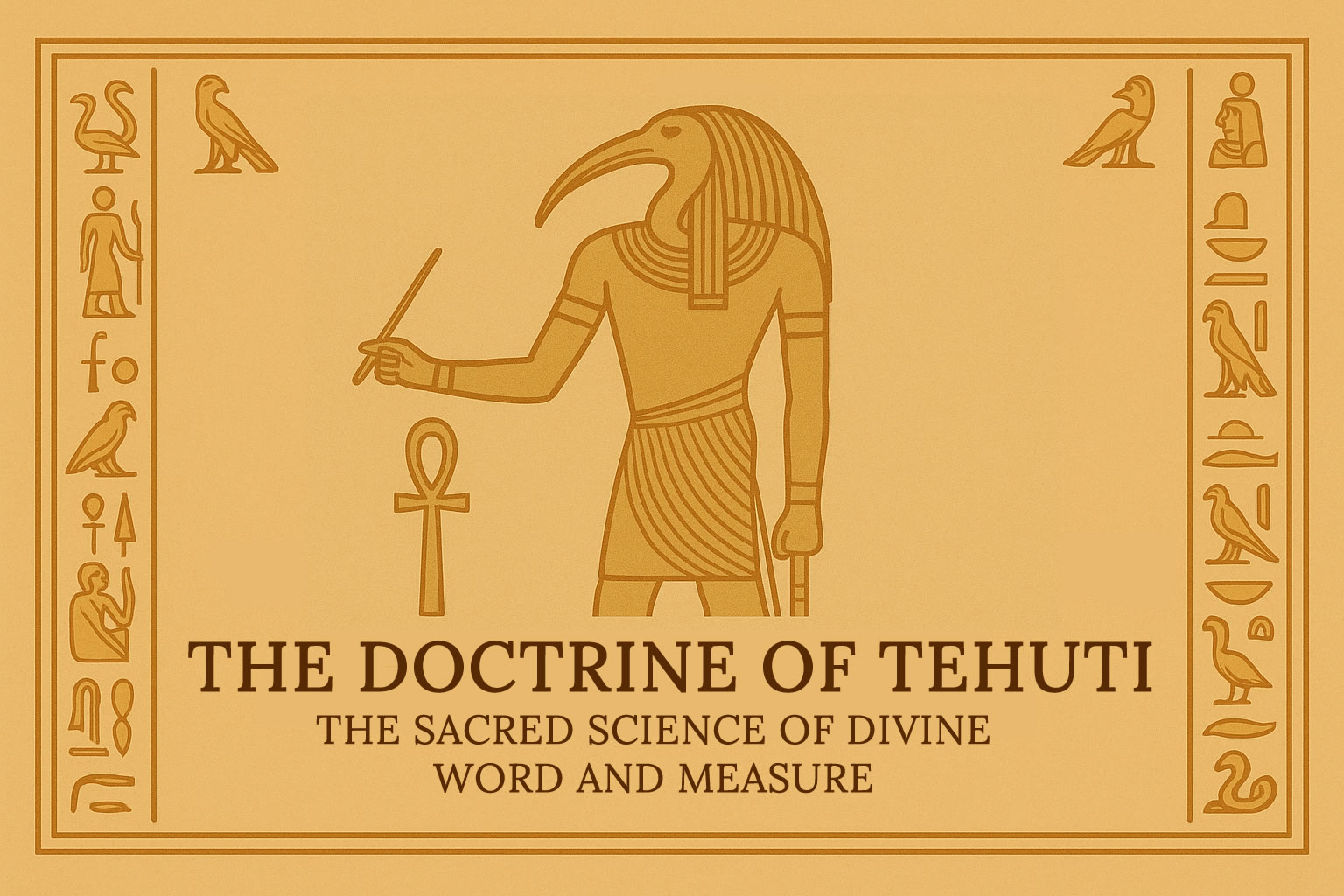
- The Ibis — representing Tehuti himself
- The Scribe’s Palette — symbolizing writing, record-keeping, and intellectual mastery
- The Lunette or Crescent — signifying lunar cycles and measurement
- Phonetic signs that encode the sounds Ḏ-ḥ-w-ty
Together these glyphs express Tehuti as the lunar scribe, the measurer of time, and the divine intellect that orders creation.
The Meaning of “He of Djehut”
The phrase “He of Djehut” refers to a sacred location or metaphysical domain associated with the ibis and with divine knowledge. In ancient thought, physical places often carried cosmic significance. Thus, “Djehut” may be understood as:
- A region sanctified by lunar rites
- A symbolic realm of knowledge and calculation
- A metaphysical “house of wisdom”
To be “of Djehut” is to belong to the domain where cosmic order is translated into intelligible form. It signifies mastery of measurement, language, intuition, and divine memory.
The Lunar Dimension of Tehuti
Tehuti’s association with the moon is foundational to understanding his name. The moon governs cyclical time, regulates the tides, and illuminates the night with a reflective, gentle light. These qualities symbolize:
- Reflective intelligence — insight that perceives what is subtle
- Measurement and rhythm — counting days, months, and sacred intervals
- Purification and clarity — gentle illumination of the hidden
Thus the name Ḏḥwty encapsulates Tehuti as the divine measurer who brings order through perception.
Early Appearances of the Name
The name Tehuti appears as early as the Old Kingdom, inscribed in pyramid texts, temple walls, and the earliest ritual corpora. In these inscriptions, Tehuti is invoked as:
- He who records the words of the gods
- The heart and tongue of Ra
- The one who speaks Maʽat into being
From the beginning of Egyptian history, his name is associated with language, mathematics, healing, magic, timekeeping, and cosmic intelligence. No other Neter unites these domains so comprehensively.
The Sacred Function Contained in the Name
The name Tehuti is not merely an identifier; it is a description of function. In ancient Egypt, a divine name reveals the essence and power of the being it names. Thus Ḏḥwty signifies:
- The Divine Intellect that shapes order
- The Scribe who records the unfolding of creation
- The Measurer who establishes time, number, and proportion
- The Speaker who gives form to thought
- The Healer who restores harmony through knowledge
To invoke the name Tehuti is to acknowledge the living principle of divine reason operating within the cosmos and within the human mind.
Conclusion: The Name as the First Mystery
The name Ḏḥwty stands at the threshold of all further understanding. It reveals Tehuti as the embodiment of measured consciousness, sacred utterance, and lunar wisdom. To know his name is to take the first step into the science of divine word and measure, the path through which the cosmos becomes intelligible.
“In the name of Tehuti, the hidden becomes clear, and thought becomes the architecture of creation.”
Proceed next to Part II: The Birth of Divine Intelligence — Tehuti in the Cosmologies of Kemet.