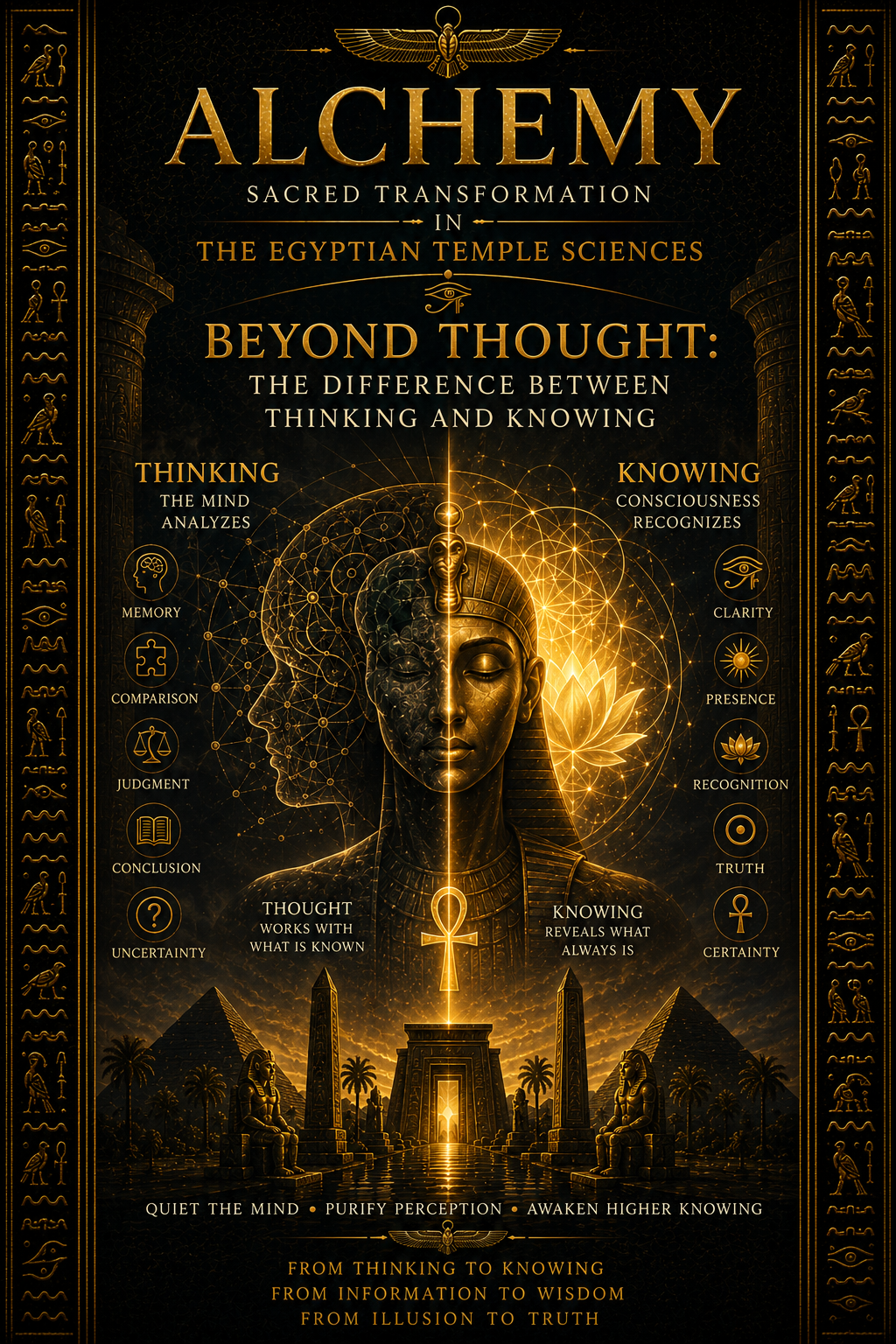
Beyond Thought: The Difference Between Thinking and Knowing
Understanding the distinction between mental activity and higher knowing within the Egyptian wisdom tradition
There are moments in which the mind reaches its limit.
Not because it lacks intelligence, but because there exist forms of recognition that thought alone cannot produce. One may analyse endlessly, compare possibilities, and construct increasingly refined conclusions, yet still remain distant from certainty.
Within the Egyptian wisdom tradition, this distinction was clearly understood.
Thought was recognised as necessary, yet insufficient. For there exists a form of knowing that does not arise through mental construction, but through direct apprehension, a clarity that emerges when perception is no longer governed solely by the activity of the mind.
The Function and Limitation of Thought
Thought serves an essential function.
It compares, categorises, interprets, and organises experience into forms the mind can navigate. Without thought, communication, structure, and discernment would be impossible.
Yet thought possesses inherent limitations.
It operates through what is already known. It draws upon memory, prior experience, learned concepts, and accumulated interpretation. Even its most creative movements arise through recombination of existing material.
Thus, thought cannot directly perceive what lies beyond the boundaries of its conditioning.
It can infer. It can speculate. It can approximate.
But it cannot know in the deeper sense intended within the temple sciences.
Intuition Versus Thinking
The modern use of the word intuition often lacks precision, becoming associated with emotion, impulse, or subjective feeling. Yet within the Egyptian teachings of consciousness, higher knowing is neither emotional reaction nor instinctive preference.
It is direct recognition.
This recognition does not emerge through sequential reasoning. It arises when perception becomes sufficiently clear that truth is apprehended immediately, without the intermediary constructions of discursive thought.
This does not oppose thinking.
Rather, it places thought in its rightful relation.
Thinking processes information.
Knowing perceives reality directly.
The difficulty, however, lies in distinguishing genuine knowing from assumption, desire, projection, or emotional certainty. Many mistake intensity of feeling for truth, when in reality the two are not synonymous.
Thus, discernment becomes essential.
The Noise of the Conditioned Mind
One of the primary obstacles to higher knowing is the constant activity of the conditioned mind.
The mind seeks continuity. It resists uncertainty and attempts to fill silence with interpretation. In doing so, it often overlays reality with projections derived from fear, memory, desire, or expectation.
This activity becomes so habitual that many no longer recognise it as activity.
They assume they are perceiving clearly, while in truth they are perceiving through layers of internal movement.
Within Egyptian alchemy, stillness is not valued merely for calmness.
It is valued because distortion becomes more visible within it.
When the mind ceases its compulsive movement, subtler forms of perception begin to emerge, forms previously obscured by constant interpretation.
Yet stillness alone is not enough.
Without alignment and purification, silence may simply reveal deeper confusion rather than true knowing.
Higher Knowing in Egyptian Wisdom Consciousness
In the Egyptian wisdom consciousness tradition, higher knowing is not treated as mystical abstraction or rare gift. It is understood as a faculty inherent within human consciousness, though often dormant beneath layers of distortion.
This faculty does not operate through belief.
It operates through direct correspondence between perception and truth.
When the inner structure is properly aligned, knowing arises naturally, not as conclusion, but as recognition. There is no strain within it, no compulsion to defend it, and no need to convince.
It carries a different quality from thought.
A stillness.
A certainty without aggression.
Yet the temple sciences also recognised the danger of self-deception. For the ego may imitate certainty, and the conditioned mind may present its conclusions with great conviction.
Thus, genuine knowing requires preparation.
The vessel through which it arises must first be refined.
Why Thought Alone Cannot Complete Transformation
Transformation cannot be completed through thought alone because thought itself exists within the structure that requires transformation.
The mind may understand principles intellectually while remaining inwardly unchanged. It may speak with sophistication about alignment, purification, or truth, yet continue to operate through the same conditioned patterns.
This is why knowledge, in the ordinary sense, is not equivalent to wisdom.
Wisdom requires embodiment.
It requires that what is known penetrate beyond conceptual understanding into the structure of one’s being.
Until this occurs, transformation remains partial.
One may think differently without truly seeing differently.
The Unresolved Threshold
If there exists a form of knowing beyond thought, and if the conditioned mind is capable of imitating clarity, then an inevitable question emerges:
How is true knowing recognised?
By what means does one distinguish direct perception from projection, intuition from desire, or wisdom from mental construction?
And if the mind itself cannot fully answer these questions, what faculty must awaken in order for truth to be known directly?
These questions cannot be resolved through thought alone.
They indicate the presence of a threshold beyond conceptual understanding, a threshold that must ultimately be entered through lived transformation.
Alchemy course
What has been outlined here is only the beginning.
The full path of this work, its structure, discipline, and lived application is explored in depth within the Alchemy course.
If you recognise the call within these teachings, you may proceed here:
https://mysteryschooloftehuti.com/alchemy/