The Egyptian Temple as a School of Consciousness
How Sacred Architecture, Symbolism and Ritual Guided Human Transformation in Ancient Egypt
When modern visitors stand before the temples of Karnak, Luxor, Edfu, Dendera, or Philae, it is easy to see them primarily as extraordinary monuments of an ancient civilization.
Their colossal columns, sacred reliefs, processional avenues, hidden chambers, and monumental gateways inspire awe even after thousands of years.
Yet the Ancient Egyptian temple was far more than an impressive building.
It was a sacred environment.
A place where heaven and earth were understood to meet.
A dwelling place of the Neteru.
A centre of ritual, learning, sacred science, and priestly service.
And, at a deeper level, the temple may be understood as something even more profound:
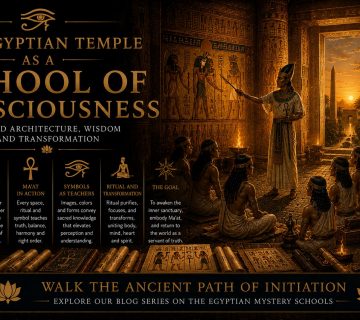
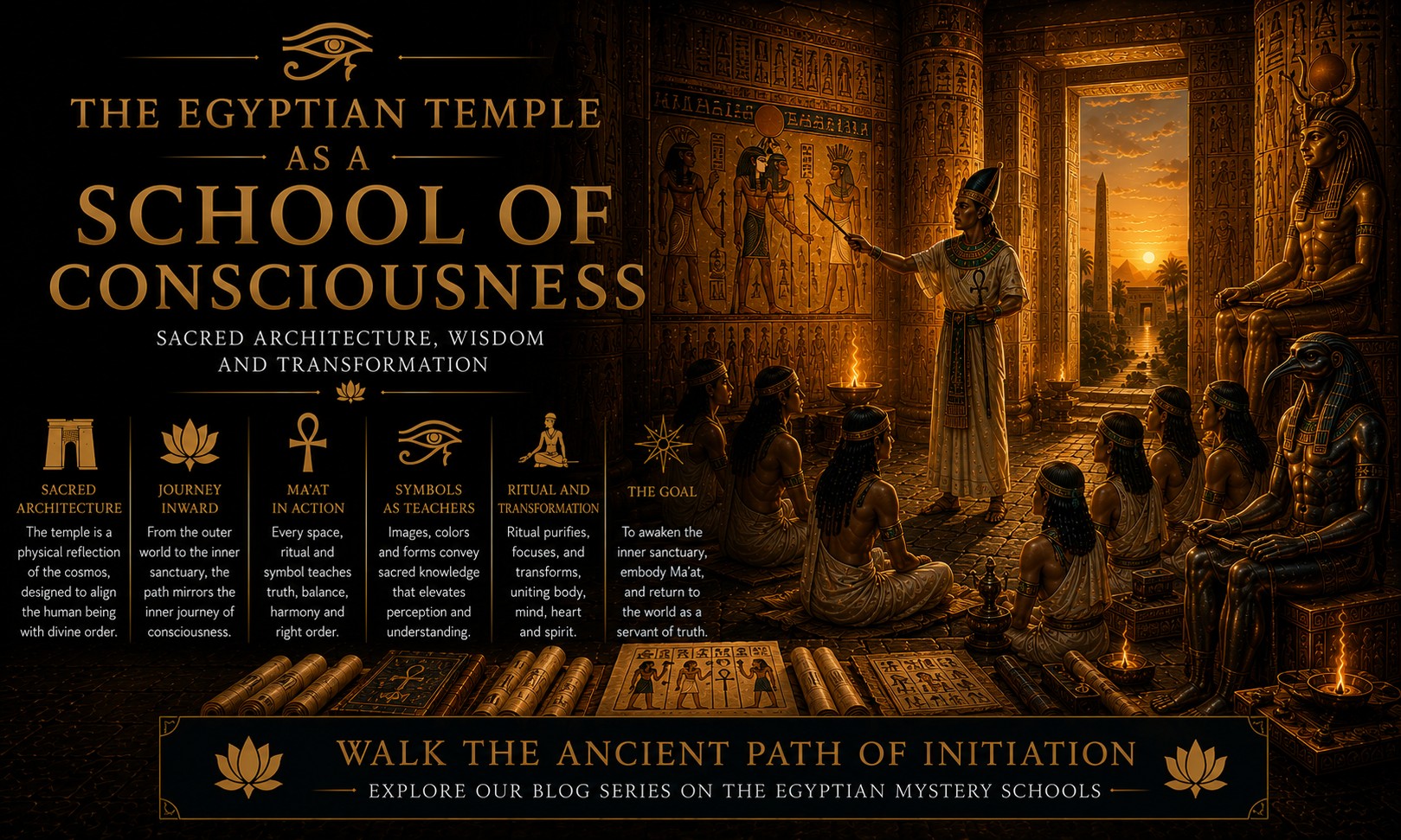
A school of consciousness.
The temple did not simply teach through words.
It taught through space.
Through proportion.
Through symbol.
Through light and darkness.
Through ritual.
Through silence.
Through movement from the outer world toward the inner sanctuary.
Everything within the temple invited the participant to move from ordinary perception toward sacred awareness.
The temple itself became a teaching.
More Than a Place of Worship
Modern religious categories can sometimes obscure the deeper function of Egyptian temples.
They were certainly sacred places dedicated to the Neteru.
Yet they also served as:
- Centres of ritual.
- Repositories of sacred texts.
- Institutions of priestly training.
- Centres of astronomy and calendrical knowledge.
- Places of healing.
- Houses of sacred writing.
- Centres of administration.
- Guardians of cosmological knowledge.
The Egyptian temple united domains that modern civilization often separates.
Religion was not isolated from science.
Architecture was not isolated from symbolism.
Ethics were not isolated from spirituality.
Knowledge was not isolated from transformation.
Everything existed within a unified sacred order.
The Temple as an Image of the Cosmos
Sacred Architecture Was Never Accidental
The Egyptian temple was conceived as an ordered reflection of creation.
Its architecture expressed a cosmological vision.
The temple floor could evoke the fertile earth.
Columns could resemble papyrus or lotus plants rising from the primordial marsh.
Ceilings were frequently decorated with stars, celestial figures, and astronomical imagery.
The sanctuary represented the hidden divine centre from which order radiated outward.
The temple therefore did not merely contain sacred imagery.
It embodied a sacred universe.
To enter the temple was symbolically to enter creation itself.
Architecture became cosmology expressed in stone.
From the Outer World to the Inner Sanctuary
One of the most striking features of Egyptian temple architecture is the progressive movement inward.
The visitor passed through successive thresholds.
The Pylon
The monumental gateway marked the transition from ordinary space into sacred space.
The Courtyard
A more open area where certain public or ceremonial activities could occur.
The Hypostyle Hall
A vast forest of columns in which light became increasingly controlled and atmosphere more solemn.
Inner Chambers
Access became progressively restricted.
The Sanctuary
At the heart of the temple stood the sacred dwelling of the Neter.
This movement was physical.
But it was also symbolic.
One travelled from openness toward mystery.
From brightness toward sacred darkness.
From multiplicity toward unity.
From the outer world toward the centre.
In initiatory language, this movement mirrors the inward journey of consciousness itself.
The Threshold as a Teaching
Every doorway represented a transition.
The person crossing a temple threshold was leaving one condition and entering another.
This is one reason thresholds occupy such an important place within initiatory traditions.
A threshold asks:
What must be left behind?
What must be purified?
What must be understood before one proceeds further?
The Egyptian temple contained many such transitions.
The architecture therefore reinforced a fundamental initiatory principle:
Wisdom is entered progressively.
One does not simply arrive at the sanctuary.
One becomes prepared for it.
Sacred Space and the Ordering of Consciousness
The Egyptian temple was governed by order.
Geometry.
Orientation.
Ritual sequence.
Sacred proportion.
Correct speech.
Correct movement.
Correct timing.
This reflected Ma’at.
Ma’at was not merely an ethical concept.
It represented truth, balance, harmony, justice, and right order throughout creation.
The temple was a manifestation of Ma’at in architectural form.
Within an ordered sacred environment, the priest or initiate was continually reminded that consciousness itself must also become ordered.
Disordered thought.
Disordered emotion.
Disordered speech.
Disordered action.
All had to be brought into harmony.
Thus, the temple taught Ma’at not merely through doctrine but through experience.
The Role of Ma’at Within the Temple
Every ritual performed within the temple ultimately served the maintenance of divine order.
The priesthood did not understand ritual as mere ceremony.
Ritual helped renew the proper relationship between:
- Humanity and the Neteru.
- Earth and heaven.
- Society and cosmic order.
- The visible and invisible worlds.
The presentation of Ma’at to the Neteru appears repeatedly in Egyptian temple imagery.
This conveyed a profound truth.
The highest offering was order itself.
To live Ma’at was to participate consciously in the harmony of creation.
The Temple as a Living Book
Ancient Egyptian temples were covered with images and inscriptions.
To the untrained eye, these may appear decorative.
They were anything but decorative.
Temple walls recorded:
- Rituals.
- Hymns.
- Divine names.
- Sacred myths.
- Cosmological teachings.
- Festival calendars.
- Offering formulas.
- Theological principles.
- Astronomical information.
The temple was therefore a vast sacred text written in stone.
Its walls could be read.
Its chambers interpreted.
Its symbols contemplated.
The building itself became a repository of wisdom.
Learning Through Symbol
The Egyptian tradition understood that profound truths cannot always be communicated adequately through literal explanation.
Symbol allows many levels of meaning to coexist.
Consider familiar Egyptian symbols:
The Ankh
Life, vitality, and participation in divine existence.
The Djed
Stability, endurance, and restoration.
The Lotus
Emergence, renewal, and awakening.
The Scarab
Transformation, becoming, and solar renewal.
The Feather of Ma’at
Truth, balance, and right order.
The Solar Disk
Divine illumination and the creative principle.
The Eye of Heru
Restoration, wholeness, protection, and awakened perception.
Such symbols were not merely visual ornaments.
They trained perception.
They invited the student to see beneath the surface.
The Temple Trained Sacred Perception
One of the deepest functions of temple education was the transformation of perception.
Ordinary consciousness sees objects.
Sacred consciousness perceives relationships.
The sun becomes more than a celestial body.
It becomes a visible expression of renewal, illumination, and divine order.
The Nile becomes more than water.
It becomes fertility, cyclical renewal, and the sustaining current of life.
The temple becomes more than stone.
It becomes cosmos.
The human being becomes more than body.
It becomes a multidimensional sacred mystery.
The temple trained the mind to perceive a world alive with meaning.
Ritual as a Technology of Consciousness
Ritual occupied the centre of temple life.
Modern people sometimes regard ritual as empty repetition.
Within Ancient Egypt, correctly performed ritual was understood very differently.
It required:
- Intention.
- Presence.
- Sacred speech.
- Gesture.
- Timing.
- Purification.
- Symbolic understanding.
Ritual brought consciousness into order.
The priest repeatedly entered sacred time and sacred space.
Through disciplined repetition, ordinary patterns of attention were interrupted.
The ritual became a means of remembrance.
A way of returning consciousness to Ma’at.
Sacred Speech and Heka
Speech possessed profound significance within Egyptian sacred tradition.
This brings us to Heka.
Heka is often translated simply as “magic,” yet its meaning extends far beyond modern ideas of magic.
It concerns divine efficacy, the power through which thought, intention, symbol, and sacred utterance participate in creation.
Within temple ritual, words had to be spoken correctly.
Divine names mattered.
Formula mattered.
Intention mattered.
The priest therefore learned that speech carries consequence.
This was spiritual discipline.
One did not speak carelessly within sacred space.
Sacred speech trained consciousness to become precise.
Tehuti and the Intelligence of the Temple
Tehuti stands naturally at the centre of this understanding.
Known to the Greeks as Thoth, Tehuti was associated with:
- Wisdom.
- Sacred writing.
- Divine speech.
- Calculation.
- Measure.
- Time.
- Knowledge.
The Egyptian temple required all of these qualities.
Its rituals depended upon correct language.
Its architecture depended upon measure.
Its calendar depended upon time.
Its inscriptions preserved knowledge.
Its sacred sciences required understanding.
Tehuti therefore represents the intelligence through which sacred order becomes intelligible.
He is not simply a patron of knowledge.
He embodies knowledge rightly measured and rightly expressed.
Light and Darkness as Sacred Teachers
The architecture of many Egyptian temples creates a gradual reduction of natural light as one moves inward.
The outer spaces are open.
The inner chambers become increasingly enclosed.
The sanctuary may be deeply shadowed.
This creates a powerful symbolic movement.
Modern consciousness often associates knowledge exclusively with brightness.
The Egyptian temple suggests something subtler.
There are truths discovered in illumination.
And there are truths encountered in sacred darkness.
Darkness can symbolize:
- Mystery.
- Potential.
- The unseen.
- Gestation.
- The primordial state before manifestation.
The initiate learns not to fear what is hidden.
The unseen becomes a field of revelation.
Silence as Instruction
Not every teaching requires words.
The temple also taught through silence.
Within sacred spaces, silence changes perception.
Attention becomes sharper.
Subtlety becomes visible.
The mind begins to reveal its own movement.
Silence therefore becomes a mirror.
The initiate discovers how much internal noise normally fills consciousness.
To enter sacred silence is to encounter oneself.
This is one reason contemplative disciplines across many traditions regard silence as indispensable.
Purification Before Sacred Service
Priestly participation required purification.
This could include physical washing, clean garments, dietary regulations, shaving, and other forms of ritual preparation.
Yet the symbolism points toward something deeper.
Purification means becoming fit for sacred service.
The body is prepared.
The mind is prepared.
Speech is prepared.
Intention is prepared.
One does not enter the sacred carelessly.
The outer purification reflects an inner principle:
To approach the centre, disorder must be relinquished.
The Temple and the Human Being
One of the most compelling ways to understand Egyptian temple symbolism is to see a correspondence between temple and human being.
The outer temple may be compared with ordinary awareness.
The inner chambers represent progressively deeper levels of consciousness.
The sanctuary represents the hidden centre.
This interpretation should not be confused with a single universally documented Egyptian doctrine.
Yet as an initiatory reading, it expresses something essential about temple architecture.
The journey inward mirrors the journey within.
The temple asks the seeker to move from surface toward essence.
The Heart as the Inner Sanctuary
Ancient Egyptian spirituality placed extraordinary importance upon the Ib, the heart.
The heart was associated with conscience, character, memory, intention, and moral responsibility.
In the famous weighing of the heart, the Ib was measured against the feather of Ma’at.
This reveals an essential truth.
The ultimate temple cannot merely be external.
The sacred order represented by the temple must eventually be established within the heart.
Stone architecture prepares the way.
Inner architecture completes the work.
The Temple and the Neteru
The Neteru were not simply figures decorating the temple walls.
They represented divine powers and principles active within creation.
Through myth, ritual, symbolism, and sacred imagery, the temple taught the initiate to understand these powers.
Ausar.
Auset.
Heru.
Ra.
Tehuti.
Ma’at.
Sekhmet.
Ptah.
And countless others.
Each revealed dimensions of cosmic order.
To contemplate the Neteru was therefore also to contemplate the principles through which reality unfolds.
The temple became a meeting place between human consciousness and divine intelligence.
The Temple as a Centre of Sacred Science
The phrase “sacred science” helps us understand why temple learning was so comprehensive.
Egyptian temples preserved and developed knowledge relating to:
Astronomy
The observation of celestial cycles and sacred time.
Mathematics
Measurement, calculation, and proportion.
Medicine
Healing and restoration.
Writing
The preservation and transmission of sacred knowledge.
Ritual
The maintenance of divine order.
Cosmology
Understanding creation and humanity’s place within it.
These were not necessarily separate disciplines in the modern sense.
They belonged to one ordered vision of reality.
The Temple as a Place of Transformation
The temple did not simply explain transformation.
Its entire structure enacted it.
The individual entered.
Crossed thresholds.
Was purified.
Encountered sacred imagery.
Participated in ritual.
Learned sacred speech.
Moved inward.
Approached the sanctuary.
Returned outward.
This pattern resembles initiation itself.
Entry.
Preparation.
Encounter.
Transformation.
Return.
The person who returned from the sacred centre was expected to carry something of its order back into the world.
Knowledge Had to Become Embodiment
This may be the most important distinction between modern education and the temple tradition.
Modern education often asks:
What do you know?
The Egyptian sacred tradition asks:
What have you become?
A person might understand Ma’at intellectually while still living dishonestly.
They might study sacred symbols while remaining governed by chaos.
They might memorize ritual formulas without embodying reverence.
Such knowledge would remain incomplete.
The temple demanded integration.
Wisdom had to descend from mind into life.
The Temple Was Not Designed for Escape
The purpose of sacred consciousness was not withdrawal from the world.
The priest eventually returned to service.
Ma’at had to be lived within society.
Wisdom had to become action.
Healing had to benefit others.
Sacred knowledge had to preserve harmony.
The temple therefore represented not escape from earthly life but deeper participation within it.
One entered the sacred centre in order to return more consciously to the world.
Why the Egyptian Temple Still Speaks to Us
Thousands of years later, Egyptian temples continue to exert extraordinary power upon the imagination.
Perhaps this is because modern society has largely separated what Ancient Egypt held together.
Knowledge from wisdom.
Science from sacred meaning.
Architecture from consciousness.
Education from transformation.
Speech from responsibility.
Humanity from cosmos.
The Egyptian temple presents another possibility.
It reminds us that human beings may inhabit a meaningful universe.
That space can educate consciousness.
That beauty can communicate truth.
That knowledge can be sacred.
And that education can be directed not merely toward acquiring information, but toward becoming more fully human.
The Temple Within
The deepest lesson of the Egyptian temple may ultimately be inward.
One may travel across the world and stand within the ruins of Karnak.
One may study every hieroglyph.
One may memorize every name of every Neter.
Yet the initiatory question remains:
Has the temple been established within?
Is there order within thought?
Ma’at within the heart?
Precision within speech?
Integrity within action?
Awareness within consciousness?
The outer temple points toward an inner architecture.
Its ultimate invitation is not merely to enter a sacred building.
It is to become one.
Conclusion
The Egyptian temple was far more than a place of worship.
It was a sacred cosmos rendered in stone.
A repository of wisdom.
A centre of ritual.
A house of sacred science.
A school of perception.
And, in the deepest sense, a school of consciousness.
Through architecture, symbolism, Ma’at, Heka, sacred speech, purification, ritual, silence, and progressive movement toward the sanctuary, the temple trained the individual to perceive and participate in divine order.
Its greatest teaching may therefore be found not upon a wall, but within the structure of the temple itself.
Move inward.
Become ordered.
Enter the centre.
Receive wisdom.
Return transformed.
The Egyptian temple did not merely contain the mysteries.
The temple itself was one of the mysteries.
Related Articles
- Ancient Egyptian Initiation: Meaning and Practice
https://mysteryschooloftehuti.com/ancient-egyptian-initiation-meaning-and-practice/ - The Purpose of the Egyptian Mystery Schools
https://mysteryschooloftehuti.com/the-purpose-of-the-egyptian-mystery-schools/ - What Did the Priests of Ancient Egypt Teach?
https://mysteryschooloftehuti.com/what-did-the-priests-of-ancient-egypt-teach/ - The House of Life (Per Ankh): Ancient Egypt’s Centre of Sacred Learning
https://mysteryschooloftehuti.com/house-of-life-per-ankh/ - The Role of the Priesthood in Ancient Egypt
https://mysteryschooloftehuti.com/role-of-the-priesthood-in-ancient-egypt/ - Who Is Tehuti?
https://mysteryschooloftehuti.com/who-is-tehuti/ - What Is Ma’at?
https://mysteryschooloftehuti.com/what-is-maat/ - Heka Explained
https://mysteryschooloftehuti.com/heka-explained/