Christ Within the Perennial Tradition
Part VI of the Series: The Language of the Divine
Opening Invocation
May the mind become still enough to perceive truth,
May the heart remain balanced in the scales of Ma’at,
May the words that follow serve clarity rather than confusion,
And may wisdom arise in harmony with the eternal order.
Opening Discussion
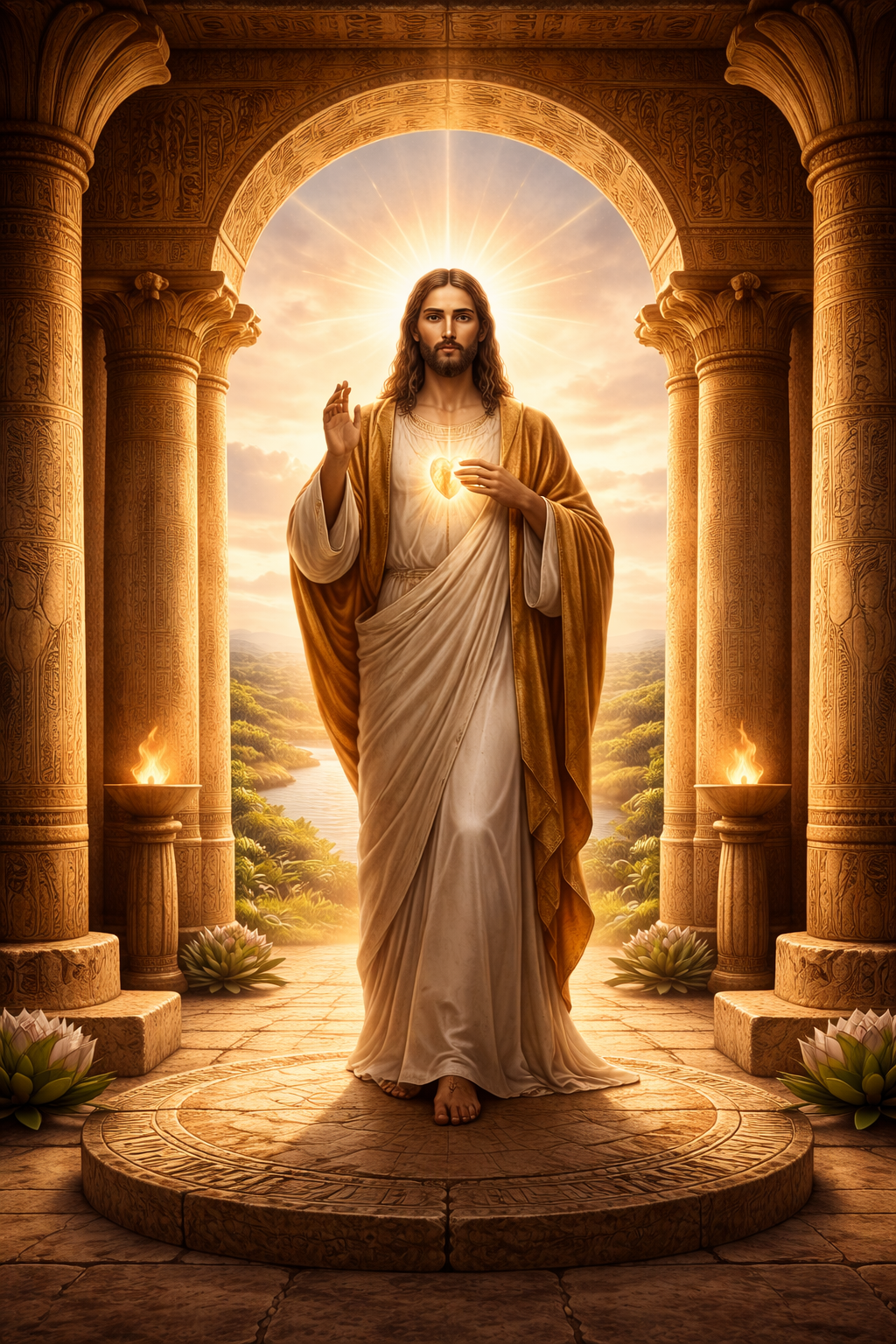
Who, in truth, is Jesus Christ?
Is he to be understood as a singular exception within history, wholly separate from all other expressions of divine wisdom? Or does his life reveal a universal pattern, one that has appeared in different forms across the ages?
And if such a pattern exists, does it diminish his significance, or does it reveal a deeper and more profound dimension of his presence?
The answer depends not on belief alone, but on understanding.
The Question of Uniqueness and Universality
Within many religious frameworks, Christ is presented as entirely unique, a singular manifestation of the Divine, beyond comparison or parallel.
This perspective preserves reverence, yet it can also create division, separating one tradition from all others.
The perennial approach offers a different lens.
It does not deny the greatness of Christ; rather, it seeks to understand the principle he embodies.
For if truth is universal, it cannot be confined to a single moment, place, or form. It must reveal itself wherever conditions allow it to be realised.
Thus, the question is not whether Christ is diminished by universality, but whether universality reveals the full extent of what he represents.
Christ as the Realisation of Divine Consciousness
Within the framework established throughout this series, the Divine is understood as consciousness itself, the ground of being from which all existence arises.
To realise this fully is to awaken to unity with the Divine.
From this perspective, Christ may be understood as one who embodied this realisation completely.
His life reflects a profound alignment with divine will, truth, and purpose. His teachings consistently point beyond the ego toward a deeper identity rooted in unity with the Divine.
In this sense, Christ is not merely a figure to be observed, but a demonstration of realised consciousness.
The Initiatory Pattern
When viewed through the lens of sacred tradition, the life of Christ reveals a pattern that appears across many initiatory systems:
- withdrawal from ordinary identity
- confrontation with trial and transformation
- surrender of the lower self
- emergence into renewed life
- service to humanity grounded in truth
This pattern is not accidental. It reflects a universal process of inner transformation.
Within the Kemetic tradition, similar principles are encoded in the journeys of the Neteru; cycles of death, renewal, and restoration that mirror the inner path of awakening.
Thus, Christ’s life may be seen as a living embodiment of this eternal initiatory current.
The Relationship to Ma’at
Central to the life and teaching of Christ is an unwavering alignment with truth, justice, and divine order.
This alignment resonates deeply with the principle of Ma’at.
- where there is truth, there is Ma’at
- where there is righteousness, there is Ma’at
- where there is harmony between human will and divine order, there is Ma’at
Christ’s teachings emphasise:
- purity of heart
- integrity of action
- love grounded in truth
These are not separate from Ma’at; they are expressions of it within a different cultural and historical context.
Thus, the life of Christ may be understood as a living articulation of Ma’at.
Beyond Exclusivity
One of the greatest challenges in spiritual understanding arises when devotion becomes bound to exclusivity.
When a single form is held as the only valid expression of truth, the underlying unity of wisdom becomes obscured.
The perennial perspective does not ask one to abandon devotion. It asks one to deepen it through understanding.
To honour Christ fully is not to isolate him from the universal stream of wisdom, but to recognise the depth of what he embodies.
In doing so:
- reverence is preserved
- division is reduced
- understanding is expanded
Christ remains central, not because all else is denied, but because his realisation is recognised in its fullness.
The Living Presence
To understand Christ in this way is not merely an intellectual exercise.
It transforms the nature of spiritual practice.
Christ is no longer perceived only as an external figure to be worshipped, but as a living principle to be realised.
This does not diminish devotion; it deepens it.
For devotion then becomes:
- alignment with truth
- embodiment of compassion
- participation in divine consciousness
The external and internal are brought into harmony.
Toward Integration
We now arrive at a point of integration within the series.
If divine consciousness expresses through the Neteru,
if it is articulated through Tehuti,
if it is lived as Ma’at,
and if it is realised in figures such as Christ,
then what is the role of the many religions that preserve these teachings?
Are they pathways to truth, or barriers to it?
Are they to be followed, transcended, or understood differently?
In the final article, we will explore:
Religion as Nourishment, Not Bondage, bringing the entire series into a unified and practical understanding.
Closing Affirmation
May understanding restore balance where confusion has arisen.
May wisdom guide the mind toward harmony rather than division.
And may all who seek truth learn to recognise the quiet language through which the Divine order speaks.
For where Ma’at is honoured,
clarity arises,
and consciousness remembers its source.