Ma’at as the True Speech of God
Part IV of the Series: The Language of the Divine
Ma’at as the True Speech of God: A Kemetic Understanding of Divine Order and Sacred Language
Opening Invocation
May the mind become still enough to perceive truth,
May the heart remain balanced in the scales of Ma’at,
May the words that follow serve clarity rather than confusion,
And may wisdom arise in harmony with the eternal order.
Opening Discussion
If the Divine expresses itself through consciousness, and if that expression becomes intelligible through sacred order, then what is the highest form of that expression?
Is the language of God a sound, a word, or a hidden vibration known only to mystics?
Or is it something far more immediate, something lived, embodied, and enacted within the fabric of existence itself?
The ancient wisdom of Kemet offers a profound answer: the true language of the Divine is not merely spoken. It is lived as Ma’at.
Beyond Sound: Rethinking Divine Language
Across many traditions, the idea persists that the Divine communicates through sacred utterance, a primordial sound, a hidden name, or a vibrational key.
While such concepts point toward deeper truths, they remain incomplete when taken in isolation.
For sound alone does not sustain the cosmos. A word, however sacred, cannot maintain the balance of existence unless it is aligned with an underlying order.
The Kemetic tradition therefore directs attention beyond sound toward principle.
Divine language, in its highest sense, is not merely what is spoken, it is what is upheld.
The Meaning of Ma’at
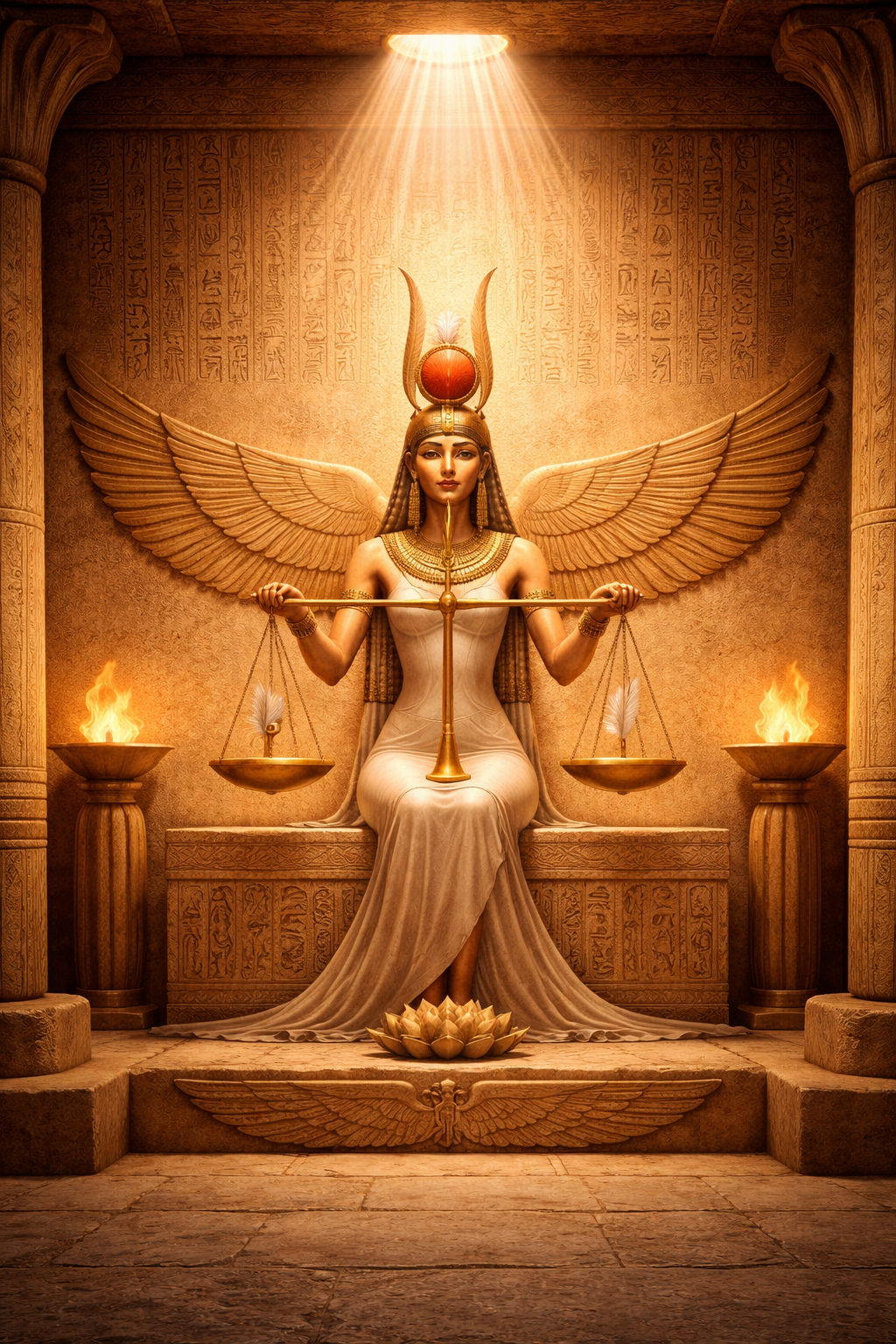
At the heart of this understanding stands Ma’at, one of the most profound and comprehensive principles within Kemetic philosophy.
Ma’at is often translated as:
- truth
- balance
- harmony
- justice
- right order
Yet none of these words alone fully captures its depth. Ma’at is not simply a moral guideline; it is the structural equilibrium of reality itself.
It is the principle through which:
- the cosmos remains ordered
- life unfolds in balance
- truth aligns with being
Without Ma’at, existence would dissolve into chaos. With Ma’at, all things find their proper place within the whole.
Ma’at as Living Language
If we return to the question of divine language, a deeper insight emerges.
Language, at its highest level, is that which communicates meaning with clarity and coherence.
What, then, communicates more perfectly than a universe held in balance?
What speaks more truthfully than harmony itself?
Ma’at is therefore not simply a concept; it is the living articulation of divine order.
- When the cosmos moves in harmony, it speaks Ma’at
- When truth is upheld, it speaks Ma’at
- When justice is enacted, it speaks Ma’at
In this sense, Ma’at is the speech of the Divine made visible within reality.
The Relationship Between Ma’at and Thoth
In the previous article, we explored the role of Tehuti, the principle of divine articulation and measure.
If Tehuti represents the capacity to express and communicate, Ma’at represents the truth that must be expressed.
The relationship between these two principles is essential:
- Tehuti gives structure to knowledge
- Ma’at ensures its alignment with truth
Without Ma’at, articulation becomes distortion. Words may be spoken, but they no longer reflect reality.
Without Tehuti, truth remains unexpressed. It exists, but is not communicated or understood.
Together, they form a complete system:
truth and its expression,
order and its articulation,
balance and its communication.
The Ethical Dimension of Divine Language
To understand Ma’at is to recognise that divine language is not confined to sacred texts or rituals.
It is expressed through human action.
Every thought, word, and deed participates in one of two movements:
- alignment with order
- or deviation from it
To speak falsely is to depart from Ma’at.
To act unjustly is to disrupt it.
To live without balance is to obscure it.
Conversely:
- to act with integrity is to embody Ma’at
- to speak truth is to express it
- to restore harmony is to serve it
Thus, the highest form of spiritual practice is not merely contemplation, but alignment.
The Restoration of Inner and Outer Balance
The principle of Ma’at operates not only within the cosmos, but within the human being.
Inner imbalance reflects outer disorder. Confusion within the mind often manifests as disorder in action.
To restore clarity, one must return to alignment.
This involves:
- disciplined thought
- truthful speech
- measured action
- conscious equilibrium
Through these, the individual becomes a participant in the maintenance of cosmic order.
In this way, spirituality ceases to be abstract and becomes lived reality.
The True Language of the Divine
We may now return to the original question: what is the language of God?
It is not confusion.
It is not contradiction for its own sake.
It is not hidden in obscurity.
The language of the Divine is order, harmony, and truth in expression.
It is Ma’at.
To live in accordance with Ma’at is to speak the language of the Divine without words.
Preparing for the Next Step
Yet a challenge remains.
If Ma’at represents perfect order and balance, why does human experience often feel fragmented, contradictory, and unstable?
Why do seekers encounter paradox in ways that lead not to clarity, but to confusion?
The answer lies in the condition of the human ego and its relationship to truth.
In the next article, we will explore:
Paradox, Ego, and Initiatory Stability, and how authentic spiritual development transforms confusion into integration.
Closing Affirmation
May understanding restore balance where confusion has arisen.
May wisdom guide the mind toward harmony rather than division.
And may all who seek truth learn to recognise the quiet language through which the Divine order speaks.
For where Ma’at is honoured,
clarity arises,
and consciousness remembers its source.