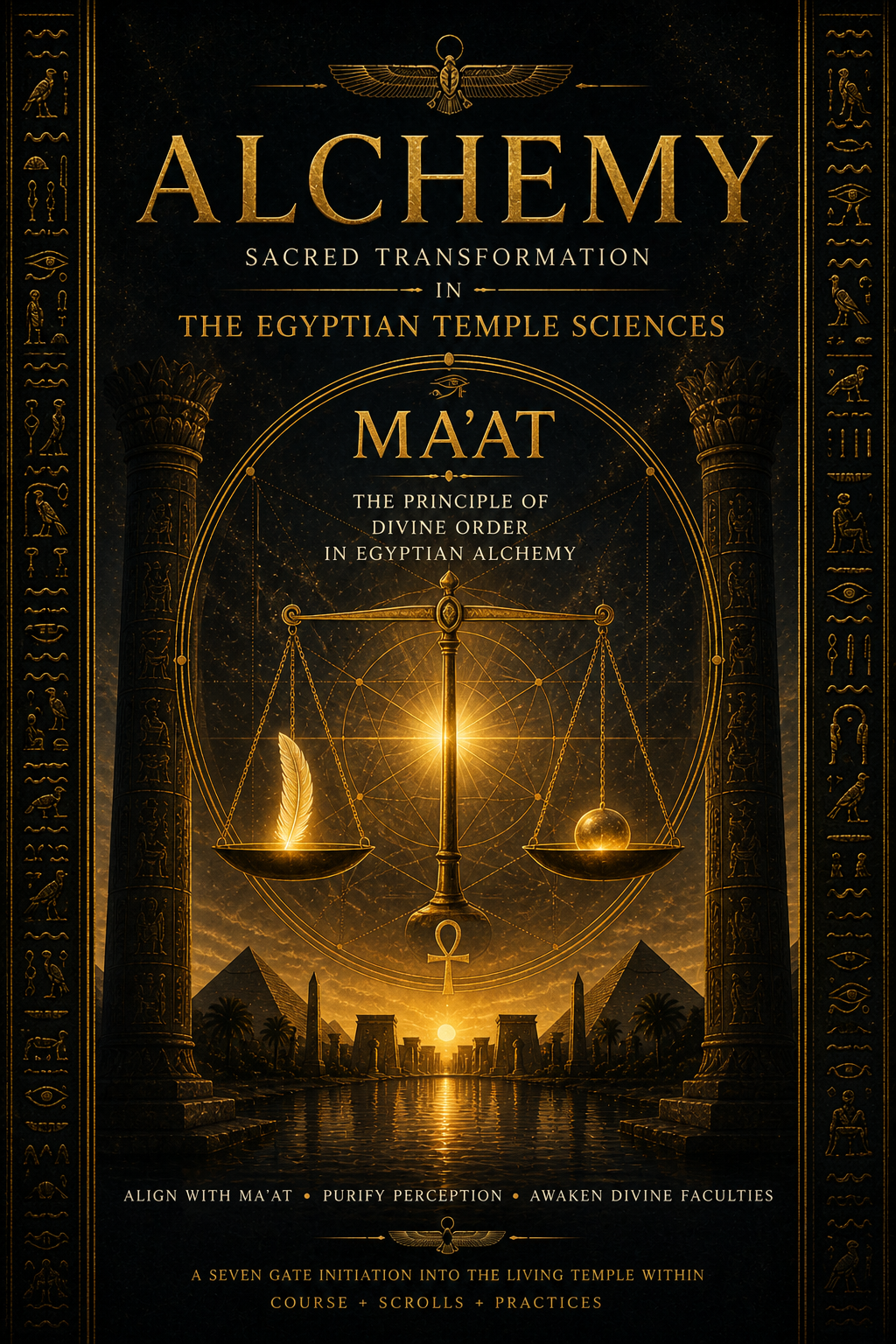
Ma’at: The Principle of Divine Order in Egyptian Alchemy
Understanding the living foundation of alignment within the Egyptian temple sciences
There are principles that may be studied, and there are principles that must be entered.
Ma’at belongs to the latter.
Often translated as truth, balance, or order, Ma’at is frequently reduced to a moral ideal or philosophical concept. Yet within the Egyptian temple sciences, such interpretations remain insufficient. For Ma’at does not describe an abstract virtue to be admired; it denotes a living principle, one that governs the structure of reality itself, and by extension, the possibility of transformation within the human being.
To speak of alchemy without Ma’at is to speak without foundation.
Ma’at as the Ground of All Transformation
Within the framework of Egyptian alchemy, Ma’at is not introduced as one principle among many. It is the ground upon which all transformation becomes possible.
It is that which establishes right proportion, right relation, and right function, both within the cosmos and within the inner constitution of the individual.
Where Ma’at is present, there is coherence.
Where Ma’at is absent, distortion arises.
This distinction is not moral in the conventional sense. It does not concern notions of good or bad, nor does it yield to subjective interpretation. Rather, it reflects a precise condition: whether something is aligned with the order that sustains reality, or deviates from it.
Alchemy begins not with effort, but with this recognition.
The Misunderstanding of Balance
Balance, as commonly understood, suggests equilibrium between opposing forces, a negotiation, a compromise, or a state of relative harmony.
Ma’at does not operate in this manner.
It does not reconcile opposites through adjustment; it establishes order through alignment. What appears as balance is not the result of managing conflict, but the natural expression of coherence when each element occupies its rightful place.
Thus, imbalance is not caused by excess alone, but by misplacement.
One may possess clarity, yet apply it where it does not belong. One may exercise discipline, yet direct it toward that which is misaligned. In such cases, the appearance of order conceals a deeper dissonance.
Ma’at does not correct this through effort.
It reveals it through truth.
Alignment and the Inner Structure
To approach Ma’at is to encounter the question of structure.
For the human being is not a singular entity, but a composite, comprised of thought, perception, impulse, and subtler faculties that operate beyond immediate awareness. When these elements are not ordered according to Ma’at, fragmentation arises.
This fragmentation is often subtle.
It may present as contradiction between thought and action, between intention and outcome, or between perception and reality itself. Yet such contradictions are not incidental; they are indicators of misalignment within the inner structure.
Alchemy, therefore, does not impose order from without.
It restores order from within, by bringing each aspect of the self into accordance with the principle of Ma’at.
Ma’at and the Limits of Personal Interpretation
A significant obstacle arises when Ma’at is approached through personal interpretation.
For if Ma’at is reduced to what one believes to be true, then it ceases to function as an ordering principle and becomes instead an extension of the very distortion it is meant to reveal.
Within the temple sciences, Ma’at is not defined by the individual.
It defines the individual.
This distinction is decisive.
It requires a relinquishing of the assumption that one already perceives clearly. It demands a willingness to question not only one’s conclusions, but the very basis upon which those conclusions are formed.
Without this, Ma’at remains conceptual.
With it, Ma’at becomes operative.
The Unresolved Threshold
If Ma’at is the governing principle of order, and if true transformation depends upon alignment with it, then a question emerges with increasing urgency:
How is such alignment established?
By what means does one discern the presence of Ma’at within oneself, rather than assume it?
And if perception itself may be conditioned by distortion, how can one rely upon it to recognise what is true?
These questions do not yield to assumption, nor to isolated reflection. They point toward a deeper requirement—one that cannot be fulfilled through understanding alone.
Thus, the threshold remains.
Visible, yet not fully entered.
The Alchemy Course
What has been outlined here is only the beginning.
The full path of this work, its structure, discipline, and lived application is explored in depth within the Alchemy course.
If you recognise the call within these teachings, you may proceed here:
https://mysteryschooloftehuti.com/alchemy/