Religion as Nourishment, Not Bondage
Part VII of the Series: The Language of the Divine
Opening Discussion
May the mind become still enough to perceive truth,
May the heart remain balanced in the scales of Ma’at,
May the words that follow serve clarity rather than confusion,
And may wisdom arise in harmony with the eternal order.
Opening Discussion
If truth is universal, why do so many religions appear divided?
Why do systems originally intended to guide humanity toward the Divine so often become sources of separation, rigidity, and conflict?
And how may one honour sacred tradition without becoming confined by it?
The answer lies not in rejecting religion, but in understanding its proper role.
The Purpose of Religion
Religion, in its origin, is not an end in itself.
It is a vehicle of transmission, a structured means through which wisdom, ethics, and spiritual insight are preserved and conveyed across generations.
Each tradition emerges within a particular time, place, and culture. It adopts forms, symbols, and language suited to those conditions, allowing eternal truths to be made accessible to specific communities.
In this sense, religion serves a vital function.
It nourishes the soul.
The Diversity of Sacred Forms
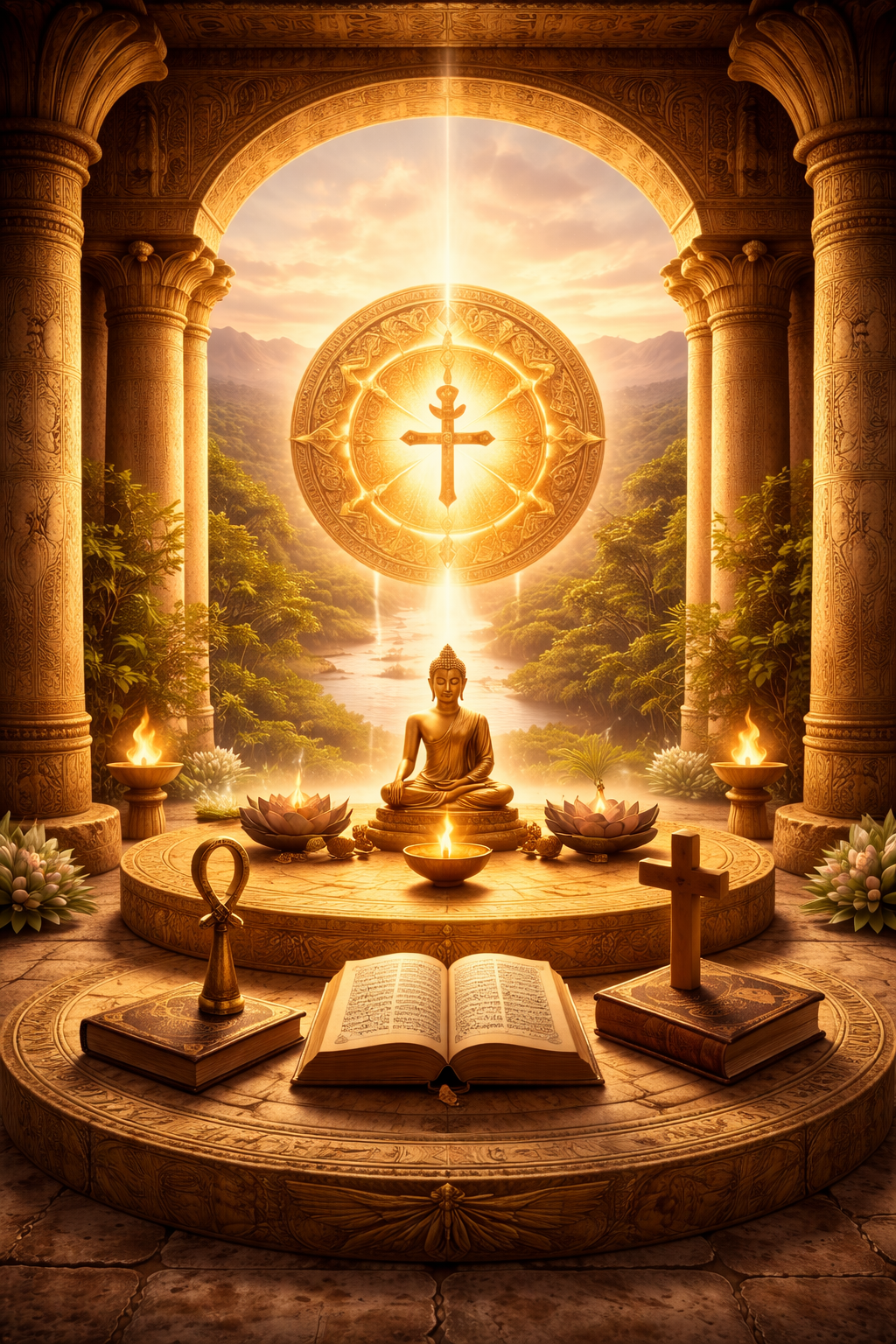
Across the world, many traditions have arisen, each carrying elements of truth expressed through different forms.
Some emphasise devotion, others discipline; some speak through philosophy, others through ritual and symbol.
From the perspective developed throughout this series, these differences do not necessarily indicate contradiction.
They reflect adaptation.
Just as nourishment must be suited to the needs of the body, spiritual teaching must be suited to the capacity of the seeker.
Thus, diversity among religions may be understood not as division at the level of truth, but as variation at the level of expression.
When Nourishment Becomes Bondage
Yet a subtle transformation can occur.
What begins as a vehicle of guidance may become a structure of limitation when:
- form is mistaken for essence
- symbol is mistaken for reality
- doctrine is held without understanding
In such cases, religion ceases to nourish and begins to confine.
The seeker is no longer guided toward truth, but bound to a fixed interpretation of it.
This is not a failure of the original teaching, but a shift in its reception.
The Role of Understanding
To move beyond this limitation, one must return to understanding.
The principles established throughout this series provide a foundation:
- the Divine as consciousness itself
- the Neteru as expressions of that consciousness
- Thoth (Tehuti) as the articulation of divine intelligence
- Ma’at as the living order of truth
- the role of paradox in expanding perception
- the example of Jesus Christ as realised consciousness
When these are understood, religion can be approached with clarity rather than dependency.
Honouring Without Attachment
It is possible to honour a tradition deeply without becoming bound by its outer form.
To honour a tradition is to recognise the truth it carries, to respect its symbols, and to appreciate its role in the preservation of wisdom.
To become bound is to assume that its particular form is the only valid expression of truth.
The difference lies in perception.
When essence is recognised, form becomes transparent. It serves its purpose without limiting understanding.
The Inner Orientation
At a certain stage of development, the seeker’s orientation begins to shift.
Rather than asking:
- which religion is correct
the question becomes:
- how does truth express itself through this tradition?
This shift transforms the relationship to religion.
It becomes a source of nourishment, insight, and alignment, rather than a structure of confinement.
The individual learns to receive what is true, while remaining rooted in deeper understanding.
Unity Beneath Diversity
When viewed through the lens of consciousness and sacred order, the apparent divisions between traditions begin to soften.
Different languages, symbols, and teachings point toward a shared foundation:
- alignment with truth
- embodiment of balance
- realisation of unity
This does not erase difference, but places it within a larger context.
Diversity remains, yet conflict dissolves.
Spiritual Maturity
To engage religion as nourishment rather than bondage requires maturity.
This maturity includes:
- discernment without cynicism
- reverence without rigidity
- openness without confusion
- alignment without dependence
Such maturity allows the seeker to walk a path that is both grounded and expansive.
The Completion of the Series
We may now see the full arc of the teaching:
The Divine as consciousness
expressing through the Neteru
articulated through Tehuti
lived as Ma’at
encountered through paradox
embodied in figures such as Christ
and transmitted through the many forms of religion
All are aspects of a single, coherent reality.
A Return to the Language of the Divine
The journey of this series has not been toward complexity, but toward clarity.
The language of the Divine is not hidden in obscurity. It is present wherever order, truth, and harmony are upheld.
To recognise this is to move beyond confusion.
To live this is to participate in the restoration of balance.
Closing Affirmation
May understanding restore balance where confusion has arisen.
May wisdom guide the mind toward harmony rather than division.
And may all who seek truth learn to recognise the quiet language through which the Divine order speaks.
For where Ma’at is honoured,
clarity arises,
and consciousness remembers its source.