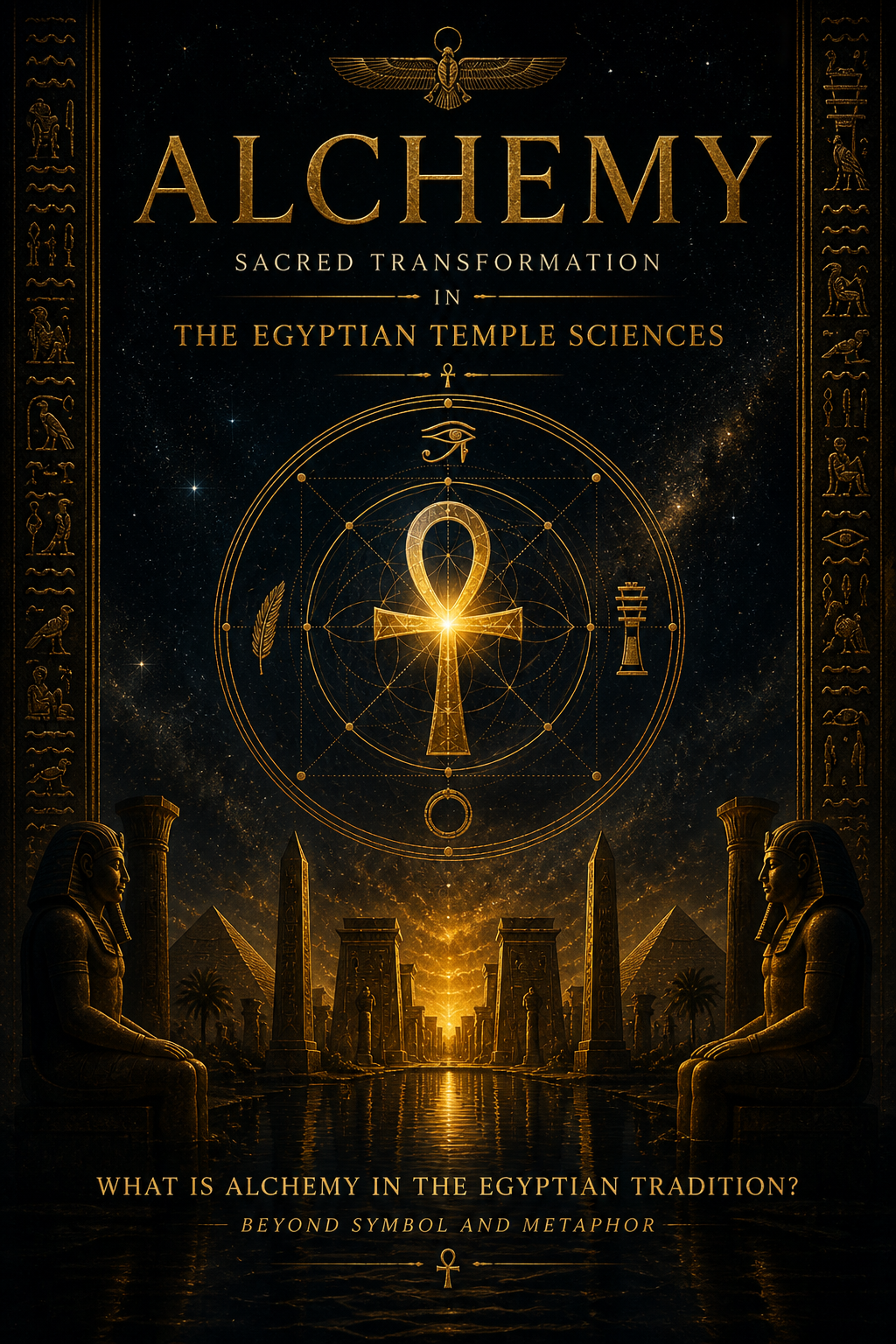
What is Alchemy in the Egyptian Tradition? (Beyond Symbol and Metaphor)
Reclaiming the original science of transformation within the Egyptian temple tradition
The word alchemy has long been separated from its origin, reduced in many minds to symbol, allegory, or philosophical curiosity. Yet within the Egyptian temple sciences, alchemy was neither speculative nor symbolic in the diminished sense through which it is now often understood. It was approached as a living discipline; a precise and guarded science concerning the transformation of the human condition. To inquire into its meaning, therefore, is not merely to interpret an idea, but to approach a field of knowledge that demands a different order of perception.
The Misconception of Alchemy as Symbol Alone
It has become common to interpret alchemy as a language of metaphor, wherein the transmutation of base metals into gold represents an inner psychological refinement. While this reading gestures toward a deeper truth, it remains incomplete.
For within the Egyptian tradition, symbol does not replace reality; it encodes it.
The imagery associated with alchemical transformation was not devised to obscure meaning, nor to render it abstract. Rather, it functioned as a precise method of transmission, one that required preparation in order to be rightly understood. Without such preparation, the symbol is mistaken for the teaching itself.
Thus, a subtle inversion occurs: what was once a gateway becomes a conclusion.
Alchemy as the Science of Inner Reordering
In its original context, Egyptian alchemy refers to a structured and exacting process through which the inner field of the individual is brought into alignment with universal order.
This process does not operate through belief, nor through the accumulation of external knowledge. It concerns the reconfiguration of perception, thought, impulse, and subtle force according to principles that are not subject to personal interpretation.
The human being, as understood within the temple sciences, is not inherently aligned. Rather, there exists a condition of distortion, a deviation from the original order that governs both cosmos and consciousness.
Alchemy begins at the moment this condition is no longer concealed from oneself.
It is here that transformation becomes possible; not as an idea, but as necessity.
Beyond Improvement: The Question of Foundation
A critical distinction must be made between transformation and refinement.
Refinement operates upon the existing structure. It seeks to enhance clarity, strengthen discipline, and cultivate greater coherence within the current configuration of the self. Yet such efforts, however sincere, may leave the underlying distortion untouched.
Alchemy does not proceed in this manner.
It does not seek to improve the structure as it stands, but to bring it into accordance with a deeper principle of order. This often requires a confrontation with aspects of oneself that have not been previously perceived, or have been subtly avoided.
Without this confrontation, what appears as growth may simply be the reinforcement of misalignment.
The Role of Ancient Egyptian Spiritual Transformation
The phrase ancient Egyptian spiritual transformation must be understood with precision. It does not refer to a general process of personal development, nor to a collection of adaptable practices.
It denotes a disciplined engagement with principles that govern transformation itself.
These principles were preserved within the temple structures not as philosophical speculation, but as living knowledge, tested, refined, and transmitted under conditions that ensured their integrity.
To approach this tradition is therefore to enter into a relationship with something that exceeds interpretation.
It requires a reorientation of the one who seeks to understand.
The Unresolved Threshold
If Egyptian alchemy is indeed a science rather than a symbol; if it operates according to principles that cannot be altered by personal preference, then a question emerges with increasing clarity:
By what means is this transformation enacted?
What governs the precise transition from distortion to alignment?
And how does one discern whether what is being experienced is genuine transformation, or merely the appearance of it?
Such questions cannot be resolved through reflection alone. For the instrument through which one reflects may itself remain conditioned by the very distortion one seeks to transcend.
Thus, a threshold presents itself, clear in its outline, yet not easily crossed.
The Alchemy Course
What has been outlined here is only the beginning.
The full path of this work, its structure, discipline, and lived application is explored in depth within the Alchemy course.
If you recognise the call within these teachings, you may proceed here:
https://mysteryschooloftehuti.com/alchemy/