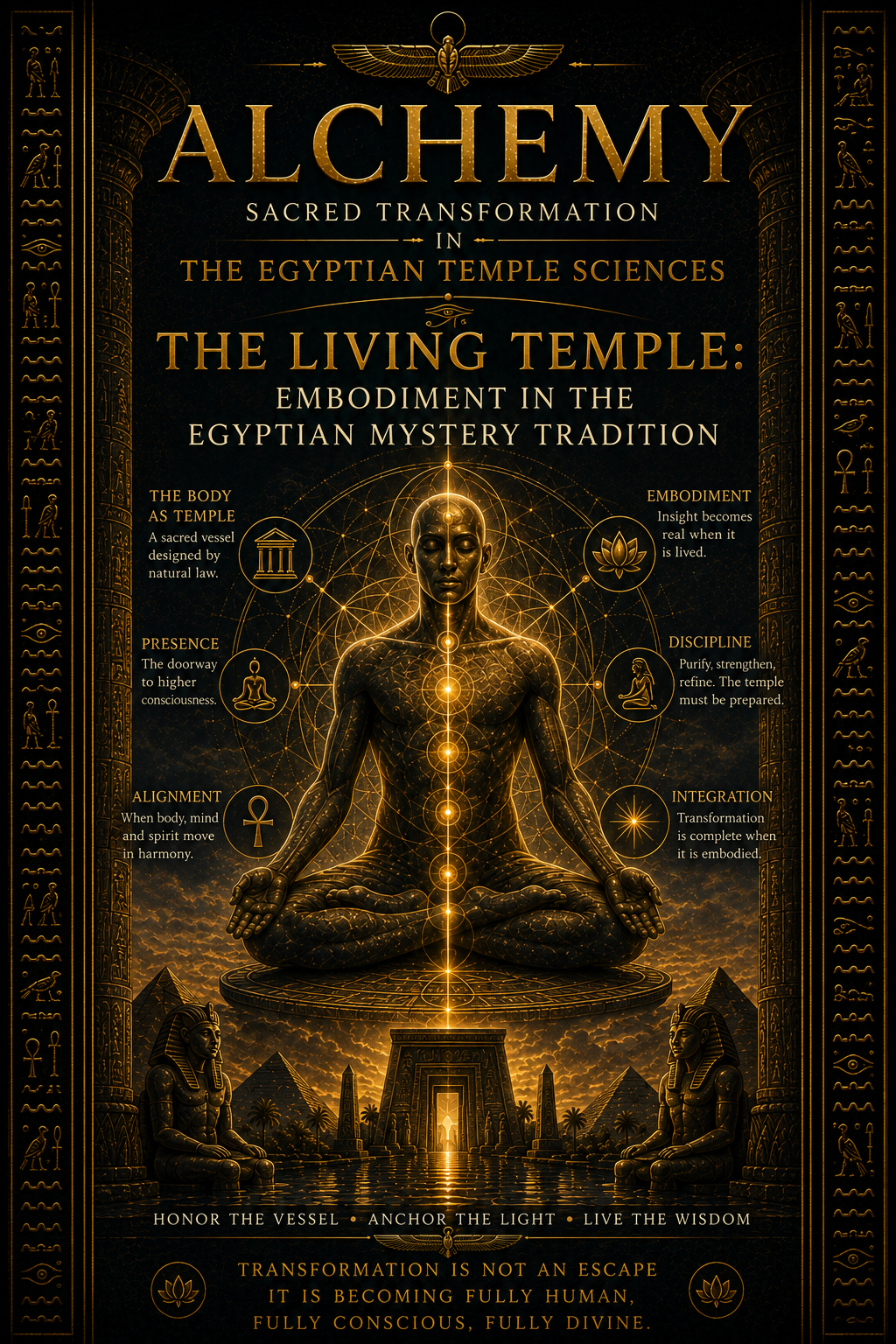
The Living Temple: Embodiment in the Egyptian Mystery Tradition
Understanding the body as a sacred vessel within the Egyptian temple sciences
There is a tendency within spiritual pursuits to move away from embodiment.
The body becomes regarded as secondary, temporary, or even obstructive, something to transcend in the pursuit of higher awareness. Yet within the Egyptian Mystery Tradition, such a division would have been understood as a profound misunderstanding.
For the temple sciences do not seek escape from embodiment.
They seek its sanctification.
The body, rightly understood, is not separate from the work of transformation. It is the ground through which transformation becomes stabilised, expressed, and ultimately made living.
The Meaning of the Body as Temple
The phrase body as temple is often repeated, yet rarely examined with sufficient depth.
Within the Egyptian teachings, the temple was not merely a place of worship. It was a structured environment designed according to sacred proportion, alignment, rhythm, and function. Every chamber, passage, and orientation reflected deeper laws governing both cosmos and consciousness.
To describe the human being as a living temple is therefore not poetic symbolism alone.
It is structural recognition.
The body is understood as a vessel through which consciousness may either remain fragmented or become properly ordered. Its condition affects perception, stability, attention, and the capacity to sustain higher states of awareness.
Thus, embodiment is not peripheral to alchemy.
It is essential to it.
Why Transformation Must Become Embodied
A transformation that remains conceptual cannot endure.
One may experience moments of insight, heightened perception, or spiritual recognition, yet if these are not integrated into the structure of one’s being, they remain temporary. They illuminate, but they do not transform.
The Egyptian temple sciences therefore place great emphasis upon embodiment.
What is realised inwardly must become established outwardly, within speech, movement, action, and presence itself. Otherwise, a division emerges between understanding and living reality.
This division is subtle, yet decisive.
For one may speak of truth while remaining inwardly fragmented. One may understand sacred principles intellectually while the body, behaviour, and nervous system continue to reflect disorder.
Embodiment closes this division.
It brings consciousness into lived expression.
Presence and the Ordered Body
The body reflects condition.
Tension, agitation, fragmentation, and imbalance are not merely physical states; they often reveal deeper patterns operating within consciousness itself. In the same way, stillness, groundedness, and coherent presence may indicate increasing alignment.
Yet embodiment within the Egyptian Mystery Tradition extends beyond physical posture or external composure.
It concerns the ordering of the entire human instrument.
Presence arises when thought, perception, energy, and action no longer move in contradiction. In such moments, the body ceases to function merely as a reactive mechanism and becomes receptive to a subtler order.
This receptivity is not passive.
It is disciplined openness.
A state in which consciousness may inhabit the body fully, without fragmentation or resistance.
Embodiment and Egyptian Temple Teachings
Within Egyptian temple teachings, embodiment was inseparable from initiation.
Sacred knowledge was not transmitted for intellectual accumulation alone. It was intended to alter the state of the initiate to reshape the relationship between consciousness, perception, and lived reality.
Thus, knowledge required incarnation within the individual.
The initiate was not measured solely by what could be spoken, remembered, or explained, but by what had become present within their being.
This is why embodiment cannot be imitated.
External appearance may suggest refinement while concealing inner contradiction. True embodiment reveals itself through coherence, a quiet correspondence between what one perceives, understands, and expresses.
Such coherence cannot be manufactured.
It emerges through sustained alignment.
The Danger of Disembodied Spirituality
One of the great distortions of modern spirituality is the attempt to ascend without grounding.
There is often a pursuit of transcendence detached from structure, discipline, or embodiment. Experiences are sought, states are pursued, yet little attention is given to whether the vessel itself is capable of holding what is being invoked.
Without embodiment, imbalance becomes likely.
Higher states may be glimpsed without integration. Insight may arise without transformation. Energy may intensify without order.
The temple sciences approach this differently.
They recognise that consciousness must descend as well as ascend. It must become anchored within the living structure of the individual, or else remain unstable and incomplete.
Thus, embodiment is not the final stage after transformation.
It is present throughout the work itself.
The Unresolved Threshold
If the body is indeed a living temple, and if true transformation must become embodied rather than merely understood, then a deeper question emerges:
How is consciousness fully anchored within the human vessel?
By what means does embodiment become stable rather than temporary?
And how does one distinguish genuine presence from the appearance of spiritual refinement?
These questions cannot be resolved through theory alone. They require a form of work in which understanding becomes lived structure, and knowledge becomes being.
Thus, the threshold remains.
Not distant, but deeply near, awaiting entry through embodiment itself.
Alchemy course
What has been outlined here is only the beginning.
The full path of this work, its structure, discipline, and lived application is explored in depth within the Alchemy course.
If you recognise the call within these teachings, you may proceed here:
https://mysteryschooloftehuti.com/alchemy/