What Were the Egyptian Mystery Schools?
Discovering the Sacred Wisdom Tradition of Ancient Egypt
For thousands of years, Ancient Egypt stood as one of the world’s greatest centres of wisdom, science, spirituality, and civilization. Behind its magnificent temples, sacred writings, and enduring symbols lay a profound initiatory tradition whose purpose extended far beyond religion or philosophy.
Modern historians often refer to this tradition as the Egyptian Mystery Schools.
Yet what were the Egyptian Mystery Schools, and what did they truly seek to accomplish?
Were they merely centres of priestly education? Secret societies hidden from the public? Or were they something deeper, a path of inner transformation designed to awaken the highest possibilities latent within the human being?
To answer these questions, we must look beyond modern assumptions and enter the world of Ancient Egypt itself.
What Were the Egyptian Mystery Schools?
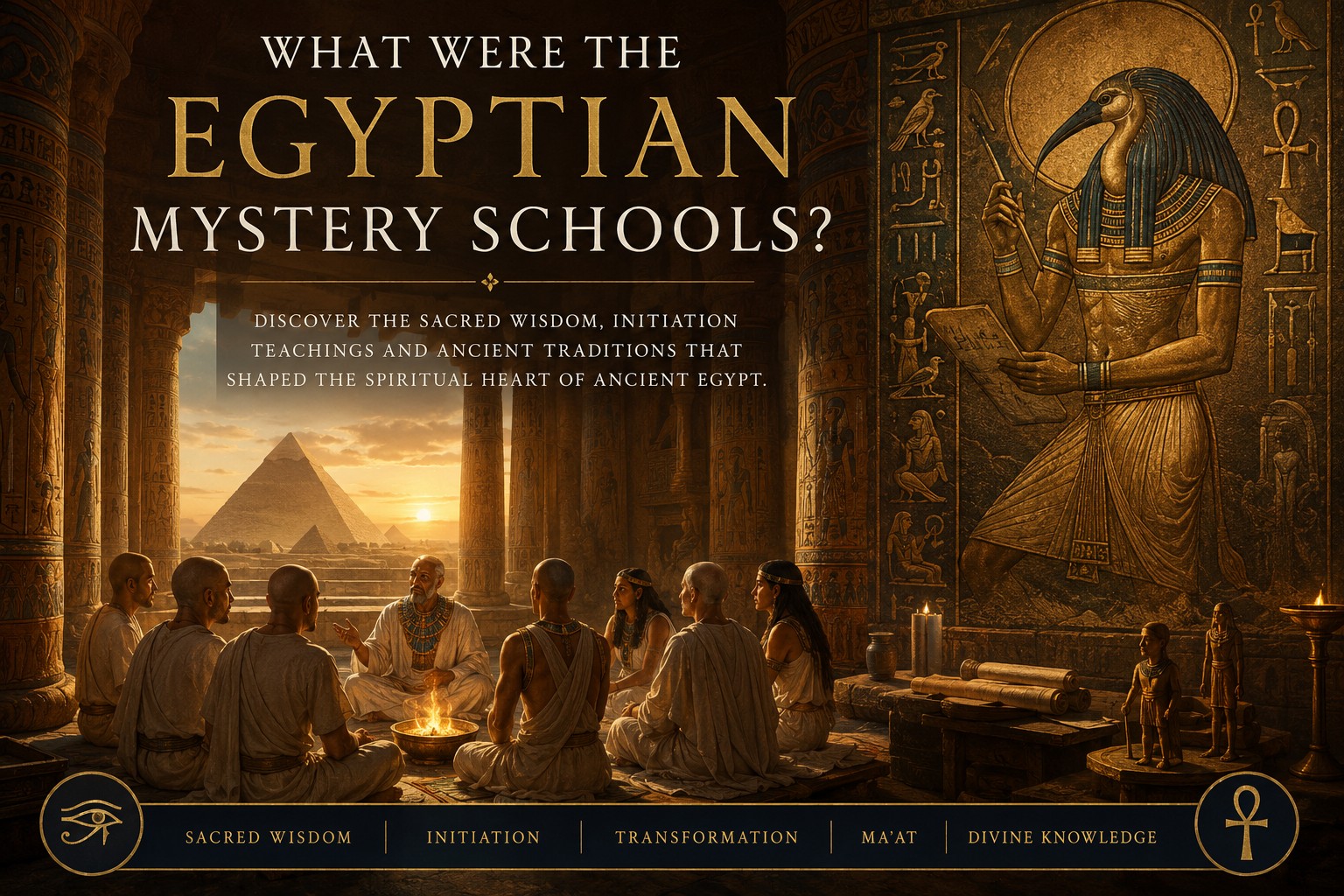
The Egyptian Mystery Schools were centres of sacred learning and initiatory development associated with the temples of Ancient Egypt.
Their purpose was not simply to communicate information, but to cultivate wisdom, virtue, and spiritual maturity.
Unlike modern systems of education, which primarily seek to fill the mind with knowledge, the Egyptian approach sought the transformation of the whole person.
The aspirant was expected to align with Ma’at, the principles of truth, balance, harmony, and right order, while gradually developing a deeper understanding of the visible and invisible dimensions of existence.
Knowledge was regarded as sacred, and genuine understanding arose through disciplined study, contemplation, ethical living, and direct experience.
The Meaning of “Mystery”
Why Were They Called Mystery Schools?
The word mystery derives from the Greek mysterion, referring to sacred teachings revealed through initiation.
In this context, mystery did not imply secrecy for its own sake.
Rather, it referred to truths that could only be understood through experience.
Certain dimensions of wisdom cannot be adequately communicated through words alone.
They must be lived, contemplated, and embodied.
Ancient Egypt recognized that profound spiritual knowledge required preparation and inner development.
Wisdom was therefore transmitted progressively, according to the readiness of the individual.
The Temple as a School of Transformation
The temples of Ancient Egypt were far more than places of worship.
They functioned simultaneously as:
Centres of learning
Sacred texts, astronomy, mathematics, medicine, language, and ritual sciences were preserved and transmitted within the temple system.
Centres of spiritual development
The cultivation of character, ethical refinement, and alignment with Ma’at formed an essential part of training.
Centres of initiation
Through symbolic rites and contemplative disciplines, the individual underwent a process of inner transformation.
Centres of sacred science
The Egyptians understood the cosmos as an ordered and living reality in which humanity participated.
Knowledge of this relationship formed part of the temple teachings.
Who Studied Within the Egyptian Mystery Schools?
Not everyone who entered a temple necessarily became an initiate.
Different levels of participation existed.
Among those associated with the temple tradition were:
Priests and priestesses
Custodians of sacred rites and temple functions.
Scribes
Preservers of knowledge and sacred writing.
Physicians
Students of healing arts and medicine.
Astronomers
Observers of celestial cycles and sacred time.
Seekers of wisdom
Individuals dedicated to self-mastery and spiritual development.
The ultimate aim was not status or power, but the cultivation of an integrated and harmonious life.
The Role of Tehuti
Among the most revered figures within Egyptian wisdom traditions was Tehuti, known to the Greeks as Thoth.
Tehuti was associated with:
- Sacred writing.
- Wisdom.
- Divine speech.
- Measurement.
- Knowledge.
- Time.
- Cosmic order.
He was regarded as the patron of scribes and the embodiment of divine intelligence.
For this reason, many later traditions viewed Tehuti as the archetypal teacher and transmitter of sacred knowledge.
His influence upon Egyptian spirituality and philosophy remains profound.
Initiation in Ancient Egypt
What Was the Purpose of Initiation?
Initiation was not intended to confer social privilege.
Its purpose was transformation.
The initiate sought to:
- Cultivate virtue.
- Align with Ma’at.
- Understand the nature of the soul.
- Develop self-mastery.
- Live in harmony with cosmic order.
- Participate consciously in the unfolding of life.
In this sense, initiation represented a journey from ignorance toward wisdom.
It was a path of remembrance rather than accumulation.
The Egyptian Understanding of the Human Being
Ancient Egyptian teachings viewed the human person as possessing multiple dimensions.
Among these were:
Ren
The sacred name and identity.
Ib
The heart and moral centre.
Ka
Vital life force.
Ba
Individual essence and soul expression.
Sheut
The shadow.
Akh
The luminous and effective spirit.
This understanding reveals that Ancient Egypt possessed a remarkably sophisticated vision of human nature, one that extended beyond the purely physical dimensions of existence.
Did the Egyptian Mystery Schools Really Exist?
Scholars continue to debate how the expression “Egyptian Mystery Schools” should be understood.
While the modern phrase itself is relatively recent, there is abundant evidence for:
- Temple education.
- Priestly instruction.
- Sacred rituals.
- Initiatory practices.
- Esoteric symbolism.
- Systems of spiritual and ethical development.
Many later traditions, including Greek philosophy and Hermetic thought, were deeply influenced by the wisdom of Ancient Egypt.
Thus, while the exact structure of the so-called Mystery Schools may remain a subject of discussion, the existence of profound sacred traditions within Egypt is beyond dispute.
Why Do the Egyptian Mystery Schools Continue to Fascinate Us?
Perhaps because the questions they addressed remain the questions humanity continues to ask:
Who am I?
Why am I here?
What is the purpose of life?
How can I live in harmony?
What survives death?
How may wisdom be cultivated?
These questions transcend time.
Ancient Egypt approached them not merely as intellectual problems, but as living realities to be explored through disciplined practice and inner transformation.
Conclusion
The Egyptian Mystery Schools represented far more than secret societies or repositories of hidden information.
They embodied a sacred vision of human development grounded in wisdom, virtue, and harmony with the divine order.
Their teachings sought not merely to educate the mind, but to transform the whole being.
Thousands of years later, the enduring symbols, texts, and temple traditions of Ancient Egypt continue to inspire seekers throughout the world.
Perhaps their greatest message is that wisdom is not something external to be acquired.
It is something to be awakened.
And the journey toward that awakening begins within.