Did Ancient Egypt Have Mystery Schools?
Examining the Historical Roots of Ancient Egypt’s Sacred Wisdom Tradition
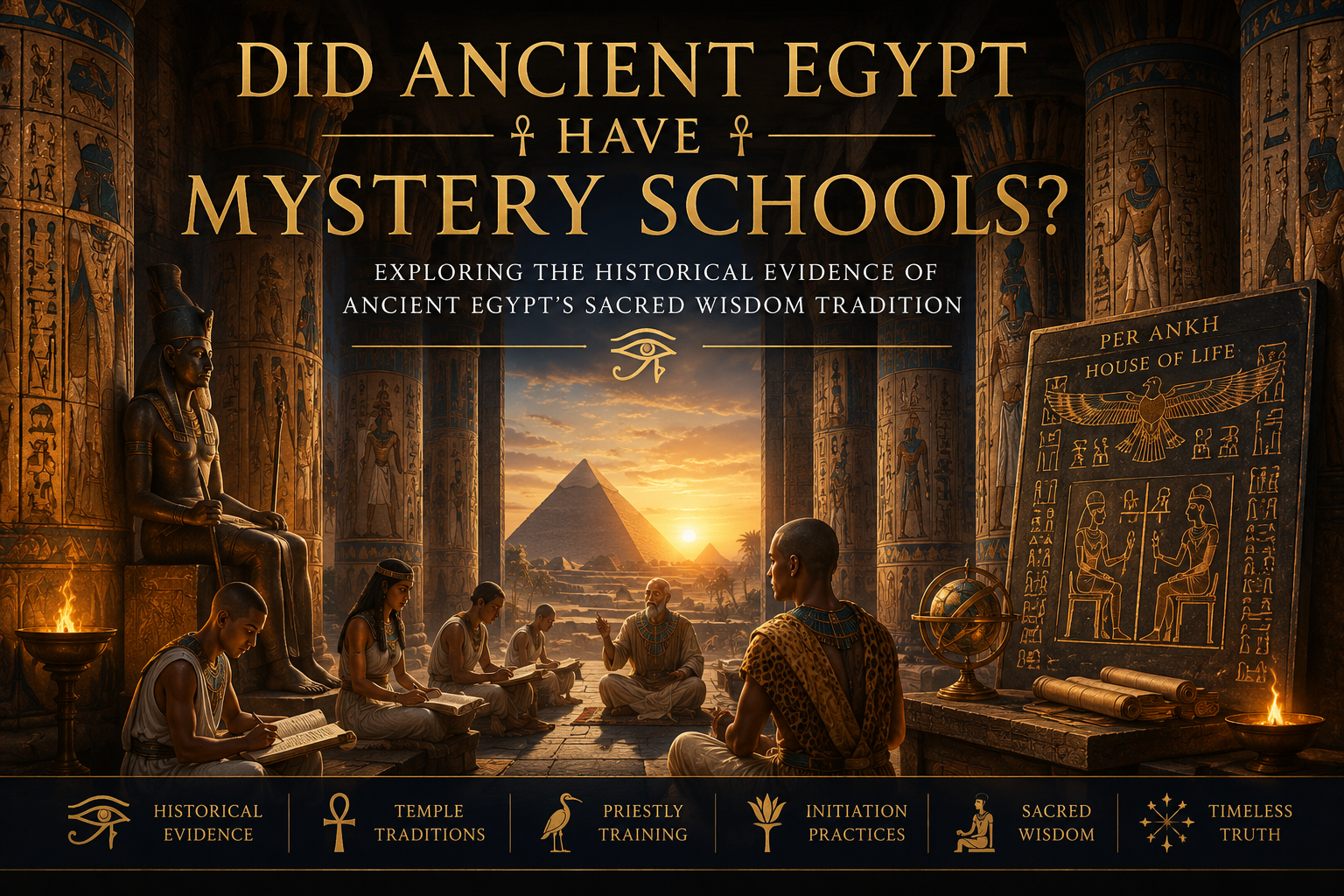
For centuries, the idea of the Egyptian Mystery Schools has fascinated philosophers, historians, spiritual seekers, and students of ancient wisdom.
Books, documentaries, and esoteric traditions frequently refer to these mysterious centres of initiation and sacred knowledge. Yet an important question remains:
Did Ancient Egypt actually have Mystery Schools?
The answer is both simple and nuanced.
The modern expression “Egyptian Mystery Schools” was not used by the ancient Egyptians themselves. Nevertheless, overwhelming evidence reveals that Ancient Egypt possessed sophisticated systems of temple education, priestly training, sacred rites, and initiatory practices that formed one of the most remarkable wisdom traditions in human history.
Understanding this distinction helps separate historical reality from modern speculation.
What Do Historians Mean by “Mystery Schools”?
The phrase “Mystery Schools” is largely a modern term.
It is used to describe traditions in which wisdom was transmitted progressively through initiation rather than openly taught to everyone.
Such traditions existed throughout the ancient world.
Among them were:
- The Eleusinian Mysteries of Greece.
- The Orphic traditions.
- Hermetic schools.
- Various priestly traditions of Ancient Egypt.
Although the Egyptians themselves did not leave behind documents referring to “Mystery Schools” by that name, they certainly maintained temples and priesthoods dedicated to preserving sacred knowledge.
The Temple System of Ancient Egypt
Temples Were More Than Places of Worship
Modern people often imagine temples as places reserved solely for religious ceremonies.
Ancient Egyptian temples fulfilled many functions.
They served as:
Centres of learning
Knowledge concerning mathematics, astronomy, medicine, writing, and sacred symbolism was preserved within the temples.
Centres of ritual
Priests performed ceremonies designed to maintain harmony between humanity and the divine order.
Centres of initiation
Spiritual disciplines and symbolic rites formed part of the training of priests and advanced students.
Centres of sacred science
The Egyptians viewed the universe as an ordered and living reality governed by divine principles.
Evidence for Sacred Instruction
The House of Life
One of the strongest pieces of evidence comes from institutions known as the Per Ankh, or “House of Life.”
These establishments were associated with temples and functioned as centres of learning and preservation.
Within them, scribes and priests studied:
- Sacred texts.
- Language and writing.
- Astronomy.
- Healing arts.
- Ritual sciences.
- Theology.
- Cosmology.
The House of Life demonstrates that Ancient Egypt possessed formal systems for transmitting knowledge across generations.
The Priesthood and Initiatory Training
Were Priests Simply Religious Officials?
Far from it.
Egyptian priests underwent extensive preparation and discipline.
Their responsibilities included:
- Ritual practice.
- Purification.
- Study of sacred writings.
- Observation of celestial cycles.
- Preservation of temple traditions.
- Service to the Neteru.
Knowledge was considered sacred and was entrusted to those capable of bearing its responsibilities.
This gradual transmission of wisdom strongly resembles what later traditions would call initiation.
Greek Testimony About Egyptian Wisdom
Many Greek thinkers regarded Egypt as the source of profound wisdom.
Ancient writers such as:
Pythagoras
Plato
Solon
Herodotus
all associated Egypt with advanced learning and priestly knowledge.
Whether every later story is historically accurate remains uncertain.
Nevertheless, the reputation of Egypt as a centre of sacred wisdom was widespread throughout the ancient world.
Why Some Scholars Question the Idea
Modern historians are careful with terminology.
Some scholars object to the phrase “Egyptian Mystery Schools” because:
- No surviving Egyptian text uses the expression.
- Many modern accounts exaggerate or romanticize the past.
- Certain claims lack archaeological evidence.
These concerns are understandable.
However, rejecting sensationalism does not require dismissing the existence of authentic temple traditions, priestly education, and initiatory practices.
The Meaning of Initiation
Was Initiation Secret?
Not necessarily.
In Ancient Egypt, initiation was less about secrecy and more about transformation.
Wisdom was considered something to be embodied rather than merely learned.
Preparation involved:
Purification
The cultivation of virtue and discipline.
Alignment with Ma’at
Living in harmony with truth, balance, and right order.
Self-mastery
Learning to govern thoughts, emotions, and actions.
Sacred Knowledge
Understanding the relationship between humanity, the cosmos, and the divine.
Thus, initiation was fundamentally a process of inner development.
Tehuti and the Transmission of Wisdom
Among the Neteru, Tehuti occupied a unique role.
Known to the Greeks as Thoth, Tehuti was revered as:
- Lord of Divine Speech.
- Master of Writing.
- Keeper of Sacred Knowledge.
- Guardian of Time and Measure.
- Patron of Scribes.
- Embodiment of Wisdom.
For this reason, many later traditions viewed him as the archetypal teacher and custodian of the sacred sciences.
His influence extends through Hermeticism, philosophy, and the enduring spiritual legacy of Ancient Egypt.
Were the Egyptian Mystery Schools Secret Societies?
Popular culture often portrays Mystery Schools as hidden organizations guarding secret powers.
The historical reality appears far more profound.
Their purpose was not exclusivity.
Their purpose was transformation.
The emphasis lay upon:
- Character.
- Wisdom.
- Ethical living.
- Harmony with Ma’at.
- Service to the divine order.
- The development of the whole human being.
Knowledge carried responsibility, and therefore it was transmitted with care.
Why Does This Matter Today?
The fascination with the Egyptian Mystery Schools persists because they addressed questions that remain timeless:
Who am I?
Why am I here?
How should I live?
What is the nature of consciousness?
How may wisdom be cultivated?
Ancient Egypt approached these questions not as abstract theories, but as living realities requiring practice, discipline, and inner transformation.
Conclusion
Did Ancient Egypt have Mystery Schools?
If we mean secret organizations exactly matching modern descriptions, the answer is uncertain.
If we mean centres of sacred learning, temple education, priestly training, initiatory practices, and systems of spiritual transformation, then the evidence is abundant.
Ancient Egypt preserved one of humanity’s most remarkable wisdom traditions.
Its temples were not merely monuments of stone.
They were schools of consciousness.
And their enduring legacy continues to inspire those who seek wisdom, harmony, and remembrance of the divine order.
Related Articles
- What Were the Egyptian Mystery Schools?
- Who Is Tehuti?
- What Is Ma’at?
- Ancient Egyptian Initiation Explained
- Heka: The Sacred Science of Ancient Egypt
- The Seven Parts of the Soul in Ancient Egypt