How Did the Egyptian Mystery Schools Work?
Understanding Ancient Egypt’s Sacred System of Learning and Transformation
The Egyptian Mystery Schools are often described as centres of sacred wisdom, initiation, and spiritual development. Yet many people naturally ask a practical question:
How did the Egyptian Mystery Schools actually work?
Were they classrooms?
Were they secret societies?
Were they religious institutions?
Or were they something entirely different?
While much remains hidden beneath the sands of history, the surviving evidence reveals a remarkable system of learning that differed profoundly from modern education.
The Egyptian Mystery Schools were not primarily concerned with accumulating information.
They were concerned with transformation.
Their purpose was to guide individuals from ignorance toward wisdom, from disorder toward harmony, and from fragmentation toward wholeness.
To understand how they worked, we must first understand the worldview upon which they were built.
A Different Understanding of Education
Modern education generally focuses on acquiring knowledge and developing practical skills.
Ancient Egypt certainly valued knowledge, but knowledge alone was never considered sufficient.
The true objective was wisdom.
The Egyptian approach sought to develop the whole human being.
Learning therefore involved:
- Intellectual understanding.
- Ethical development.
- Spiritual refinement.
- Self-mastery.
- Practical application.
- Service to the divine order.
Knowledge without transformation was considered incomplete.
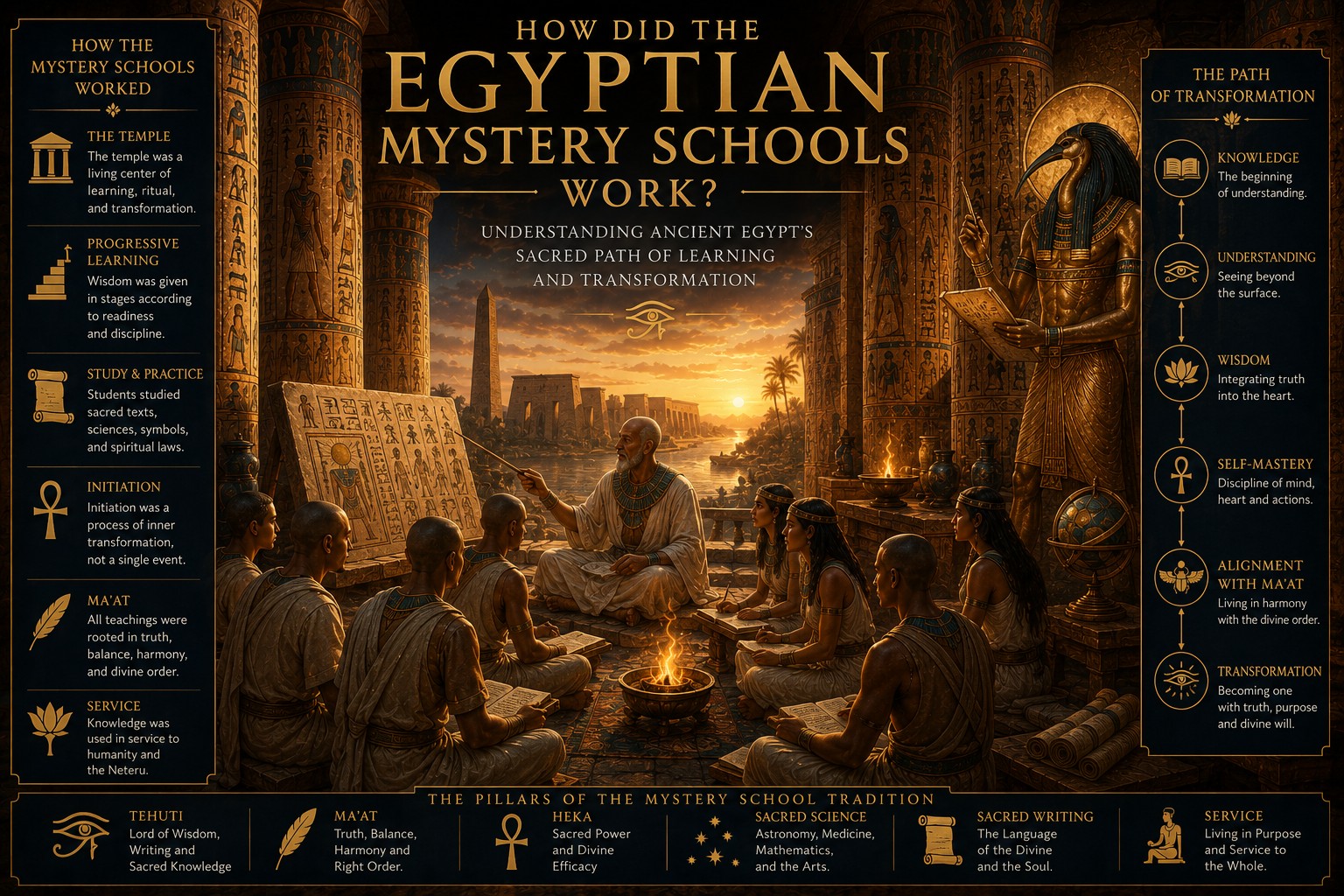
The Temple as a Centre of Learning
More Than a Place of Worship
The Egyptian temple served many functions.
It was simultaneously:
A sanctuary
A sacred space dedicated to the Neteru.
A school
A place where wisdom and knowledge were transmitted.
A library
A repository of sacred writings and records.
A laboratory
A centre for studying astronomy, mathematics, medicine, and sacred sciences.
A place of initiation
A setting for personal transformation and spiritual development.
The temple therefore formed the heart of Egypt’s wisdom tradition.
The House of Life
One of the most important institutions associated with the temples was the Per Ankh, or House of Life.
The House of Life functioned as a centre for learning and preservation.
Students studied subjects such as:
Sacred writing
Hieroglyphs and religious texts.
Cosmology
The structure and order of the universe.
Astronomy
The movements of celestial bodies.
Medicine
Physical and spiritual healing.
Ritual practice
The sacred ceremonies of the temple.
Theology
The nature of the Neteru and creation.
These institutions ensured that sacred knowledge was preserved and transmitted across generations.
Learning Through Stages
Wisdom Was Given Progressively
One of the defining characteristics of initiatory traditions is that knowledge is transmitted in stages.
The Egyptians recognized that wisdom must be matched to readiness.
Students progressed gradually through increasing levels of understanding.
This approach ensured that knowledge was not merely memorized but integrated.
Each stage built upon the one before it.
Learning was therefore a journey rather than an event.
The Role of Initiation
What Was Initiation?
Initiation was not simply a ceremony performed on a particular day.
It was a process of inner development.
The purpose of initiation was to prepare the individual for greater levels of responsibility, understanding, and self-mastery.
This process often involved:
- Study.
- Reflection.
- Ritual.
- Discipline.
- Service.
- Personal transformation.
Initiation marked a shift in consciousness rather than the acquisition of status.
The Central Importance of Ma’at
No aspect of Egyptian education can be understood without Ma’at.
Ma’at represented:
- Truth.
- Harmony.
- Balance.
- Justice.
- Right order.
The purpose of learning was not simply to become knowledgeable.
The purpose was to align one’s life with Ma’at.
Every aspect of training sought to cultivate this alignment.
Without Ma’at, wisdom became distorted.
With Ma’at, knowledge became transformative.
The Guidance of Tehuti
Tehuti occupied a central place within Egypt’s wisdom tradition.
Known to the Greeks as Thoth, he was revered as:
- Lord of Wisdom.
- Master of Writing.
- Keeper of Knowledge.
- Guardian of Sacred Science.
- Patron of Scribes.
Tehuti represented the principle through which divine intelligence becomes accessible to humanity.
For this reason, he was closely associated with learning, teaching, and the transmission of sacred knowledge.
Learning Through Symbol and Myth
Modern education often relies upon facts and explanations.
The Egyptians also taught through symbol, story, and sacred imagery.
Temple walls, statues, rituals, and myths served as teaching tools.
These symbols communicated multiple levels of meaning simultaneously.
A beginner might perceive a simple story.
An advanced initiate might perceive profound metaphysical truths.
This symbolic language allowed wisdom to unfold gradually through contemplation and experience.
The Practice of Heka
The Mystery Schools also taught Heka.
Today, Heka is often translated as magic.
A more accurate understanding is sacred power or divine efficacy.
Heka referred to the intelligent force woven throughout creation.
Students learned how thought, speech, intention, and action participate in this living reality.
The study of Heka formed part of Egypt’s sacred science and practical spirituality.
The Goal of the Mystery Schools
What Was the Final Objective?
The ultimate purpose of the Egyptian Mystery Schools was not merely to create scholars or priests.
Their aim was the development of an integrated human being.
An individual aligned with:
Ma’at
Living in harmony with truth and order.
Wisdom
Understanding the deeper principles of existence.
Self-mastery
Governing thoughts, emotions, and actions.
Service
Contributing to the wellbeing of society and the cosmos.
Spiritual awareness
Recognizing one’s relationship with the divine.
The goal was transformation of being.
How the Egyptian Mystery Schools Differed from Modern Education
Modern education often asks:
“What do you know?”
The Mystery Schools asked:
“Who are you becoming?”
Modern systems frequently prioritize information.
The Egyptian tradition prioritized wisdom.
Modern learning often ends when knowledge is acquired.
The Mystery Schools viewed learning as a lifelong process of refinement and awakening.
This difference helps explain why the Egyptian tradition continues to fascinate seekers throughout the world.
Why Their Method Still Matters Today
Many people today possess more information than any previous generation.
Yet confusion, anxiety, fragmentation, and lack of purpose remain widespread.
The Egyptian Mystery Schools addressed these challenges by focusing on the development of the whole person.
Their teachings remind us that wisdom involves more than knowledge.
It involves character, balance, purpose, and alignment.
In this sense, the core principles of the Mystery Schools remain profoundly relevant.
Conclusion
How did the Egyptian Mystery Schools work?
They worked by combining education, initiation, ethical development, sacred science, and spiritual practice into a unified path of transformation.
Their purpose was not merely to inform.
Their purpose was to awaken.
Within the temples of Ancient Egypt, knowledge was preserved, wisdom was cultivated, and individuals were guided toward deeper harmony with themselves, the cosmos, and the divine order.
This vision of human development remains one of the most enduring legacies of Ancient Egypt and continues to inspire seekers more than three thousand years later.
Related Articles
- What Were the Egyptian Mystery Schools?
- Did Ancient Egypt Have Mystery Schools?
- The Egyptian Mystery Schools Explained
- What Is Ma’at?
- Who Is Tehuti?
- Heka Explained
- The Seven Parts of the Soul in Ancient Egypt