What Did the Priests of Ancient Egypt Teach?
Exploring the Sacred Knowledge Preserved Within the Egyptian Temples
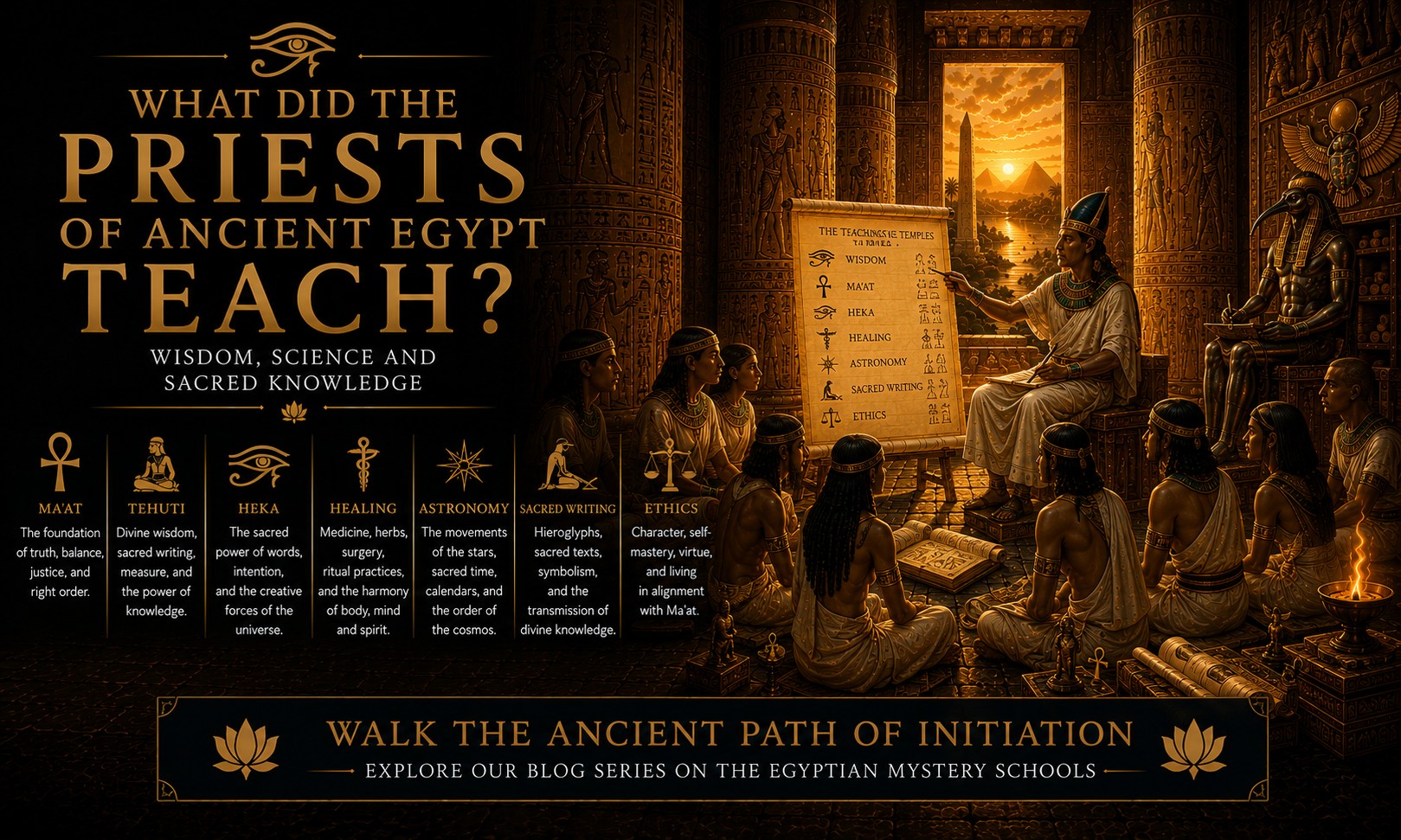
For more than three thousand years, the temples of Ancient Egypt stood among the greatest centres of learning in the ancient world.
Within their walls, generations of priests preserved an extraordinary body of knowledge concerning the cosmos, humanity, ethics, ritual, medicine, mathematics, astronomy, sacred writing, and the divine order of existence.
Yet one question continues to fascinate historians and spiritual seekers alike:
What did the priests of Ancient Egypt actually teach?
The answer reaches far beyond religion.
The Egyptian priesthood sought to cultivate wise human beings who understood both the visible and invisible dimensions of reality.
Their education united observation with symbolism, science with spirituality, and practical responsibility with inner transformation.
To study with the priests was not merely to acquire knowledge.
It was to undergo a disciplined process of becoming.
The Purpose of Temple Education
The Egyptian priesthood did not teach simply to increase learning.
Its purpose was transformation.
Knowledge was understood as a sacred trust rather than personal possession.
Students were expected to develop:
- Wisdom.
- Character.
- Self-mastery.
- Reverence.
- Responsibility.
- Alignment with Ma’at.
Every subject ultimately served this greater aim.
Education was therefore inseparable from ethics.
The purpose of learning was not merely to know.
It was to become worthy of knowledge.
Ma’at: The Foundation of Every Teaching
At the heart of Egyptian civilization stood Ma’at.
No subject was more fundamental.
Ma’at represented:
- Truth.
- Balance.
- Justice.
- Harmony.
- Right order.
The priests taught that the universe itself functioned according to these principles.
Human beings flourished when they aligned their lives with Ma’at.
Disorder arose whenever greed, falsehood, violence, pride, or injustice displaced harmony.
Students therefore learned that wisdom began not with intellectual achievement but with ethical living.
Before mastering sacred knowledge, one first learned how to live truthfully.
Tehuti: Lord of Divine Wisdom
Among all the Neteru, Tehuti occupied a unique place within temple education.
Known to the Greeks as Thoth, he was revered as:
- Lord of Wisdom.
- Master of Sacred Writing.
- Divine Scribe.
- Keeper of Knowledge.
- Guardian of Measure.
- Lord of Time.
Everything associated with learning naturally fell under his patronage.
The priesthood regarded wisdom as something transmitted rather than invented.
The role of the student was not to create truth but to receive, preserve, embody, and transmit it faithfully.
Sacred Writing and Hieroglyphs
Writing was never viewed as a merely practical skill.
Hieroglyphs were considered sacred signs through which deeper realities could be communicated.
Students learned:
Reading and Writing
The careful preservation of sacred texts.
Symbolic Interpretation
Understanding the multiple layers of meaning within hieroglyphic imagery.
Ritual Texts
Learning hymns, invocations, liturgies, and ceremonial formulas.
Divine Speech
Recognising the creative power of properly ordered words.
Writing therefore became an initiatory discipline rather than simply literacy.
Heka: The Sacred Science of Creative Power
One of the most profound subjects taught within the temple tradition was Heka.
Although often translated as “magic,” Heka possessed a far richer meaning.
The priests understood Heka as the divine power through which creation itself is ordered.
Students learned that:
- Thought carries influence.
- Speech shapes reality.
- Intention directs action.
- Consciousness participates in creation.
Heka therefore represented the responsible use of sacred power.
Its purpose was never manipulation.
Its purpose was alignment with divine order.
Cosmology and the Nature of Creation
The Egyptian priesthood taught a sophisticated understanding of the universe.
Creation was not viewed as accidental.
It unfolded according to ordered principles.
Students explored:
- The emergence of creation from the primordial waters.
- The role of the Neteru.
- Cycles of renewal.
- Solar symbolism.
- Sacred kingship.
- Cosmic balance.
These teachings helped students understand humanity’s place within the greater order of existence.
Astronomy and Sacred Time
The priests were careful observers of the heavens.
Astronomy formed an essential part of temple life.
The movement of the stars regulated:
- Festivals.
- Agricultural cycles.
- Temple rituals.
- Calendars.
- Sacred ceremonies.
The heliacal rising of Sirius, for example, marked the beginning of the inundation and the Egyptian New Year.
Observation of the heavens was not merely scientific.
It was also symbolic.
The order visible in the sky reflected the order that should exist within human life.
Mathematics and Sacred Measure
The temples also preserved advanced mathematical knowledge.
Measurement was essential for:
- Temple construction.
- Architecture.
- Land surveying.
- Astronomy.
- Calendar calculation.
- Sacred proportion.
The priests understood that harmony could be expressed through number.
Geometry therefore became both a practical science and a symbolic language revealing the order of creation.
Healing the Whole Human Being
Healing occupied an honoured place within temple education.
Ancient Egyptian medicine combined careful observation with spiritual understanding.
Students learned about:
Physical Health
Diagnosis, remedies, surgery, and herbal medicine.
Emotional Balance
The relationship between the heart, mind, and behaviour.
Ritual Healing
Sacred prayers and ceremonial practices.
Holistic Wellbeing
Recognising that body, mind, and spirit are interconnected.
The aim was not merely the absence of illness.
It was the restoration of harmony.
Ethics and Character Formation
The priests regarded character as more important than intellectual brilliance.
Students were encouraged to cultivate:
- Humility.
- Patience.
- Self-control.
- Truthfulness.
- Compassion.
- Responsibility.
Instruction literature such as The Maxims of Ptahhotep emphasised practical wisdom, respectful speech, careful listening, and honourable conduct.
Knowledge without virtue was considered incomplete.
The Human Being as a Sacred Mystery
Among the most remarkable aspects of Egyptian teaching was its understanding of the human being.
Rather than reducing a person to the physical body alone, the priests recognised multiple dimensions of existence.
Students gradually encountered teachings concerning:
Ren
The sacred identity.
Sheut
The shadow.
Ib
The heart and conscience.
Ka
Vital life force.
Ba
Individual soul expression.
Akh
The luminous and effective spirit.
These teachings provided a sophisticated vision of human development and spiritual maturation.
The purpose was integration.
Every aspect of the human being was to be brought into harmony.
Ritual as Living Education
Modern readers sometimes assume ritual existed merely to satisfy religious obligations.
The Egyptian priesthood understood ritual differently.
Properly performed ritual educated the whole person.
It united:
- Body.
- Mind.
- Emotion.
- Speech.
- Symbol.
- Intention.
Every movement expressed an aspect of cosmic order.
Through repeated participation, students gradually embodied what they had previously understood only intellectually.
The Transmission of Wisdom
Knowledge within the temple was transmitted carefully.
Some teachings were public.
Others required preparation.
This progression reflected respect for both the student and the teaching.
Wisdom unfolded gradually because understanding matures gradually.
The priests recognised that information can be given instantly.
Wisdom cannot.
It must be cultivated through experience, reflection, discipline, and practice.
The Ultimate Aim of the Priesthood
Although the Egyptian temples preserved remarkable knowledge concerning astronomy, mathematics, medicine, writing, ritual, and cosmology, these subjects all pointed toward a single purpose.
The formation of the human being.
The priests sought to cultivate individuals who were:
Wise
Able to perceive truth clearly.
Balanced
Living according to Ma’at.
Disciplined
Capable of governing themselves.
Compassionate
Serving others with integrity.
Spiritually Awake
Conscious of humanity’s relationship with the divine order.
Education therefore became a sacred path rather than merely an academic pursuit.
Why These Teachings Still Matter
The questions explored within the Egyptian temples remain strikingly relevant today.
How should we live?
What is wisdom?
How do we develop character?
How do we balance knowledge with responsibility?
How do we understand our place within the universe?
These questions continue to shape human life.
The enduring value of the Egyptian priesthood lies not simply in the information it preserved but in its vision of education as the cultivation of the whole person.
This holistic approach continues to inspire those seeking a path of wisdom grounded in ethics, consciousness, and inner transformation.
Conclusion
What did the priests of Ancient Egypt teach?
They taught far more than ritual.
They taught wisdom.
They taught Ma’at as the foundation of ethical life.
They taught Heka as the sacred power underlying creation.
They preserved astronomy, mathematics, healing, sacred writing, and temple symbolism.
Above all, they sought to guide the human being toward greater harmony, responsibility, and conscious participation in the divine order.
Their legacy reminds us that true education is not measured merely by what we know.
It is measured by who we become.
Related Articles
- What Were the Egyptian Mystery Schools?
- Did Ancient Egypt Have Mystery Schools?
- The Egyptian Mystery Schools Explained
- How Did the Egyptian Mystery Schools Work?
- What Was Initiation in Ancient Egypt?
- Ancient Egyptian Initiation: Meaning and Practice
- Were the Egyptian Mystery Schools Real?
- Who Is Tehuti?
- What Is Ma’at?
- Heka Explained