The Purpose of the Egyptian Mystery Schools
Why Ancient Egypt Created a Path of Wisdom, Transformation, and Awakening
When most people hear the phrase “Egyptian Mystery Schools,” they immediately think of hidden knowledge, secret teachings, and ancient initiation rituals.
While such ideas contain elements of truth, they often overlook a more important question:
Why did the Egyptian Mystery Schools exist in the first place?
What purpose did they serve?
Why would an entire civilization devote immense resources to temples, priesthoods, sacred texts, ritual systems, and generations of initiatory training?
The answer reveals something profound about Ancient Egypt itself.
The Mystery Schools were not created to preserve secrets.
They were created to transform human beings.
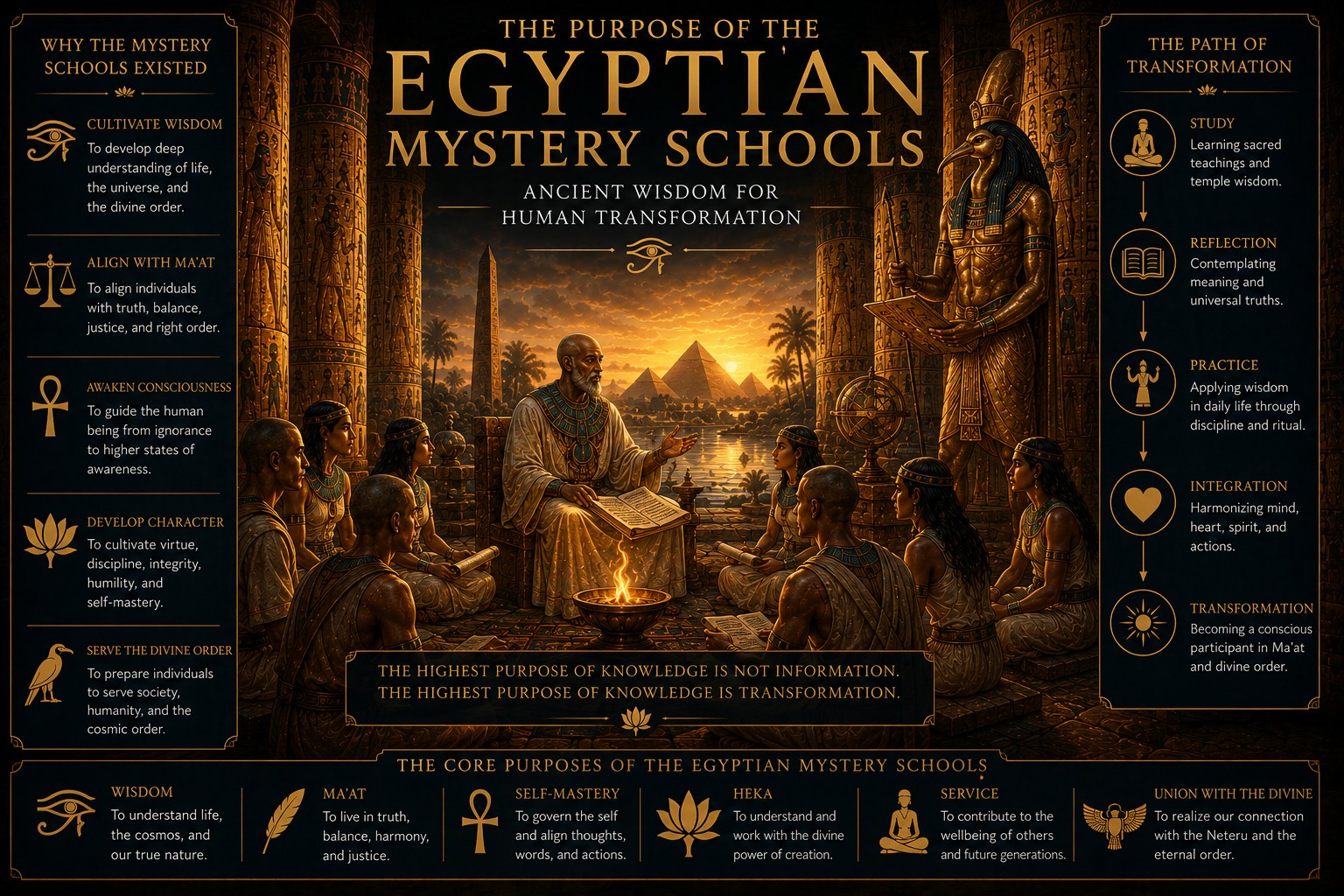
Their purpose was to cultivate wisdom, develop character, align individuals with Ma’at, and guide them toward conscious participation in the divine order of existence.
To understand the purpose of the Mystery Schools is to understand the heart of Ancient Egyptian civilization.
A Purpose Greater Than Religion
One of the most common misconceptions about the Mystery Schools is that they were simply religious institutions.
Ancient Egypt certainly possessed a rich spiritual tradition, yet the Mystery Schools extended far beyond religion in the modern sense.
They addressed the whole human being.
They concerned themselves with:
- Character.
- Consciousness.
- Ethics.
- Wisdom.
- Self-mastery.
- Service.
- Cosmic order.
Their goal was not merely belief.
Their goal was transformation.
The Egyptians understood that spiritual knowledge has little value unless it changes the way a person lives.
The Cultivation of Wisdom
Knowledge Was Not Enough
Modern education often emphasizes the accumulation of information.
Ancient Egypt distinguished between information and wisdom.
A person could possess knowledge without possessing wisdom.
Wisdom required understanding.
It required experience.
It required application.
For this reason, the Mystery Schools sought to cultivate individuals capable of living according to higher principles rather than merely discussing them.
Wisdom was considered a living force that shaped thought, speech, action, and character.
Alignment With Ma’at
At the centre of Egyptian civilization stood Ma’at.
Ma’at represented:
- Truth.
- Balance.
- Harmony.
- Justice.
- Right order.
The Egyptians believed that both society and the individual flourished when aligned with these principles.
The Mystery Schools therefore existed to help individuals embody Ma’at.
This alignment affected every aspect of life.
It shaped:
Thought
Learning to perceive truth clearly.
Speech
Speaking honestly and responsibly.
Action
Acting in accordance with harmony and justice.
Character
Developing integrity and self-control.
The purpose of initiation was not merely to learn about Ma’at.
It was to become an expression of Ma’at.
Understanding the Human Being
Ancient Egypt possessed one of the most sophisticated models of human nature found in the ancient world.
The Mystery Schools taught that human beings were multidimensional.
Among the aspects frequently discussed were:
Ren
Identity and sacred name.
Sheut
The shadow.
Ib
The heart.
Ka
Vital life force.
Ba
Soul expression.
Akh
The luminous and effective spirit.
The purpose of the Mystery Schools was to bring these dimensions into harmony.
The individual was not viewed as broken.
The individual was viewed as unfinished.
The work of initiation was to cultivate wholeness.
Awakening Consciousness
The Egyptian tradition understood that human beings possess the capacity for greater awareness.
The Mystery Schools sought to awaken this potential.
This awakening involved:
- Self-observation.
- Reflection.
- Discipline.
- Contemplation.
- Sacred study.
The objective was to move beyond mechanical living and become increasingly conscious of oneself, one’s actions, and one’s relationship to the cosmos.
In this sense, initiation was a journey of awakening.
The Role of Tehuti
No discussion of the Mystery Schools is complete without understanding Tehuti.
Known to the Greeks as Thoth, Tehuti was revered as:
- Lord of Wisdom.
- Master of Sacred Writing.
- Keeper of Knowledge.
- Patron of Scribes.
- Guardian of Divine Speech.
Tehuti represented the transmission of divine intelligence into human understanding.
His presence within Egyptian tradition symbolizes one of the central purposes of the Mystery Schools:
The cultivation of wisdom.
Knowledge was not regarded as personal property.
It was considered a sacred trust.
The Development of Character
Ancient Egypt did not separate wisdom from ethics.
Knowledge without virtue was considered dangerous.
For this reason, the Mystery Schools placed great emphasis upon character development.
Students were expected to cultivate:
Discipline
The ability to govern oneself.
Integrity
Consistency between thought, word, and action.
Humility
Recognition that learning is a lifelong process.
Responsibility
Using knowledge wisely.
Service
Contributing to the wellbeing of others.
The goal was not simply intellectual brilliance.
The goal was noble character.
Service to the Divine Order
The Mystery Schools did not exist solely for personal development.
They also served a broader purpose.
The Egyptians believed that humanity participates in maintaining cosmic harmony.
Every individual contributes either to order or disorder.
The Mystery Schools therefore prepared individuals to become conscious participants in the maintenance of Ma’at.
This service could take many forms:
- Teaching.
- Healing.
- Leadership.
- Ritual practice.
- Administration.
- Preservation of wisdom.
The ultimate aim was to benefit both society and the cosmos.
The Purpose of Initiation
Transformation Rather Than Membership
Modern people often think of initiation as joining a group.
Ancient Egypt viewed initiation differently.
Its purpose was transformation.
Initiation sought to guide individuals:
From ignorance to wisdom.
From imbalance to harmony.
From fragmentation to wholeness.
From unconsciousness to awareness.
From self-centredness to service.
Every stage of initiation reflected this process.
The objective was not status.
The objective was becoming.
Why the Mystery Schools Still Matter Today
Although thousands of years have passed, the questions addressed by the Mystery Schools remain remarkably relevant.
People continue to ask:
Who am I?
Why am I here?
What is the purpose of life?
How can I live wisely?
How may I develop my highest potential?
Ancient Egypt approached these questions with extraordinary seriousness and depth.
The Mystery Schools offered not merely answers, but a structured path of personal transformation.
This is one reason they continue to fascinate seekers around the world.
Conclusion
The purpose of the Egyptian Mystery Schools was far greater than preserving secret knowledge.
Their aim was to cultivate wise, balanced, and conscious human beings capable of living in harmony with Ma’at and participating responsibly in the divine order of existence.
They sought to develop the whole person.
Mind, heart, character, spirit, and action.
Through sacred study, initiation, self-mastery, and service, the Mystery Schools provided a path of transformation whose influence continues to echo across the centuries.
Perhaps their greatest lesson is this:
The highest purpose of knowledge is not information.
The highest purpose of knowledge is transformation.
Related Articles
- What Were the Egyptian Mystery Schools?
- Did Ancient Egypt Have Mystery Schools?
- How Did the Egyptian Mystery Schools Work?
- Who Could Enter the Egyptian Mystery Schools?
- What Was Initiation in Ancient Egypt?
- What Is Ma’at?
- Who Is Tehuti?
- Heka Explained