Inner Alignment: The Hidden Structure Behind True Transformation
Revealing the inner architecture through which Egyptian alchemy becomes operative
There is a persistent inclination to regard transformation as movement, progressing from one state to another, ascending toward greater clarity or expanded awareness. Yet within the Egyptian temple sciences, transformation is not first understood as movement.
It is understood as alignment.
For without alignment, movement does not lead toward order; it extends the pattern already in place. Thus, the question is not how far one has progressed, but whether what is present is arranged according to a deeper and governing structure, one that does not reveal itself to the unexamined eye.
The Meaning of Spiritual Alignment
Spiritual alignment, in its precise sense, is not the harmonising of preferences, nor the cultivation of a state that feels coherent or centred. Such conditions, though often sought, may arise independently of true alignment.
Alignment refers to the ordering of the inner constitution according to principles that are not self-derived.
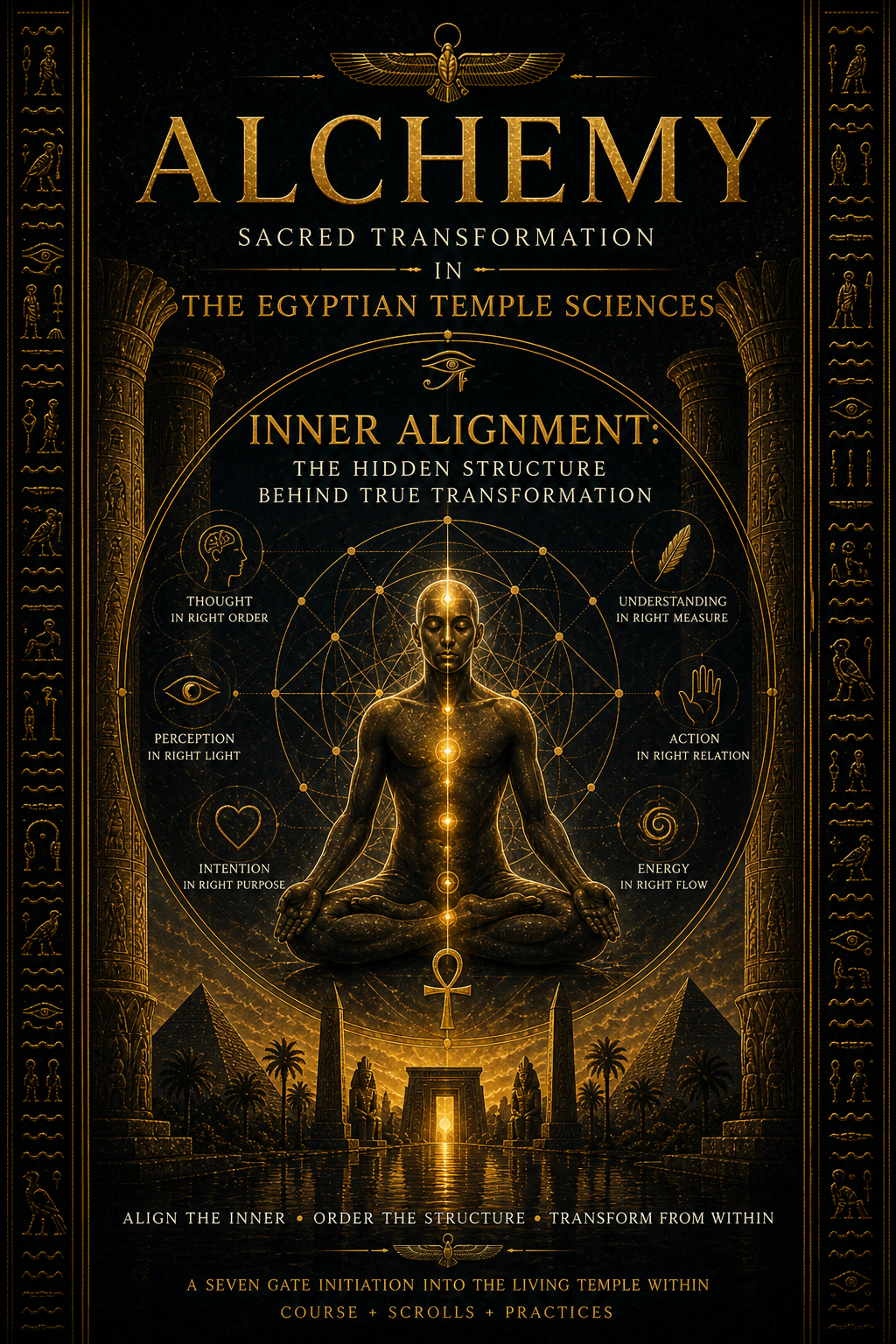
Within Egyptian alchemy, these principles govern relation: the relation between thought and perception, between perception and action, and between the individual and that which transcends individual interpretation.
Where alignment is present, each element functions in accordance with its rightful place.
Where alignment is absent, even refined qualities may operate in contradiction.
Thus, alignment is not an outcome of effort alone.
It is the result of right relation established within the structure of the self.
The Inner Structure of Transformation
Transformation, as understood within the Egyptian teachings of consciousness, does not occur within an undefined field. It unfolds within a structure, subtle, precise, and often unrecognised.
This structure consists not only of the visible aspects of thought and behaviour, but of underlying patterns that determine how these arise and interact. These patterns form an architecture through which perception is filtered, decisions are made, and meaning is assigned.
If this architecture remains disordered, transformation cannot stabilise.
One may experience moments of clarity, insight, or expansion; yet without an ordered structure, these remain transient. They do not take root, nor do they alter the underlying condition from which they arise.
Inner alignment addresses this directly.
It does not seek isolated experiences, but the reconfiguration of the structure itself.
The Subtlety of Misalignment
Misalignment is rarely obvious.
It does not always present as confusion or contradiction. In many cases, it appears as coherence, thoughts that follow logically, actions that seem appropriate, and intentions that appear sincere.
Yet beneath this surface, there may exist a misrelation between elements.
Thought may be clear, yet based on incomplete perception. Perception may be sharp, yet guided by unexamined assumption. Action may be decisive, yet directed toward what does not accord with deeper order.
In such cases, what appears aligned is only superficially so.
Egyptian alchemy does not measure alignment by appearance.
It discerns it through relation.
Alignment and the Egyptian Teachings of Consciousness
Within the Egyptian teachings of consciousness, alignment is not imposed; it is uncovered.
The structure that governs true relation is not constructed by the individual. It exists as a principle that precedes personal interpretation. The work, therefore, is not to invent alignment, but to recognise where misalignment persists and allow it to be corrected.
This requires a refinement of awareness.
For misalignment often operates beneath conscious recognition, influencing perception and action without revealing its source. To bring it into view is to begin the process of reordering.
Yet recognition alone does not complete the work.
Alignment must be established, stabilised, and sustained, each requiring a depth of engagement that exceeds surface understanding.
The Limits of Self-Derived Order
A further complexity arises when one attempts to establish alignment through self-derived frameworks.
The mind, seeking order, may construct systems of understanding that appear coherent and internally consistent. Yet if these systems arise from within a field already shaped by distortion, they will inevitably reflect that distortion.
Thus, what is created may seem ordered, while remaining fundamentally misaligned.
Egyptian alchemy does not rely upon such constructions.
It requires that alignment be measured against principles that do not originate within the conditioned mind. This introduces a demand for discernment, one that cannot be satisfied through reasoning alone.
It calls for a different order of knowing.
The Unresolved Threshold
If inner alignment depends upon a structure that is not self-derived, and if misalignment may remain concealed within what appears coherent, then a more exacting question emerges:
How is true alignment recognised, rather than assumed?
By what means is the inner structure reordered in accordance with principles that exceed personal interpretation?
And how does one remain aligned, when the very instruments of perception and thought may themselves be subject to subtle distortion?
These questions do not resolve through conceptual understanding. They point toward a deeper engagement, one that requires both structure and guidance.
Thus, the threshold remains present.
Seen, yet not fully entered.
Alchemy course
What has been outlined here is only the beginning.
The full path of this work, its structure, discipline, and lived application is explored in depth within the Alchemy course.
If you recognise the call within these teachings, you may proceed here:
https://mysteryschooloftehuti.com/alchemy/