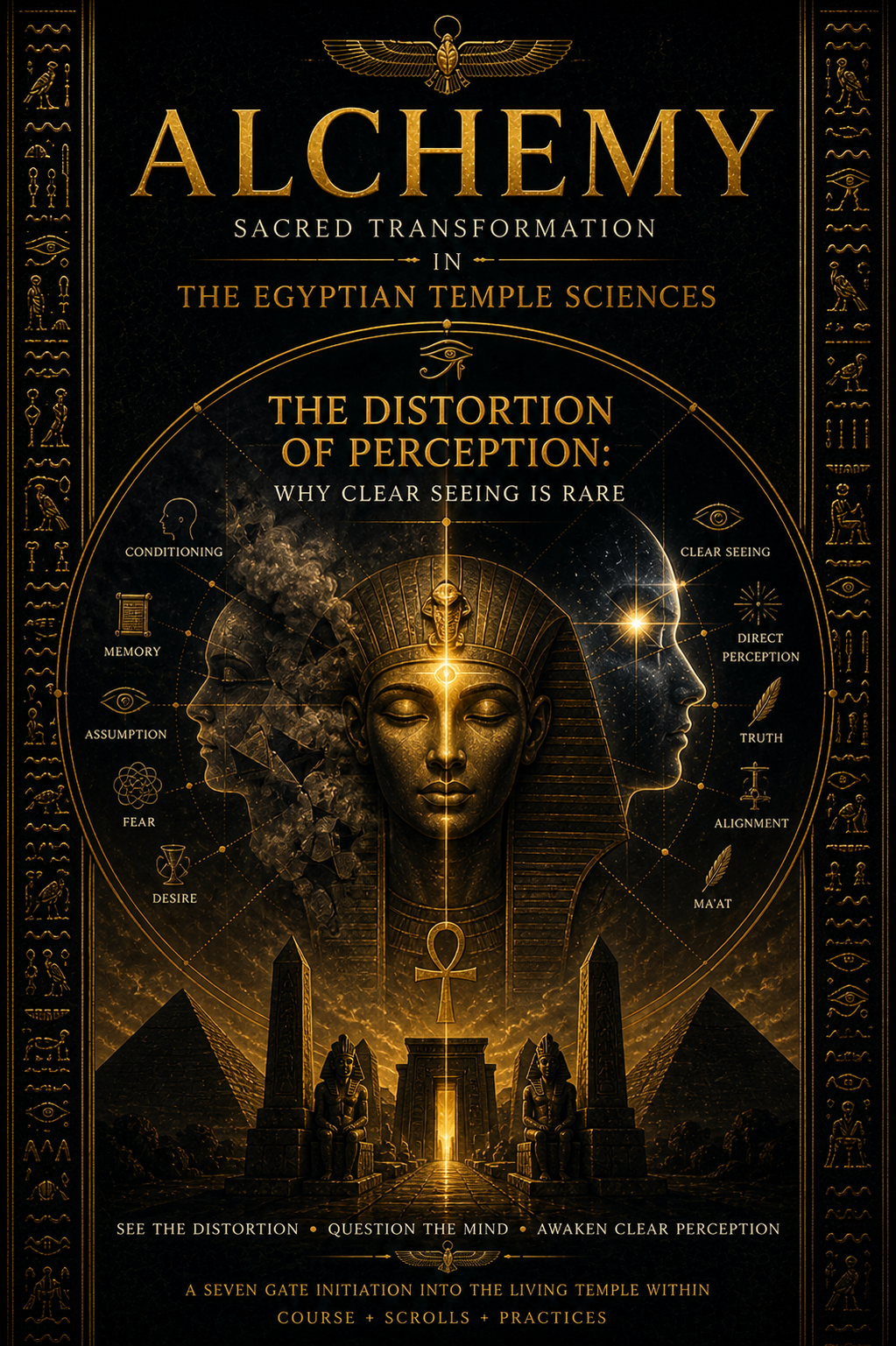
The Distortion of Perception: Why Clear Seeing is Rare
Understanding how perception is shaped, obscured, and restored within the Egyptian wisdom tradition
There is an assumption, often unexamined, that one sees as things are.
This assumption rarely announces itself; it operates quietly, forming the basis of thought, decision, and interpretation. Yet within the Egyptian wisdom tradition, this premise is not accepted without question. For what appears as direct perception is, in most cases, a conditioned process, shaped by prior impressions, internal structures, and subtle distortions that remain unseen by the one who perceives.
Thus, the question is not whether one sees.
The question is whether what is seen corresponds to what is.
Perception and Reality: A Necessary Distinction
The distinction between perception and reality is foundational, yet it is often overlooked.
Perception does not arise in isolation. It is mediated through the mind, through memory, association, expectation, and the accumulated patterns that define one’s inner structure. These elements do not merely influence perception; they participate in its formation.
What is perceived, therefore, is not reality in its unmediated form, but reality as it is interpreted.
Within Egyptian alchemy, this distinction is not treated as philosophical abstraction. It is recognised as a practical obstacle to transformation. For if perception is distorted, then any action taken upon it will reflect that distortion.
One cannot align with what one does not perceive accurately.
The Formation of Distortion in the Mind
Distortion does not arise as a singular event. It is formed gradually, through repetition and reinforcement.
Each experience leaves an imprint. Each interpretation strengthens a particular pattern of seeing. Over time, these patterns become habitual, shaping perception in ways that feel immediate and unquestioned.
This is the nature of the conditioned mind.
It does not announce its influence; it presents its conclusions as self-evident.
Thus, what is assumed to be clarity may in fact be the refinement of a pattern, one that has never been examined at its root.
Egyptian wisdom does not dismiss the mind; it seeks to understand its operation. For only through such understanding can distortion be recognised as distortion.
The Illusion of Clear Seeing
One of the more subtle obstacles is the belief that one already perceives clearly.
This belief does not arise from certainty, but from familiarity. What is repeated becomes trusted; what is trusted is rarely questioned.
In this way, distortion sustains itself.
Clarity of perception, in its true sense, is not the sharpening of existing patterns. It is the removal of that which interferes with direct seeing. This removal is not achieved through effort alone, nor through the accumulation of information.
It requires a shift in the very basis of perception.
Until such a shift occurs, one may refine perception endlessly, while remaining within the same underlying distortion.
The Egyptian Wisdom of the Mind
Within the Egyptian temple sciences, the mind is neither rejected nor elevated without discernment. It is recognised as an instrument capable of clarity, yet equally capable of distortion.
Its function depends upon its alignment.
When the mind operates in accordance with deeper principles, it reflects reality with increasing accuracy. When it operates independently, guided by its own conditioning, it generates interpretations that obscure rather than reveal.
Thus, the work is not to silence the mind, but to bring it into right relation.
This requires precision.
For without such precision, one may mistake stillness for clarity, or activity for insight, neither of which guarantees true perception.
The Unresolved Threshold
If perception is conditioned, and if distortion may remain hidden within what appears to be clarity, then a more refined question emerges:
By what means can perception be verified?
How does one distinguish between direct seeing and interpretation shaped by prior conditioning?
And if the instrument of discernment is itself subject to distortion, what serves as the measure of truth?
These questions do not resolve through analysis alone. They indicate a depth of inquiry that exceeds the capacity of unexamined perception.
Thus, the threshold remains, present, recognisable, yet not easily crossed.
Alchemy course
What has been outlined here is only the beginning.
The full path of this work, its structure, discipline, and lived application is explored in depth within the Alchemy course.
If you recognise the call within these teachings, you may proceed here:
https://mysteryschooloftehuti.com/alchemy/