Who Could Enter the Egyptian Mystery Schools?
Understanding Who Was Eligible for Initiation in Ancient Egypt
One of the most common questions asked about the Egyptian Mystery Schools is surprisingly simple:
Who could enter them?
Were they reserved exclusively for priests?
Were they open only to royalty?
Could ordinary people participate?
Or were the Mystery Schools available to anyone who sought wisdom?
The answer is more nuanced than many modern accounts suggest.
Ancient Egypt did not view sacred knowledge as a commodity to be distributed indiscriminately, nor did it regard wisdom as a privilege reserved solely for an elite class.
Rather, access to deeper teachings was often linked to preparation, discipline, responsibility, and readiness.
In other words, the central question was not simply:
“Who are you?”
The deeper question was:
“Are you prepared?”
The Purpose of the Mystery Schools
To understand who could enter the Mystery Schools, we must first understand their purpose.
The Egyptian Mystery Schools were not social clubs, political organizations, or secret societies in the modern sense.
Their aim was transformation.
They existed to cultivate:
- Wisdom.
- Self-mastery.
- Ethical development.
- Spiritual understanding.
- Alignment with Ma’at.
- Service to the divine order.
Because these objectives required commitment and discipline, entry into deeper levels of learning was often gradual.
Were the Mystery Schools Open to Everyone?
The Historical Reality
Ancient Egyptian society contained various levels of education and temple involvement.
Not every person would have participated in advanced priestly training.
However, it is equally inaccurate to imagine that sacred wisdom was restricted exclusively to kings and high priests.
Evidence suggests that the temple system involved individuals occupying many different roles.
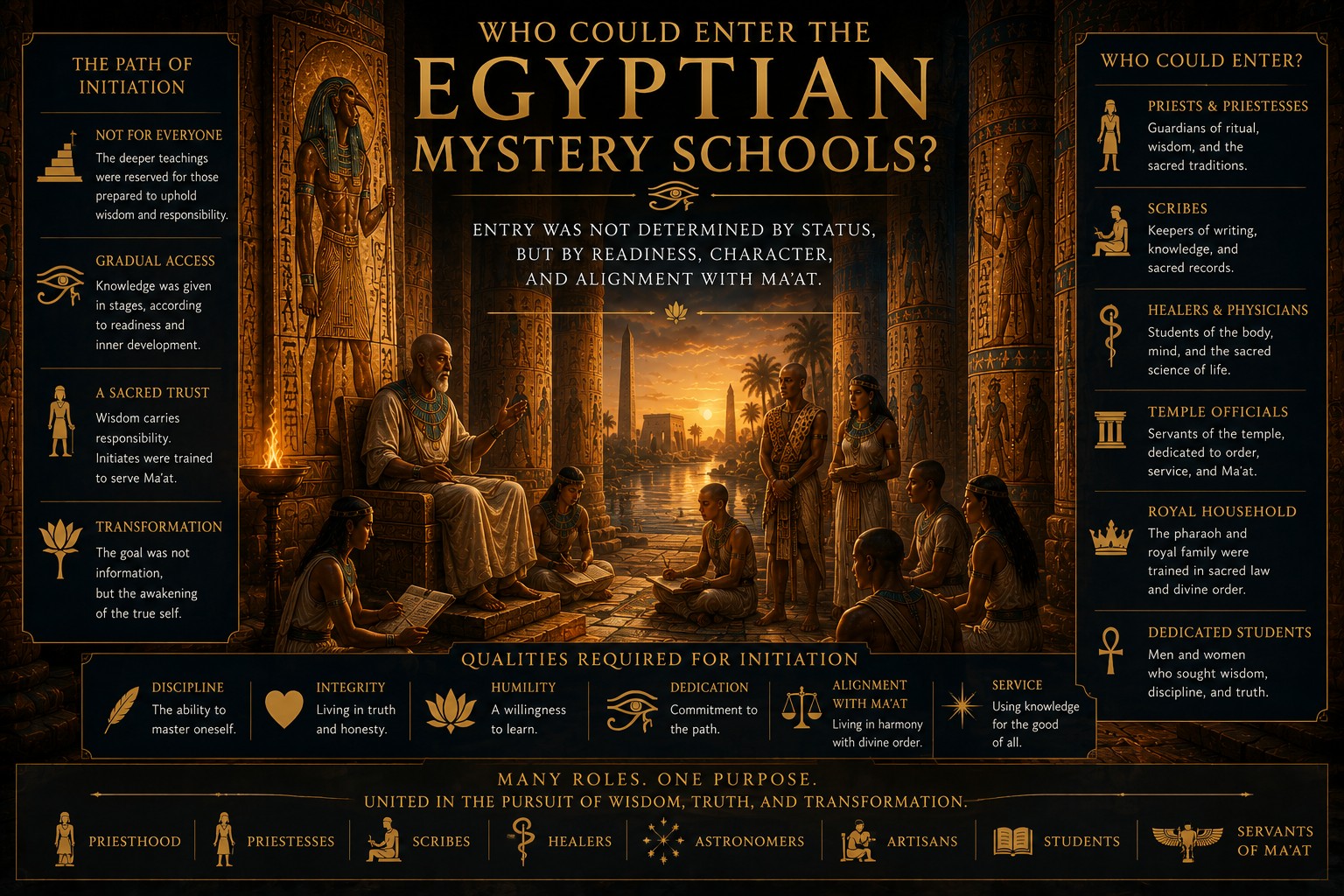
Among them were:
Priests
Custodians of ritual and sacred tradition.
Priestesses
Women who served important ceremonial and religious functions.
Scribes
Students and guardians of sacred writing.
Physicians
Practitioners of healing arts and temple sciences.
Temple Officials
Administrators and servants supporting temple life.
Dedicated Students
Individuals pursuing knowledge and spiritual development.
Thus, participation existed across a spectrum rather than within a rigid division.
The Importance of Readiness
Ancient Egypt recognized a principle that appears throughout many wisdom traditions.
Knowledge carries responsibility.
For this reason, deeper teachings were often transmitted progressively.
The determining factor was not merely social position.
It was readiness.
Readiness included:
Discipline
The ability to apply oneself consistently.
Character
Integrity and ethical conduct.
Humility
A willingness to learn.
Commitment
Dedication to the path of wisdom.
Alignment with Ma’at
Living according to truth and harmony.
These qualities were often considered more important than status or wealth.
The Role of Priests and Priestesses
Priests occupied a central place within Egypt’s sacred tradition.
Their responsibilities extended far beyond conducting rituals.
They were also:
- Scholars.
- Teachers.
- Astronomers.
- Healers.
- Keepers of sacred texts.
- Guardians of temple knowledge.
Priests underwent extensive training and purification.
Many of the teachings associated with the Mystery Schools would have been preserved and transmitted through the priesthood.
Priestesses likewise held important positions within the temple tradition and participated in numerous sacred functions.
The Scribe as an Initiate
One of the most respected professions in Ancient Egypt was that of the scribe.
Writing was regarded as a sacred art closely associated with Tehuti.
Scribes studied:
- Language.
- Sacred texts.
- Mathematics.
- Administration.
- Religious teachings.
Because literacy itself was uncommon, scribes occupied a unique position within Egyptian society.
Many became custodians of wisdom and important participants within temple culture.
Did Royalty Receive Initiatory Training?
The pharaoh occupied a unique role within Egyptian civilization.
As the symbolic guardian of Ma’at, the ruler was expected to embody divine order within society.
For this reason, members of the royal household often received extensive education concerning:
- Religion.
- Governance.
- Ritual.
- Cosmology.
- Sacred symbolism.
While royal status may have provided access to certain forms of instruction, initiation itself still required preparation and responsibility.
Wisdom could not be inherited simply through birth.
What Qualities Were Required?
Ancient Egypt appears to have valued inner qualities as much as outer position.
Those pursuing deeper wisdom would likely have been expected to cultivate:
Purity of Intention
A sincere desire for truth.
Self-Control
Mastery of thought, speech, and action.
Respect for Sacred Knowledge
Recognizing that wisdom carries responsibility.
Dedication
A willingness to persevere through challenges.
Reverence
Honouring the divine order embodied in Ma’at.
These qualities appear repeatedly throughout Egyptian teachings and literature.
The Guidance of Tehuti
The transmission of wisdom was closely associated with Tehuti.
Known to the Greeks as Thoth, Tehuti was revered as:
- Lord of Wisdom.
- Master of Writing.
- Keeper of Sacred Knowledge.
- Patron of Scribes.
- Guardian of Divine Speech.
His presence within Egyptian tradition reminds us that true wisdom involves more than intellectual ability.
It requires understanding, responsibility, and right use of knowledge.
Could Foreigners Enter the Egyptian Mystery Schools?
This question continues to fascinate historians.
Ancient writers sometimes claimed that visitors from other lands studied within Egypt.
Figures such as Pythagoras, Solon, and Plato were later associated with Egyptian wisdom traditions.
Although some details remain debated, Egypt’s reputation as a centre of learning attracted seekers from across the ancient world.
The possibility that foreigners encountered aspects of temple knowledge cannot be dismissed.
The Deeper Meaning of Entry
Perhaps the most important point is that entry into the Mystery Schools involved more than physical access.
One could stand within a temple and remain unchanged.
Another might undergo a profound transformation.
The true threshold was not merely architectural.
It was internal.
The deeper teachings became available as the individual developed the capacity to understand and embody them.
In this sense, initiation was always connected to consciousness rather than membership.
What This Means Today
Modern readers often ask who was permitted to enter the Mystery Schools.
Ancient Egypt may have asked a different question.
Not:
“Do you qualify?”
But:
“Are you prepared?”
The emphasis was not primarily upon privilege.
It was upon responsibility.
The path required discipline, self-reflection, ethical development, and a sincere commitment to wisdom.
These requirements remain relevant today.
Conclusion
Who could enter the Egyptian Mystery Schools?
Historically, participation appears to have included priests, priestesses, scribes, temple officials, healers, students, and in some cases members of the royal household.
Yet beyond social roles, the deeper qualification was readiness.
The Mystery Schools sought individuals capable of living according to Ma’at, cultivating wisdom, and accepting the responsibilities that sacred knowledge entails.
Their gates were not opened merely by status.
They were opened through preparation.
And in the highest sense, the path of initiation began not with entering a temple, but with the willingness to transform oneself.
Related Articles
- What Were the Egyptian Mystery Schools?
- Did Ancient Egypt Have Mystery Schools?
- The Egyptian Mystery Schools Explained
- How Did the Egyptian Mystery Schools Work?
- What Was Initiation in Ancient Egypt?
- Who Is Tehuti?
- What Is Ma’at?
- Heka Explained