Were the Egyptian Mystery Schools Real?
Separating Historical Evidence, Modern Myth, and Ancient Sacred Tradition
The Egyptian Mystery Schools occupy a remarkable place in the modern imagination.
They are often described as hidden temples of wisdom where priests instructed carefully chosen initiates in sacred science, spiritual transformation, cosmology, healing, symbolism, and the mysteries of life and death.
Some accounts portray them as highly organized institutions with formal grades, secret chambers, and clearly defined systems of initiation.
Others dismiss the entire idea as a modern invention.
This raises an important question:
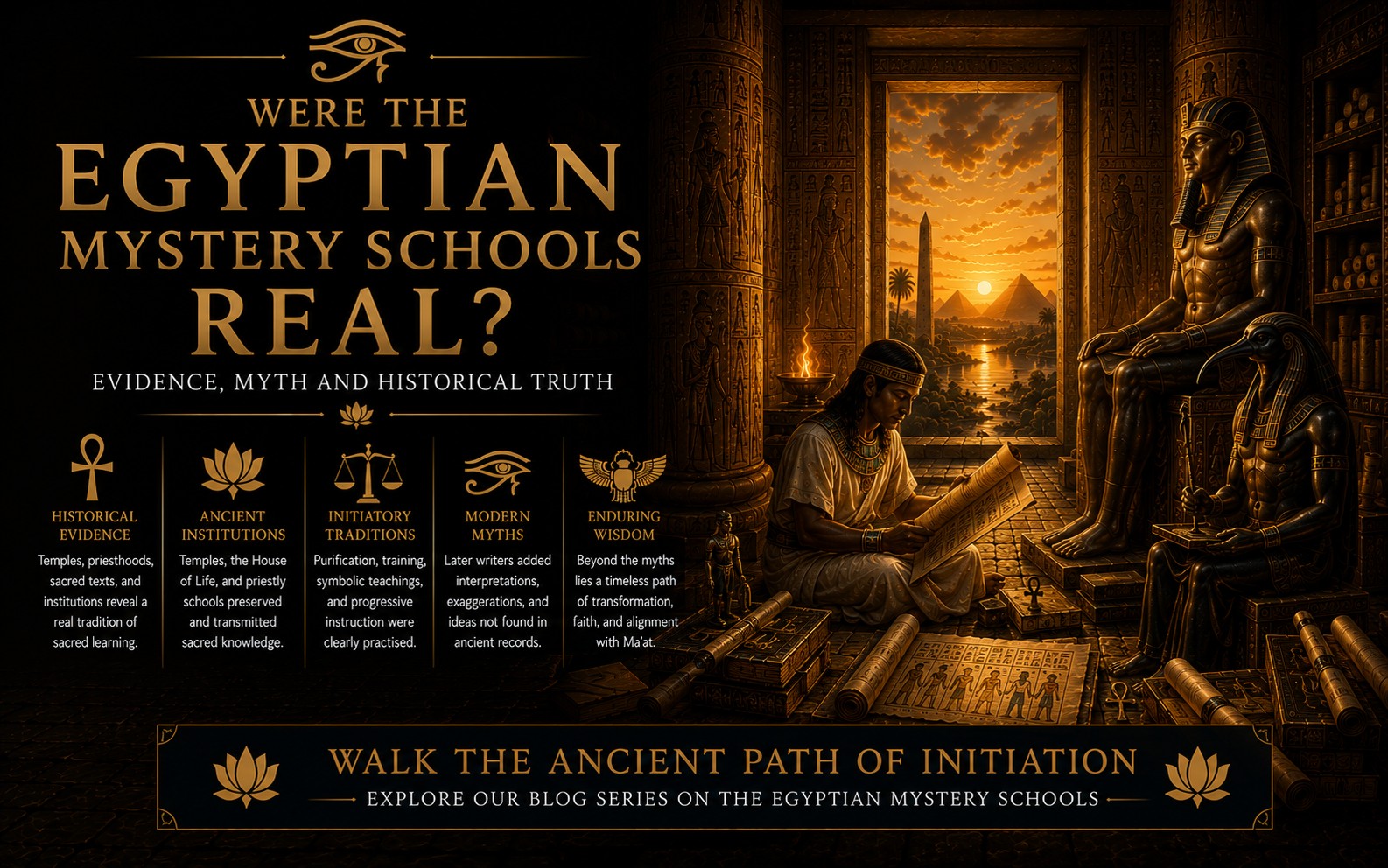
Were the Egyptian Mystery Schools real?
The most honest answer is both careful and profound.
There is no surviving Ancient Egyptian institution known by the exact modern title “Egyptian Mystery School.” The phrase itself belongs largely to later historical, philosophical, and esoteric interpretation.
Yet the realities beneath that phrase were unquestionably present.
Ancient Egypt possessed temples, priesthoods, sacred texts, Houses of Life, systems of ritual training, restricted knowledge, symbolic instruction, purification disciplines, and progressive forms of sacred education.
The question, therefore, is not whether Ancient Egypt possessed a profound initiatory tradition.
It clearly did.
The real question is how accurately the modern phrase “Mystery Schools” describes it.
Why Is the Subject So Controversial?
The controversy arises because the term “Mystery Schools” can mean different things to different people.
To a modern spiritual seeker, it may refer to a hidden tradition of initiation and inner transformation.
To a historian, it may suggest a formally organized institution for which direct archaeological evidence should exist.
To an esoteric writer, it may describe a lineage of secret wisdom extending from Ancient Egypt into Greece, Hermeticism, and later Western traditions.
These meanings overlap, but they are not identical.
Much of the disagreement disappears when the question is stated more precisely.
Ancient Egypt may not have possessed “Mystery Schools” under that exact name or in precisely the form imagined by later writers.
However, it certainly possessed sacred institutions that fulfilled many of the functions now associated with Mystery Schools.
The Modern Phrase “Mystery Schools”
Did the Ancient Egyptians Use This Name?
The ancient Egyptians did not describe their temples as “Mystery Schools” in surviving records.
The expression emerged through later interpretations of ancient religious and initiatory traditions.
The word mystery comes from the Greek mysterion, associated with rites or teachings into which a person was initiated.
In Greek and Roman traditions, mystery cults such as those associated with Eleusis, Dionysos, Isis, and Mithras involved progressive initiation, sacred rites, secrecy, and transformational religious experience.
Because Egypt possessed temples, priesthoods, sacred rites, restricted knowledge, and powerful traditions concerning death and rebirth, later writers naturally interpreted Egyptian religion through the language of mystery and initiation.
The phrase may therefore be modern, but the realities to which it points are ancient.
What Historical Evidence Actually Exists?
The evidence for an Egyptian sacred educational tradition is substantial.
It includes:
- Temple institutions.
- Organized priesthoods.
- Sacred libraries.
- Houses of Life.
- Ritual manuals.
- Priestly titles.
- Purification requirements.
- Restricted temple spaces.
- Sacred writing.
- Astronomical knowledge.
- Medical and magical texts.
- Funerary teachings.
- Initiatory symbolism.
These elements do not prove the existence of one unified national organization called the Egyptian Mystery Schools.
They do, however, demonstrate that Ancient Egypt preserved complex systems of sacred learning and priestly formation.
The Temples as Centres of Sacred Knowledge
Ancient Egyptian temples were far more than places where public worship occurred.
They were regarded as sacred dwellings of the Neteru and earthly reflections of divine order.
Within the temple system, priests carried out rituals designed to maintain harmony between the human world, the natural world, and the divine realm.
Temples also preserved:
Sacred Texts
Ritual instructions, hymns, theological writings, and ceremonial formulas.
Astronomical Knowledge
Observation of stars, calendars, sacred time, and temple orientation.
Healing Knowledge
Medical texts, remedies, diagnostic methods, and ritual healing practices.
Symbolic Teachings
Myths, temple imagery, architecture, and sacred drama.
Administrative Knowledge
Records, taxation, estates, offerings, and temple organization.
The temple was therefore simultaneously a sanctuary, institution, archive, ritual centre, and school of sacred knowledge.
The House of Life
Evidence of Formal Sacred Learning
One of the strongest historical foundations for the idea of Egyptian Mystery Schools is the Per Ankh, or House of Life.
The House of Life was associated with temples and royal institutions.
It functioned as a place where sacred texts were copied, preserved, studied, and transmitted.
Its activities appear to have included:
- Writing and copying texts.
- Medical knowledge.
- Ritual instruction.
- Theology.
- Sacred language.
- Magical texts.
- Temple learning.
The House of Life should not simply be equated with a modern school or university.
Nor should it automatically be described as a Mystery School in the later esoteric sense.
Yet it demonstrates that Ancient Egypt possessed institutions devoted to preserving and transmitting specialized knowledge.
The Egyptian Priesthood
The priesthood provides further evidence.
Egyptian priests were not merely ceremonial officials.
Depending upon their rank and function, they could serve as:
- Ritual specialists.
- Lector priests.
- Scribes.
- Astronomers.
- Healers.
- Administrators.
- Keepers of sacred texts.
- Interpreters of divine order.
Training would have varied according to role, temple, period, and location.
Not every priest possessed the same knowledge.
Not every temple taught identical material.
Nevertheless, priestly service required preparation, discipline, knowledge of ritual, and observance of purity.
This resembles initiation in its broadest sense: preparation for entry into a sacred responsibility.
Restricted Knowledge and Sacred Secrecy
Ancient Egyptian religion was not secret in the simplistic sense.
Temples, festivals, myths, and the Neteru were visible throughout society.
However, access to sacred space and specialized knowledge was restricted.
The innermost sanctuary of a temple was not open to the general public.
Priestly offices required training.
Ritual texts were not ordinary public literature.
Knowledge of divine names, sacred speech, ritual sequence, and temple practice belonged to those entrusted with specific responsibilities.
Secrecy was therefore not necessarily about concealing power for personal advantage.
It was about protecting sacred order.
Knowledge was given according to function, preparation, and responsibility.
Was There Initiation in Ancient Egypt?
The word initiation must be used carefully.
There is strong evidence for:
- Entry into priestly service.
- Ritual purification.
- Progressive temple responsibilities.
- Sacred instruction.
- Symbolic death and rebirth themes.
- Restricted ritual knowledge.
- Preparation for higher office.
What remains less certain is whether there existed one standardized system of initiation across all of Ancient Egypt resembling the formal degrees described by later occult writers.
Ancient Egyptian civilization lasted for more than three thousand years.
Its temples developed across many regions, dynasties, and theological centres.
Practices would have varied.
It is therefore more historically responsible to speak of Egyptian initiatory traditions than of one single, universal Mystery School system.
The Difference Between Evidence and Interpretation
A balanced approach requires distinguishing three levels.
What Is Historically Certain?
Ancient Egypt had temples, priesthoods, sacred rites, ritual training, sacred texts, restricted knowledge, purification practices, and institutions such as the House of Life.
What Is Historically Plausible?
Certain individuals probably underwent progressive forms of sacred instruction and transformation as they entered priestly, ritual, scribal, healing, or royal roles.
What Is Later Interpretation?
Claims concerning fixed initiation grades, universal temple curricula, underground chambers, elaborate examinations, or continuous secret lineages may derive from later philosophical, esoteric, or imaginative traditions rather than direct Egyptian evidence.
This distinction does not diminish the sacred depth of Ancient Egypt.
It protects it from distortion.
Greek Accounts of Egyptian Wisdom
Ancient Greek writers repeatedly portrayed Egypt as a land of great antiquity and wisdom.
Figures such as Herodotus, Plato, Pythagoras, Solon, and later Plutarch were associated with Egyptian knowledge in varying ways.
Some were said to have travelled to Egypt.
Others referred to Egyptian priests, laws, cosmology, ritual, mathematics, and ancient records.
These accounts helped establish Egypt as a source of primordial wisdom in the Greek imagination.
However, Greek testimony must be read carefully.
Greek writers sometimes described Egypt through their own cultural categories.
They may have interpreted Egyptian temples in ways influenced by Greek philosophy and Greek mystery traditions.
Their accounts remain valuable, but they are not always simple eyewitness descriptions.
Egypt and the Greek Mystery Traditions
The later popularity of the term “Egyptian Mystery Schools” is partly connected with the influence of Egyptian religion upon the Greek and Roman worlds.
The worship of Auset, known to the Greeks as Isis, spread widely beyond Egypt.
Mystery traditions connected with Isis involved purification, sacred drama, initiation, and personal transformation.
Hermetic writings also emerged in the Greco-Egyptian world, presenting teachings attributed to Hermes Trismegistus, the figure later associated with Tehuti.
These developments demonstrate the profound influence of Egyptian sacred thought.
However, they belong largely to later periods in which Egyptian and Greek ideas interacted.
They should not automatically be projected unchanged into the earliest dynastic periods.
The Rise of the Esoteric Egyptian Mystery School
During later centuries, Ancient Egypt became increasingly important to Western esotericism.
Hermeticists, alchemists, Rosicrucians, Freemasons, occultists, and spiritual teachers often looked toward Egypt as the source of sacred knowledge.
Egypt came to symbolize:
- Primordial wisdom.
- Initiation.
- Hidden knowledge.
- Sacred science.
- Spiritual rebirth.
- Divine kingship.
- The immortality of the soul.
These traditions helped preserve interest in Egyptian wisdom.
They also contributed many interpretations that cannot always be traced directly to Ancient Egyptian sources.
The result is a mixture of historical truth, symbolic insight, philosophical inheritance, and later invention.
Were the Mystery Schools Secret Societies?
Probably not in the modern sense.
Ancient Egyptian temples were official institutions closely connected with kingship, land, ritual, and society.
They were not necessarily underground organizations operating outside the established order.
The temple tradition stood at the centre of Egyptian civilization.
However, temple knowledge was hierarchical.
Access to ritual roles, sacred chambers, specialized texts, and priestly responsibilities was limited.
Thus, the temples were not secret societies, yet they contained restricted dimensions of knowledge and practice.
Were the Pyramids Used for Initiation?
One of the most popular modern claims is that the pyramids were used as initiation chambers.
This idea appears frequently in esoteric literature.
The Great Pyramid, in particular, has been described as a temple of initiation, a chamber of death and rebirth, an astronomical instrument, or a structure designed to transform consciousness.
Historically, the pyramids are understood primarily as royal funerary monuments within larger mortuary complexes.
Their architecture, texts, and surrounding structures reflect kingship, death, resurrection, and the afterlife.
These themes are profoundly initiatory in a symbolic sense.
However, direct evidence that the Great Pyramid functioned as a school in which living initiates underwent formal rites remains lacking.
The distinction is important.
A structure may contain initiatory symbolism without having served as an initiatory classroom.
Did Egyptian Priests Teach Hidden Spiritual Knowledge?
Egyptian priests certainly preserved specialized sacred knowledge.
Their teachings concerned:
- Ritual.
- Divine names.
- Sacred speech.
- Temple symbolism.
- Cosmology.
- The afterlife.
- Healing.
- Astronomy.
- Ma’at.
- Heka.
- The relationship between humanity and the Neteru.
Whether this knowledge should be called hidden depends upon what is meant.
Some teachings were visible in temple reliefs, public festivals, myths, and funerary writings.
Other teachings required priestly training and access.
The distinction was not always between public truth and secret truth.
It was often between visible symbol and deeper understanding.
Symbolic Truth and Historical Truth
The debate over the Egyptian Mystery Schools sometimes becomes unnecessarily rigid.
One side insists that every esoteric claim must be historically literal.
The other rejects anything not explicitly confirmed by archaeology.
Yet sacred traditions often communicate through symbol, ritual, myth, and layered meaning.
Historical truth asks:
What institutions existed?
What texts survived?
What practices can be documented?
Symbolic truth asks:
What did the temple represent?
What transformation did the myth communicate?
What pattern of consciousness did the ritual embody?
Both questions are valid.
They should not be confused, but neither should one automatically invalidate the other.
The Egyptian Temple as a School of Consciousness
Even when the phrase “Mystery School” is used cautiously, the Egyptian temple may still be understood as a school of consciousness.
It taught the individual to perceive the cosmos as ordered, living, and sacred.
It placed Ma’at at the centre of life.
It taught that speech, intention, ritual, and action participate in the maintenance of reality.
It preserved teachings concerning death, renewal, divine presence, and spiritual transformation.
The temple trained the priest not merely to perform tasks, but to serve as a mediator between worlds.
In this deeper sense, the Mystery School was not simply a building or organization.
It was a sacred process of learning how to live within divine order.
Why Historical Accuracy Matters
Historical accuracy is not the enemy of sacred tradition.
It is an expression of respect.
Ancient Egypt does not need exaggeration to be profound.
Its authentic achievements are already extraordinary.
The temples, texts, cosmologies, ritual systems, ethical teachings, and spiritual vision of Ancient Egypt reveal a civilization of immense intellectual and sacred depth.
When modern claims are presented as fact without evidence, they can weaken the credibility of the entire tradition.
A more reverent approach distinguishes clearly between:
- Archaeological evidence.
- Historical interpretation.
- Symbolic understanding.
- Living spiritual application.
This allows Ancient Egypt to speak in its own voice.
So, Were the Egyptian Mystery Schools Real?
The answer depends upon what we mean.
If we mean a single national organization officially called the Egyptian Mystery Schools, with one universal curriculum and clearly documented grades of initiation, there is insufficient evidence.
If we mean temples and sacred institutions in which priests, scribes, healers, and other trained individuals received specialized instruction, underwent purification, learned ritual, preserved sacred texts, and served the divine order, then yes.
Those institutions were real.
If we mean a tradition in which knowledge was transmitted progressively and understood as transformative rather than merely informational, then the answer is also yes.
The modern name may be imperfect.
The sacred reality behind it is not imaginary.
Why the Question Still Matters
People continue to ask whether the Egyptian Mystery Schools were real because they are seeking more than historical information.
They are asking whether Ancient Egypt possessed a genuine path of human transformation.
Did the Egyptians believe that consciousness could be refined?
That character could be transformed?
That the human being could become aligned with divine order?
That wisdom must be embodied rather than merely studied?
The surviving tradition strongly suggests that they did.
This is the deeper truth that continues to draw modern seekers toward the temples of Ancient Egypt.
Conclusion
Were the Egyptian Mystery Schools real?
The phrase itself is largely modern, and many later claims remain debated or unsupported.
Yet Ancient Egypt undeniably possessed temples, priesthoods, sacred libraries, Houses of Life, ritual training, restricted knowledge, purification disciplines, and sophisticated traditions of spiritual and ethical formation.
The modern image of the Mystery Schools may combine history, symbolism, philosophy, and later esoteric interpretation.
But beneath that image stands a genuine sacred tradition.
Ancient Egypt created institutions in which knowledge was preserved, ritual was mastered, character was refined, and humanity’s relationship with the divine order was explored with extraordinary depth.
The name may be modern.
The wisdom is ancient.
Related Articles
- What Were the Egyptian Mystery Schools?
- Did Ancient Egypt Have Mystery Schools?
- The Egyptian Mystery Schools Explained
- How Did the Egyptian Mystery Schools Work?
- What Was Initiation in Ancient Egypt?
- Who Could Enter the Egyptian Mystery Schools?
- The Purpose of the Egyptian Mystery Schools
- Ancient Egyptian Initiation: Meaning and Practice
- What Did the Priests of Ancient Egypt Teach?