Ancient Egyptian Initiation: Meaning and Practice
Understanding the Sacred Path of Transformation in the Egyptian Mystery Schools
Ancient Egyptian initiation was never merely a ceremony.
It was a sacred path.
To the modern mind, initiation is often imagined as a dramatic moment, a secret rite, a hidden chamber, or a symbolic entry into an exclusive order. Yet within the wisdom tradition of Ancient Egypt, initiation was far deeper than an outward event.
It was a process of transformation.
The initiate was not simply taught.
The initiate was prepared.
The initiate was not merely informed.
The initiate was refined.
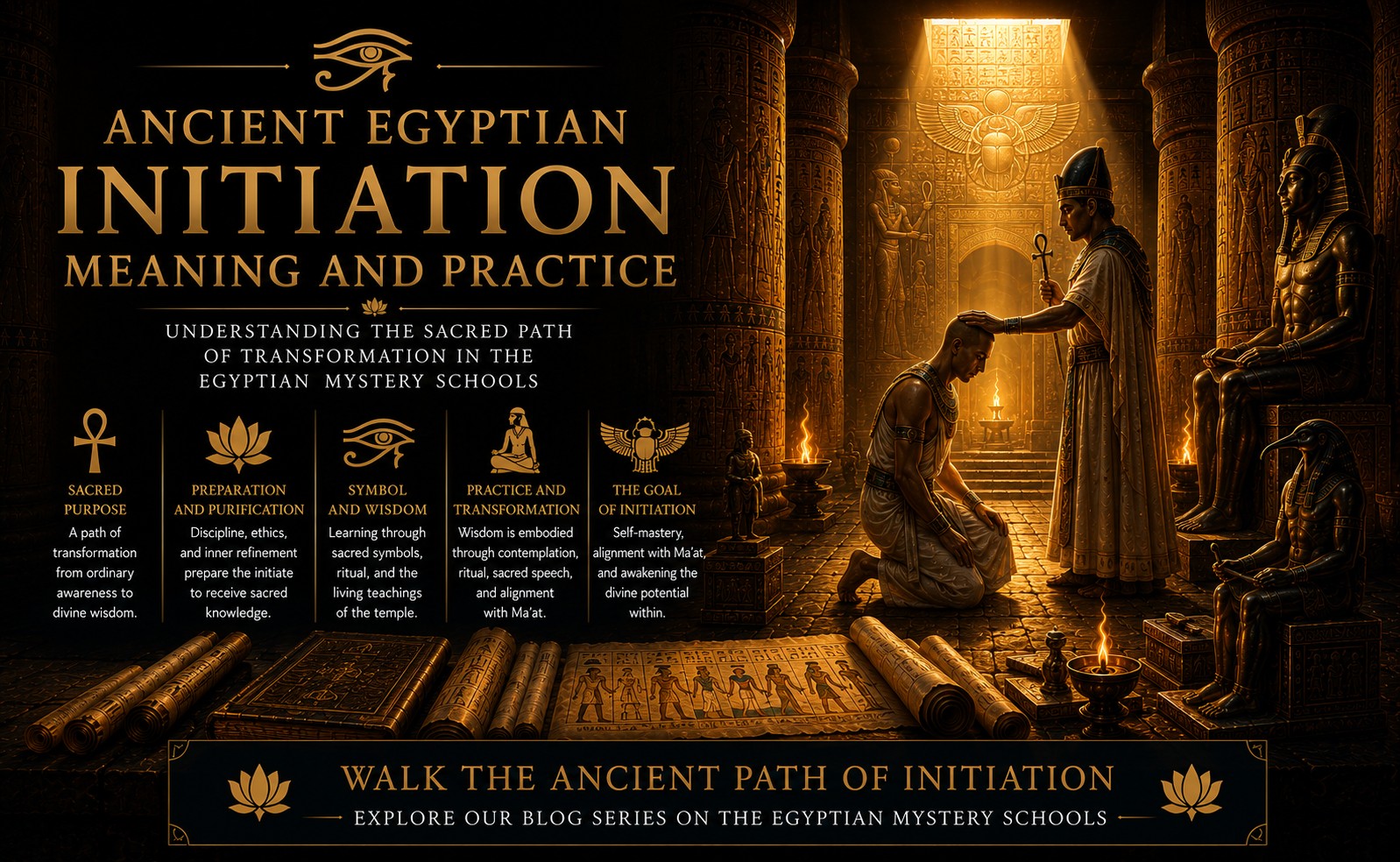
The purpose of Ancient Egyptian initiation was to guide the human being from ordinary awareness toward wisdom, self-mastery, alignment with Ma’at, and conscious participation in the divine order of existence.
To understand Ancient Egyptian initiation is to understand one of the central purposes of the Egyptian Mystery Schools.
What Did Initiation Mean in Ancient Egypt?
Initiation meant entrance into a deeper way of seeing, living, and being.
It was not simply about joining a temple community or receiving sacred information.
It was a movement from one state of consciousness to another.
The initiate entered a path of disciplined transformation in which knowledge, ritual, ethics, symbolism, and practice were woven together into a single sacred process.
In this sense, initiation was both inward and outward.
Outwardly, it may have involved training, ritual, temple service, sacred instruction, purification, and symbolic rites.
Inwardly, it required the transformation of character, perception, intention, and consciousness.
The true initiation was not only what happened in the temple.
It was what happened within the human being.
Initiation as Preparation
The First Stage Was Readiness
The Egyptian path did not treat sacred knowledge lightly.
Knowledge carried power.
Power carried responsibility.
For this reason, deeper wisdom was not given casually.
The aspirant had to be prepared.
Preparation may have included:
Discipline
The capacity to remain steady, focused, and committed.
Purification
The refinement of body, speech, intention, and conduct.
Ethical Development
The cultivation of truthfulness, humility, and responsibility.
Study
The gradual learning of sacred teachings, symbols, and temple knowledge.
Service
The willingness to contribute to something greater than personal ambition.
The purpose of preparation was not punishment or exclusion.
It was protection.
The initiate had to become capable of receiving wisdom without distorting it.
The Foundation of Ma’at
No initiation in Ancient Egypt can be understood apart from Ma’at.
Ma’at was the principle of truth, balance, harmony, justice, and right order.
It governed the cosmos.
It governed society.
It governed the heart.
The initiate was not merely expected to believe in Ma’at.
The initiate was expected to live Ma’at.
This meant bringing thought, word, action, and intention into harmony.
A person who sought sacred knowledge without ethical alignment was not yet prepared for deeper teaching.
Thus, Ma’at was not an abstract doctrine.
It was the foundation of initiation.
The Role of the Temple
The Temple Was a Sacred Environment of Transformation
Ancient Egyptian temples were not merely buildings.
They were carefully ordered sacred environments.
Their architecture, inscriptions, statues, chambers, rituals, and symbolic imagery were all part of the initiatory field.
The temple taught through space.
It taught through image.
It taught through sound, silence, rhythm, ritual, and proportion.
A person entering the temple was entering an ordered world designed to mirror the cosmic order itself.
The temple was therefore both a school and a symbol.
It reflected the universe.
It also reflected the human being.
Learning Through Symbol
Ancient Egypt taught through symbols of extraordinary depth.
To the unprepared eye, a temple wall may appear as decoration.
To the initiate, it was a sacred text.
Symbols such as the ankh, the djed pillar, the lotus, the scarab, the feather of Ma’at, the solar disk, and the Eye of Heru communicated profound truths concerning life, stability, awakening, transformation, order, and divine perception.
The initiate learned to read the world symbolically.
This was not fantasy.
It was a disciplined way of perceiving meaning beneath appearance.
Symbol trained the mind to move from surface to depth.
Initiation as Practice
Wisdom Had to Be Lived
Ancient Egyptian initiation was practical.
It was not enough to learn sacred ideas.
The initiate had to embody them.
Practice may have included:
Contemplation
Reflecting upon sacred teachings and symbols.
Ritual Participation
Engaging in ordered acts that aligned the individual with divine principles.
Sacred Speech
Learning the power of words, names, invocations, and divine utterance.
Self-Observation
Examining thought, emotion, intention, and conduct.
Ethical Action
Living according to truth, balance, and harmony.
The point was not performance.
The point was integration.
Through repeated practice, the teachings moved from the mind into the heart, the body, and the life.
Tehuti and the Transmission of Sacred Knowledge
Tehuti, known to the Greeks as Thoth, stands at the heart of Egypt’s wisdom tradition.
He was revered as Lord of Wisdom, Master of Sacred Writing, Keeper of Divine Knowledge, and Guardian of Time and Measure.
For the initiate, Tehuti represented the principle of divine intelligence entering human consciousness.
His domain included writing, speech, order, calculation, sacred record, and measured understanding.
The presence of Tehuti reminds us that initiation was not vague mysticism.
It involved precision.
It required right speech, right understanding, right measure, and right relationship to knowledge.
Heka and the Power of Sacred Speech
Initiation also involved the principle of Heka.
Heka is often translated as magic, yet this word can easily mislead the modern reader.
In Ancient Egypt, Heka referred to the divine power active within creation.
It was the sacred force through which thought, speech, intention, and action participate in reality.
For the initiate, Heka was not a theatrical art.
It was a sacred responsibility.
Words mattered.
Names mattered.
Intention mattered.
The spoken word was not merely sound.
It was an act of ordering.
To study Heka was to understand that consciousness, speech, and reality are intimately connected.
The Inner Meaning of Purification
Purification was central to Egyptian temple life.
On the surface, purification involved washing, ritual cleanliness, dietary discipline, clothing, and preparation for sacred service.
At a deeper level, purification also pointed toward inner refinement.
The initiate had to become clear.
Not perfect, but clear.
Clear in intention.
Clear in speech.
Clear in conduct.
Clear in relationship to truth.
Purification symbolized the removal of disorder so that the individual could become receptive to wisdom.
It was a movement from inner noise toward sacred order.
Initiation and the Human Being
Ancient Egyptian initiation was rooted in a profound understanding of human nature.
The human being was not seen as merely physical.
The person included multiple dimensions, such as:
Ren
The sacred name and identity.
Sheut
The shadow and hidden aspect.
Ib
The heart, conscience, and moral centre.
Ka
Vital life force.
Ba
Soul expression and individuality.
Akh
The luminous, effective spirit.
Initiation worked upon the whole being.
It sought to harmonize the name, purify the heart, strengthen the Ka, liberate the Ba, integrate the shadow, and awaken the luminous potential of the Akh.
This is why initiation was never merely intellectual.
It was total transformation.
Tests and Thresholds
Many initiatory traditions include tests, ordeals, or thresholds.
In Ancient Egypt, such thresholds may have been symbolic, ethical, ritual, psychological, or practical.
The deeper meaning of a test was not humiliation.
It was revelation.
A threshold reveals what is ready and what is not yet ready.
It shows the initiate where fear remains.
Where disorder remains.
Where pride remains.
Where the heart requires refinement.
Every threshold served the transformation of consciousness.
The initiate crossed not only from one chamber to another, but from one level of being to another.
Initiation Was Progressive
The Egyptian path unfolded in stages.
Wisdom was given according to readiness.
This progressive structure protected both the teaching and the student.
A person receives knowledge differently depending upon their level of maturity.
The same symbol may mean one thing at the beginning of the path and something far deeper after years of discipline.
This is why initiation was not a single event.
It was a lifelong unfolding.
The sacred was revealed gradually because the soul itself ripens gradually.
The Goal of Initiation
The goal of Ancient Egyptian initiation was not status.
It was not superiority.
It was not the possession of hidden information.
The goal was transformation into a wiser, more balanced, more conscious human being.
The initiate sought to become:
Aligned with Ma’at
Living according to truth and harmony.
Rooted in Wisdom
Guided by understanding rather than impulse.
Self-Mastered
Able to govern thought, speech, emotion, and action.
Spiritually Awake
Conscious of the divine order within and beyond life.
Useful to the World
Serving society, temple, cosmos, and future generations.
In the highest sense, initiation produced not merely a knower of sacred things, but a living servant of sacred order.
Ancient Egyptian Initiation Today
Modern seekers are often drawn to Ancient Egyptian initiation because they sense that something essential has been lost.
Modern life offers information, but not always wisdom.
Freedom, but not always direction.
Power, but not always responsibility.
Choice, but not always meaning.
The Egyptian initiatory vision speaks directly to this condition.
It reminds us that spiritual development requires discipline.
That wisdom must be embodied.
That transformation must include the heart.
That knowledge must serve life.
And that the true temple is ultimately awakened within the human being.
Conclusion
Ancient Egyptian initiation was a sacred path of preparation, purification, symbolic teaching, ethical refinement, and spiritual transformation.
It was not a single rite.
It was a living process.
Within the Egyptian Mystery Schools, initiation guided the aspirant from ignorance toward wisdom, from disorder toward Ma’at, from fragmentation toward wholeness, and from ordinary consciousness toward awakened participation in the divine order.
Its meaning remains profound.
Its practice remains relevant.
For the deepest purpose of initiation was never merely to reveal hidden knowledge.
It was to awaken the hidden human being.