
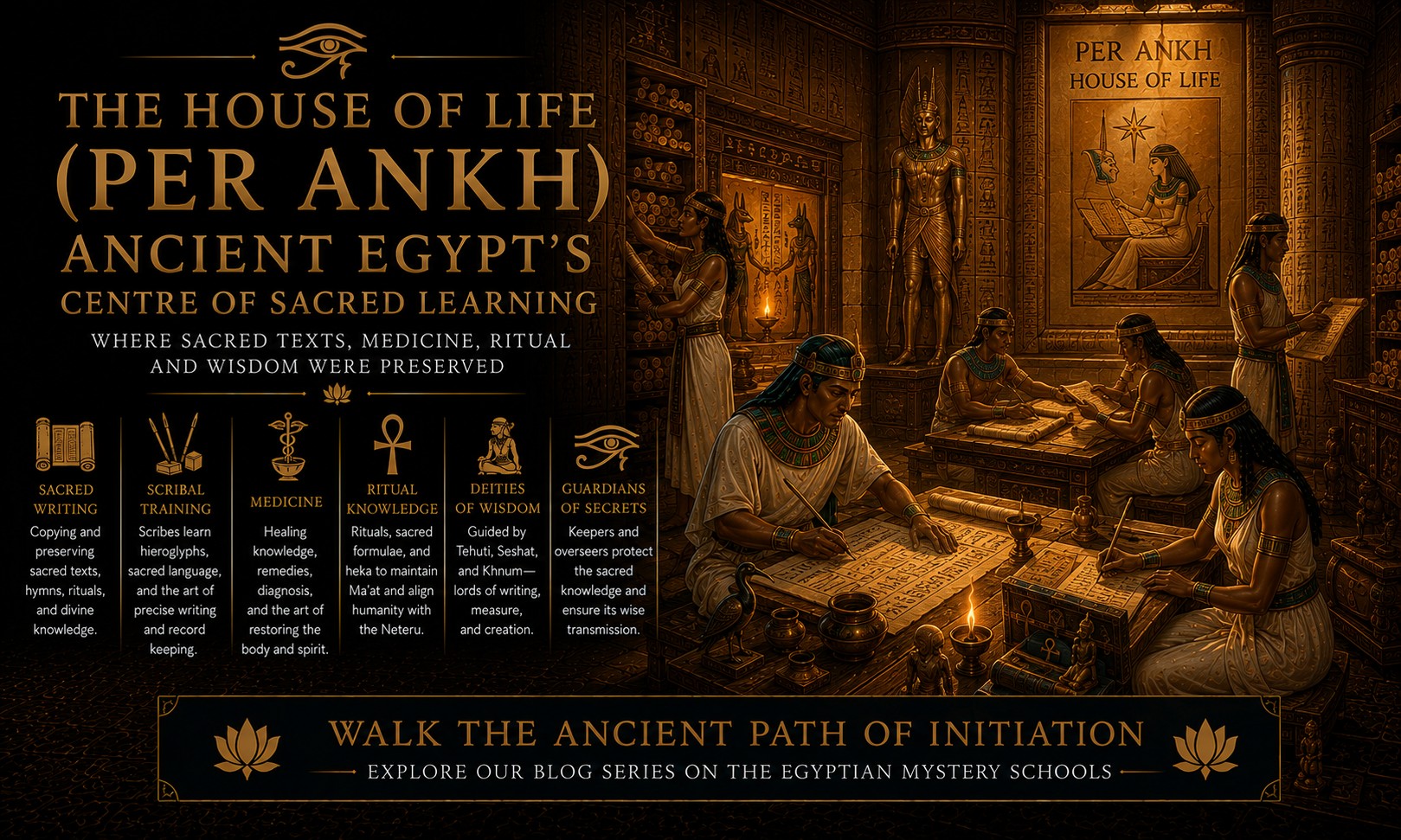
The House of Life (Per Ankh): Ancient Egypt’s Centre of Sacred Learning
Where Sacred Texts, Medicine, Ritual and the Wisdom of Ancient Egypt Were Preserved
Hidden behind the monumental architecture of Ancient Egypt lies another institution, less famous than the pyramid or temple, yet profoundly important to our understanding of Egyptian wisdom.
The Egyptians called it the Per Ankh.
The House of Life.
Its name alone is remarkable.
Not the House of Information.
Not merely the House of Books.
But the House of Life.
Associated particularly with temples and sacred learning, the Per Ankh was connected with writing, the preservation and transmission of texts, ritual knowledge, and, in some periods, medicine.
Ancient inscriptions attest to scribes of the House of Life, keepers of its secrets, and officials responsible for writing within it. Evidence for the institution appears across different periods of Egyptian history, although its precise organization and physical form remain incompletely understood.
For anyone seeking to understand how sacred knowledge was preserved within Ancient Egypt, the House of Life occupies a special place.
It brings us closer to the intellectual and sacred world behind the temple walls.
What Was the House of Life in Ancient Egypt?
The Egyptian term Per Ankh, conventionally translated as “House of Life,” referred to an institution associated with knowledge and the temple environment.
It should not be imagined too quickly as the Egyptian equivalent of a modern university, library, monastery, or school.
It possessed characteristics that overlap with several of these institutions, but it belonged to a very different civilization and worldview.
Evidence connects the House of Life particularly with:
- Writing.
- Sacred texts.
- Scribal activity.
- Ritual knowledge.
- Temple traditions.
- Medicine.
- The preservation of specialized knowledge.
Scholars remain cautious about precisely how every House of Life functioned. The evidence suggests that its character may have differed according to place and historical period.
What is clear is that the Per Ankh belonged to Egypt’s culture of sacred knowledge.
Why Was It Called the House of Life?
The name itself invites contemplation.
Why associate knowledge with life?
Within the Egyptian worldview, knowledge was not merely intellectual.
Correct knowledge sustained order.
Sacred texts preserved ritual.
Medicine restored health.
Divine names maintained relationships with the Neteru.
Ritual formulas participated in Heka.
Calendrical knowledge ensured ceremonies occurred at the proper time.
Knowledge, correctly preserved and correctly applied, helped sustain Ma’at.
In this sense, wisdom served life.
The name House of Life therefore expresses something profound about the Egyptian relationship with knowledge.
Knowledge was not separate from existence.
It participated in the maintenance and renewal of existence.
Historical Evidence for the Per Ankh
One reason the House of Life is so important to our exploration of the Egyptian Mystery Schools is that it is historically attested.
Egyptian inscriptions preserve references to individuals carrying titles connected with the institution.
Among these are references translated as:
- Scribe of the House of Life.
- Keeper of secrets of the House of Life.
- Overseer of writing in the House of Life.
Evidence also connects deities such as Seshat and Khnum with the institution in later temple inscriptions. UCL’s collection of primary references demonstrates that the House of Life was not a modern esoteric invention, but an institution known within Ancient Egypt itself.
This does not mean that every modern claim made about the Per Ankh is historically established.
It means something more valuable:
The institution itself was real.
Was the House of Life a School?
The Answer Requires Care
It is tempting to call the Per Ankh an ancient Egyptian school.
In a broad sense, this can be useful.
Scribes and specialists clearly required education, and the House of Life was associated with the written knowledge upon which such specialists depended.
Yet we should avoid imagining rows of students attending classes in the manner of a modern educational institution.
The surviving evidence does not allow us to reconstruct a standardized House of Life curriculum.
Scholars have described the institution as a scriptorium, repository of texts, centre of scholarship, and possible place of scribal education. Its precise organization remains uncertain.
It is therefore more accurate to understand the House of Life as a centre of specialized sacred and intellectual activity.
The House of Life and the Temple
The Per Ankh was closely associated with the temple world.
This is significant.
The Egyptian temple was not merely a place of worship.
As we explored in The Egyptian Temple as a School of Consciousness, the temple brought together ritual, symbolism, architecture, sacred writing, priestly service, cosmology, and knowledge.
The House of Life belonged within this greater sacred environment.
The temple maintained divine order through ritual.
The House of Life helped preserve the knowledge through which that ritual order could continue.
One enacted the sacred tradition.
The other helped preserve its memory.
Together, they participated in the continuity of Ma’at.
The Scribes of the House of Life
Writing stood at the centre of the Per Ankh.
This naturally made the scribe one of its most important figures.
Ancient Egyptian scribes did far more than record administrative information.
Within sacred contexts, they copied and preserved texts containing:
- Ritual instructions.
- Religious compositions.
- Divine names.
- Healing knowledge.
- Heka.
- Sacred formulas.
- Temple traditions.
The existence of the title scribe of the House of Life provides direct evidence for the relationship between the institution and writing.
The scribe was therefore not simply a clerk.
Within the sacred domain, the scribe became a guardian of continuity.
Tehuti and the Sacred Art of Writing
No exploration of sacred writing in Ancient Egypt can proceed very far without encountering Tehuti.
Known to the Greeks as Thoth, Tehuti was associated with:
- Wisdom.
- Writing.
- Divine speech.
- Knowledge.
- Calculation.
- Time.
- Measure.
The act of writing therefore possessed a sacred dimension.
To write was to give stable form to thought.
To copy a sacred text accurately was to preserve wisdom across generations.
To record a divine name was to participate in remembrance.
Tehuti represents the intelligence through which knowledge is measured, articulated, and transmitted.
The House of Life may therefore be understood within the wider Egyptian principle that knowledge itself belongs to sacred order.
Seshat and the House of Life
Another Neter closely connected with writing was Seshat.
Her name itself is associated with writing and scribal activity.
She appears in Egyptian tradition in connection with:
- Writing.
- Record keeping.
- Measurement.
- Temple foundation.
- Knowledge.
Later temple inscriptions explicitly describe Seshat as “foremost of the House of Life,” reinforcing the relationship between the Per Ankh and the sacred preservation of written knowledge.
Tehuti and Seshat together reveal something fundamental.
Writing was not simply technology.
It belonged to the divine ordering of knowledge.
What Texts Were Preserved in the House of Life?
The exact contents of every House of Life cannot be reconstructed.
Nevertheless, evidence associates the institution with specialized texts and sacred writings.
These could include material concerning:
Ritual
Instructions necessary for temple ceremonies.
Theology
Teachings concerning the Neteru and divine order.
Heka
Sacred formulas and efficacious speech.
Medicine
Texts concerning diagnosis, remedies, healing, and protection.
Sacred Names
Knowledge required for ritual and theological purposes.
Festival Practice
Texts preserving the proper conduct of sacred ceremonies.
The House of Life therefore helped ensure that sacred knowledge survived beyond the lifespan of any individual priest or scribe.
The House of Life and Ancient Egyptian Medicine
One of the most fascinating associations of the Per Ankh is with medicine.
Ancient Egyptian healing brought together careful observation, remedies, practical treatment, sacred speech, and Heka.
An important inscription concerning the Persian king Darius I and the Egyptian official Wedjahorresnet refers to restoring the Houses of Life and connects this restoration with the art of healing the sick. The precise interpretation of the medical role of the House of Life remains debated, but the association between the institution, scribal knowledge, and medical texts is significant.
We should therefore avoid reducing the Per Ankh to a “medical school” in the modern sense.
Its relationship with medicine appears to have been part of a broader culture of sacred and specialized knowledge.
Healing as the Restoration of Order
The connection between medicine and the House of Life becomes particularly meaningful when considered through Ma’at.
Illness represents a disruption of wellbeing.
Healing seeks restoration.
The physician attempts to restore proper function.
The ritual specialist seeks to restore sacred order.
The priest maintains harmony between humanity and the Neteru.
Although these roles should not simply be collapsed into one another, they share an underlying Egyptian concern:
The restoration and maintenance of order.
Healing, like wisdom, served life.
Heka Within the House of Life
Heka is another essential element.
Modern translations often render Heka as “magic,” but this can obscure its deeper Egyptian meaning.
Heka represented an efficacious power woven into creation itself.
Words, names, symbols, ritual actions, and intentions could participate in this power.
Medical texts sometimes combined what modern readers would distinguish as practical treatment and magical or ritual formulas. Ancient Egyptian healing did not necessarily recognize the sharp division between medicine and sacred power familiar to modern Western thought.
Within such a worldview, preserving the correct words mattered.
Accuracy mattered.
Sequence mattered.
Knowledge mattered.
The House of Life therefore preserved not merely information, but knowledge intended to be effective.
Sacred Knowledge Required Responsibility
One particularly intriguing title associated with the Per Ankh is translated as “keeper of secrets of the House of Life.”
Another individual was described as an overseer of writing there and as one to whom sacred matters were revealed.
Such titles tell us something important about the Egyptian attitude toward knowledge.
Not all knowledge was necessarily treated equally.
Certain knowledge belonged to particular offices, ritual functions, or levels of responsibility.
This does not require us to imagine a secret society.
It reveals a principle already encountered throughout the Egyptian Mystery Schools cluster:
Knowledge carries responsibility.
The deeper the knowledge, the greater the obligation to preserve and use it correctly.
Was the Per Ankh an Egyptian Mystery School?
This question requires the same historical care we applied in Were the Egyptian Mystery Schools Real?
The Ancient Egyptians themselves called the institution the Per Ankh, not the “Mystery School.”
We should therefore resist simply replacing the historical Egyptian name with a later esoteric term.
Nevertheless, the House of Life demonstrates that several elements commonly associated with the idea of Egyptian Mystery Schools genuinely existed.
There were:
- Temple-associated centres of knowledge.
- Specialized scribes.
- Sacred texts.
- Restricted knowledge.
- Ritual expertise.
- Medical knowledge.
- Priestly traditions.
- Systems for preserving and transmitting wisdom.
The Per Ankh therefore provides an important historical foundation beneath the broader idea of Egyptian sacred learning.
Knowledge Was Preserved Across Generations
Civilizations survive through memory.
Ancient Egypt endured for thousands of years partly because it developed sophisticated ways of preserving cultural and sacred knowledge.
Texts were copied.
Rituals were repeated.
Names were recorded.
Traditions were transmitted.
The House of Life participated in this continuity.
A scribe copying a sacred text was performing an act that reached beyond his own lifetime.
The words could pass to another generation.
And another.
And another.
In this sense, the Per Ankh fulfilled its name.
It gave life to knowledge by preventing knowledge from disappearing.
The House of Life as Sacred Memory
There is a deeper way to understand this function.
The House of Life preserved memory.
Not merely personal memory.
Civilizational memory.
Sacred memory.
The memory of:
- The Neteru.
- Ritual.
- Healing.
- Divine names.
- Sacred speech.
- Cosmology.
- Temple traditions.
Without memory, tradition dissolves.
Without transmission, wisdom dies with the person who possesses it.
The Per Ankh stood against forgetting.
It ensured that what had been received could be remembered.
Ren: The Importance of the Name
This preservation of memory resonates with another Egyptian principle: Ren, the name.
The name was more than a convenient label.
To preserve a name was, in an important sense, to preserve identity.
This helps explain the extraordinary Egyptian concern with inscriptions, names, monuments, and written remembrance.
Writing resists oblivion.
The House of Life participated in this sacred preservation.
Through writing, knowledge acquired continuity.
Through remembrance, what had been known could live again.
Knowledge as Transmission Rather Than Possession
Modern culture often treats knowledge as personal property.
We speak of “my ideas,” “my research,” and “my intellectual property.”
The sacred traditions of Ancient Egypt suggest another relationship.
Knowledge is received.
Preserved.
Practised.
Transmitted.
The scribe stands within a lineage of transmission.
The task is not merely to invent.
It is to preserve accurately what deserves to survive.
This principle is profoundly aligned with Tehuti.
Wisdom requires correct measure.
Correct expression.
Correct transmission.
The Relationship Between the House of Life and Initiation
We should be careful not to claim that the Per Ankh was simply an initiation school.
The surviving evidence does not justify such certainty.
Yet its existence helps us understand the environment within which deeper forms of Egyptian learning became possible.
Sacred knowledge required:
- Literacy.
- Training.
- Discipline.
- Access.
- Responsibility.
- Interpretation.
The student or scribe could not simply encounter a complex sacred text and immediately understand its full significance.
Knowledge unfolded through preparation.
This principle lies at the heart of initiation.
From Information to Understanding
A written text contains words.
But words alone do not guarantee wisdom.
The same text may be read by two people and understood very differently.
One sees information.
Another sees pattern.
Another recognizes symbol.
Another understands ritual application.
Another perceives the deeper theological principle.
This layered nature of understanding helps explain why sacred traditions require teachers, practice, and transmission.
The House of Life preserved the text.
The living tradition preserved its meaning.
The Per Ankh and the Egyptian Temple as a School of Consciousness
The previous article in this cluster explored The Egyptian Temple as a School of Consciousness.
The House of Life deepens that understanding.
The temple trained through:
- Architecture.
- Ritual.
- Symbol.
- Movement.
- Sacred space.
- Ma’at.
The House of Life preserved through:
- Writing.
- Study.
- Copying.
- Sacred texts.
- Specialized knowledge.
- Intellectual transmission.
One formed the sacred environment.
The other helped preserve the wisdom operating within it.
Together they reveal the extraordinary integration of Egyptian temple culture.
The House of Life and the Priesthood
The Per Ankh also prepares us naturally for the final article in this cluster:
The Role of the Priesthood in Ancient Egypt.
Institutions do not preserve knowledge by themselves.
People preserve it.
Scribes wrote.
Priests performed ritual.
Physicians healed.
Teachers transmitted.
Officials administered.
Specialists interpreted.
The House of Life depended upon trained human beings capable of carrying its knowledge forward.
This is why the priesthood becomes the natural final piece of our exploration.
The temple provided the sacred environment.
The House of Life preserved sacred knowledge.
The priesthood embodied and transmitted the tradition.
What the House of Life Teaches Us Today
The Per Ankh speaks to a problem that is perhaps even more urgent in the modern world.
We possess more information than any civilization in history.
Yet information is not the same as wisdom.
The House of Life represents another relationship with knowledge.
Knowledge should be:
Preserved
What is valuable should not be forgotten.
Studied
Sacred knowledge deserves sustained attention.
Understood
Words must become meaning.
Applied
Knowledge must serve life.
Transmitted
Wisdom should pass from one generation to another.
Honoured
Knowledge carries responsibility.
These principles remain timeless.
The Deeper Meaning of the House of Life
Perhaps the most beautiful aspect of the Per Ankh is its name.
The House of Life.
It suggests that the true purpose of knowledge is not accumulation.
It is animation.
Wisdom should make something more alive.
It should restore.
Illuminate.
Order.
Heal.
Remember.
Transmit.
A body of knowledge that does not enter life remains incomplete.
The House of Life reminds us that sacred learning ultimately exists to serve life itself.
The Inner House of Life
There is also an initiatory reading of the Per Ankh.
Historically, the House of Life was an Egyptian institution associated with sacred and specialized knowledge.
Symbolically, however, its name invites another question:
Where does wisdom become living knowledge within us?
A book may preserve truth.
A teacher may communicate it.
A temple may symbolize it.
But eventually the teaching must enter consciousness.
It must become lived understanding.
The true House of Life is established when knowledge ceases to remain merely upon the page and begins to shape thought, speech, character, and action.
Then wisdom becomes alive.
Conclusion
The House of Life, or Per Ankh, stands among the most fascinating institutions of Ancient Egypt.
Associated with temples, writing, sacred texts, scribes, specialized knowledge, ritual, and medicine, it helped preserve and transmit the intellectual and sacred inheritance of Egyptian civilization.
Its precise organization remains partly hidden from us.
We should therefore resist imposing modern categories upon it.
It was not simply a library.
Not simply a school.
Not simply a medical institution.
And not simply what later generations would call a Mystery School.
It belonged to an Egyptian world in which writing, wisdom, healing, ritual, and divine order remained deeply interconnected.
The House of Life preserved more than texts.
It preserved continuity.
Memory.
Knowledge.
Sacred order.
And perhaps its ancient name preserves its deepest teaching:
Knowledge becomes sacred when it serves life.
Related Articles
- Ancient Egyptian Initiation: Meaning and Practice
https://mysteryschooloftehuti.com/ancient-egyptian-initiation-meaning-and-practice/ - The Purpose of the Egyptian Mystery Schools
https://mysteryschooloftehuti.com/the-purpose-of-the-egyptian-mystery-schools/ - What Did the Priests of Ancient Egypt Teach?
https://mysteryschooloftehuti.com/what-did-the-priests-of-ancient-egypt-teach/ - The House of Life (Per Ankh): Ancient Egypt’s Centre of Sacred Learning
https://mysteryschooloftehuti.com/house-of-life-per-ankh/ - The Role of the Priesthood in Ancient Egypt
https://mysteryschooloftehuti.com/role-of-the-priesthood-in-ancient-egypt/ - Who Is Tehuti?
https://mysteryschooloftehuti.com/who-is-tehuti/ - What Is Ma’at?
https://mysteryschooloftehuti.com/what-is-maat/ - Heka Explained
https://mysteryschooloftehuti.com/heka-explained/

: Ancient Egypt’s Centre of Sacred Learning)