The Role of the Priesthood in Ancient Egypt
Guardians of Sacred Knowledge, Temple Ritual and the Divine Order of Ma’at
Few figures are more closely associated with Ancient Egypt than the priest.
Standing within the temple, clothed in ritual purity, reciting sacred words before the image of a Neter, the Egyptian priest appears to modern eyes as a mysterious intermediary between humanity and the divine.
Yet the role of the priesthood in Ancient Egypt was far more extensive than ritual alone.
Priests served as:
- Guardians of sacred knowledge.
- Custodians of temples.
- Ritual specialists.
- Scribes.
- Healers.
- Astronomers.
- Administrators.
- Teachers.
- Keepers of sacred time.
- Servants of Ma’at.
Their responsibility was not simply to perform ceremonies.
It was to help sustain the relationship between the human world, the natural world, and the divine order.
To understand the Egyptian priesthood is therefore to understand one of the central institutions through which Ancient Egyptian civilization preserved its sacred worldview for thousands of years.
What Was an Ancient Egyptian Priest?
The modern word “priest” can be misleading if we assume that Egyptian priests functioned exactly like clergy within contemporary religions.
Ancient Egyptian priesthood was highly diverse.
Different temples had different ranks, duties, and specialties.
Some priests served full time.
Others served according to rotating schedules.
Some performed ritual.
Others worked with texts, medicine, administration, astronomy, or temple estates.
The priesthood was therefore not one single profession.
It was a sacred institutional system.
At its centre stood one fundamental responsibility:
Service to the Neteru and the maintenance of Ma’at.
The Priest as Servant of the Neter
One of the most important Egyptian concepts behind priestly service was not personal authority, but service.
The temple belonged to the Neter.
The priest served within it.
The sacred image was cared for.
Offerings were presented.
Hymns were recited.
Rituals were performed.
Festivals were maintained.
The priest did not become the source of divine power.
The priest participated in an already existing sacred order.
This distinction is important.
The Egyptian priesthood was not primarily about personal spiritual charisma.
It was about correct relationship.
Correct service.
Correct measure.
Correct ritual.
Correct alignment.
The Maintenance of Ma’at
Ma’at stood at the centre of Egyptian civilization.
It represented:
- Truth.
- Balance.
- Harmony.
- Justice.
- Right order.
The priesthood participated in the maintenance of Ma’at through ritual and service.
The daily temple rites reaffirmed the proper relationship between:
- The Neteru and humanity.
- The king and the divine order.
- Society and cosmos.
- Life and renewal.
The priest therefore served something greater than individual belief.
He or she participated in the renewal of cosmic order.
The Daily Temple Ritual
The Sacred Rhythm of Service
Daily temple ritual formed one of the central duties of the priesthood.
Although practices differed according to temple and historical period, the ritual cycle could include:
Purification
The priest prepared physically and ritually before entering sacred space.
Opening the Sanctuary
The inner shrine was approached according to prescribed ritual.
Awakening the Divine Image
The sacred image of the Neter was ceremonially attended.
Clothing and Anointing
The image could be purified, clothed, perfumed, and adorned.
Offerings
Food, incense, drink, and other offerings were presented.
Sacred Speech
Hymns, formulas, and prayers were recited.
Closing the Sanctuary
The sacred space was restored and sealed.
These actions were not merely devotional.
They renewed relationship.
Order had to be maintained each day.
Ritual as Sacred Responsibility
Ancient Egyptian ritual depended upon precision.
Words mattered.
Gestures mattered.
Timing mattered.
Purity mattered.
Sequence mattered.
The priest was therefore trained to perform sacred actions correctly.
This precision reveals an important principle within the Egyptian worldview.
Ritual was not entertainment.
Nor was it simply symbolic performance.
It was regarded as an effective participation in divine order.
Through ritual, the priest helped preserve harmony.
Heka and the Priesthood
This brings us naturally to Heka.
Heka is often translated as “magic,” but in Egyptian thought it referred to an efficacious sacred power active within creation.
Priests used:
- Sacred words.
- Divine names.
- Ritual formulas.
- Symbols.
- Gestures.
- Images.
These were not necessarily understood as supernatural tricks.
They were part of a worldview in which speech, symbol, intention, and order possessed real efficacy.
The priest therefore had to understand not only what to say, but how and when to say it.
Sacred speech required discipline.
Purity and Preparation
Priestly service required ritual purity.
Ancient sources refer to practices such as:
- Washing.
- Shaving.
- Wearing clean linen.
- Dietary restrictions.
- Sexual abstinence during certain periods.
- Avoidance of ritual impurity.
The exact requirements varied.
Yet the underlying principle was consistent.
One did not enter sacred space casually.
The body had to be prepared.
The mind had to be prepared.
The priest entered the temple as a servant of order.
The Hierarchy of the Priesthood
Egyptian temples contained many priestly ranks and offices.
These varied across periods and institutions, but several broad categories are well known.
High Priest
The senior religious official associated with a major temple or cult.
Hem-Netjer
Often translated as “servant of the god,” a central designation for priestly office.
Wab Priest
A purification priest associated with ritual cleanliness and temple duties.
Lector Priest
A specialist in sacred texts, recitation, ritual formulas, and ritual knowledge.
Hour Priests
Priests connected with the timing and organization of ritual service.
Musicians and Chantresses
Individuals, often women, whose musical and ritual functions formed part of sacred worship.
The priesthood therefore included numerous forms of specialization.
The Lector Priest and Sacred Knowledge
Among the most fascinating priestly roles was that of the lector priest.
The lector priest was closely associated with:
- Sacred texts.
- Ritual recitation.
- Heka.
- Funerary rites.
- Divine names.
- Ceremonial knowledge.
This office demonstrates the close relationship between writing, knowledge, ritual, and priestly authority.
To read a sacred text was not simply to pronounce words.
The priest had to understand the ritual context.
Knowledge became action.
Priests as Scribes
Many priests were literate, and scribal ability was essential to temple culture.
Sacred texts had to be:
- Copied.
- Preserved.
- Interpreted.
- Recited.
- Transmitted.
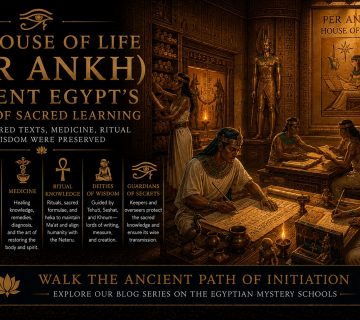
This created a natural connection between priesthood and the House of Life, or Per Ankh.
The temple required texts.
The Per Ankh preserved knowledge.
The priesthood applied that knowledge.
Together, these institutions sustained the sacred tradition.
The Priesthood and the House of Life
The House of Life belonged to the world of temple knowledge.
There, sacred texts, ritual formulas, medical knowledge, and specialized writings could be preserved and copied.
The priesthood gave this knowledge living expression.
A ritual text on a scroll remained potential.
The trained priest made it active.
A medical text preserved knowledge.
The healer applied it.
A sacred calendar recorded time.
The priest enacted ritual at the correct moment.
The House of Life preserved memory.
The priesthood embodied it.
Priests as Teachers
Education was another important dimension of priestly life.
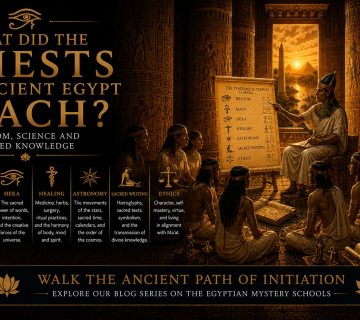
Priests and scribes transmitted knowledge to future generations.
This transmission could include:
- Writing.
- Ritual.
- Theology.
- Sacred language.
- Astronomy.
- Medicine.
- Ethics.
- Temple administration.
Knowledge did not survive accidentally.
Someone had to teach it.
This makes the priesthood one of the great vehicles of cultural continuity in Ancient Egypt.
The Priesthood and Astronomy
Priestly specialists observed the heavens.
Celestial knowledge was essential for:
- Calendars.
- Festivals.
- Temple timing.
- Seasonal cycles.
- Ritual observance.
The movement of stars and planets was not separated from sacred meaning.
Cosmic order and ritual order belonged together.
To know the heavens was to understand sacred time.
The priesthood therefore stood at the meeting point of observation and spirituality.
The Priesthood and Healing
Some temple personnel were associated with medicine and healing.
Ancient Egyptian healing combined:
- Observation.
- Remedies.
- Surgery.
- Herbal treatments.
- Sacred speech.
- Ritual.
- Heka.
The sharp distinction modern people often make between medicine and religion did not necessarily exist in the same way within Ancient Egypt.
Healing meant restoration.
And restoration belonged to the wider principle of order.
Women Within the Egyptian Priesthood
Women also held important priestly and ritual roles.
They served as:
- Priestesses.
- Chantresses.
- Musicians.
- Ritual specialists.
- Holders of prestigious religious titles.
Certain offices became particularly influential, such as the God’s Wife of Amun during later periods.
Women therefore participated meaningfully in temple ritual and sacred service.
The Egyptian priesthood should not be imagined as exclusively male.
The Pharaoh and the Priesthood
The pharaoh occupied a unique position within Egyptian religion.
Ideally, the king was the supreme mediator between the Neteru and humanity.
Temple reliefs frequently depict the pharaoh performing rituals.
In practical terms, however, priests carried out the daily temple services.
The priesthood therefore acted on behalf of the sacred order represented by kingship.
This created an intimate relationship between:
- Temple.
- Priesthood.
- Kingship.
- Ma’at.
Religion and governance were deeply intertwined.
Priests as Administrators
Major temples were not merely ritual buildings.
They controlled:
- Land.
- Workshops.
- Granaries.
- Estates.
- Personnel.
- Agricultural resources.
- Offerings.
This required substantial administration.
Priests and temple officials therefore participated in economic and organizational life.
The temple was both sacred institution and social power.
This reminds us again that Egyptian civilization did not separate religion from daily life as sharply as modern society often does.
Priesthood and Initiation
Was becoming a priest an initiation?
The answer requires care.
Ancient Egypt did not leave evidence for one universal priestly initiation system identical across all periods and temples.
Yet entry into sacred office clearly required preparation.
There were:
- Purification requirements.
- Training.
- Sacred duties.
- Restricted spaces.
- Specialized knowledge.
- Increasing levels of responsibility.
In a broad initiatory sense, priesthood involved crossing a threshold into sacred service.
One became responsible for knowledge and ritual that were not entrusted indiscriminately to everyone.
The Priest as Guardian of Thresholds
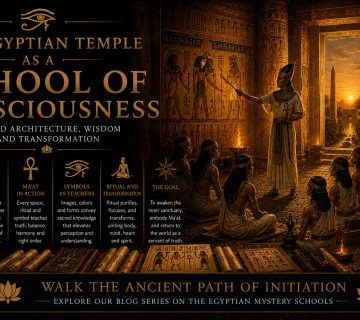
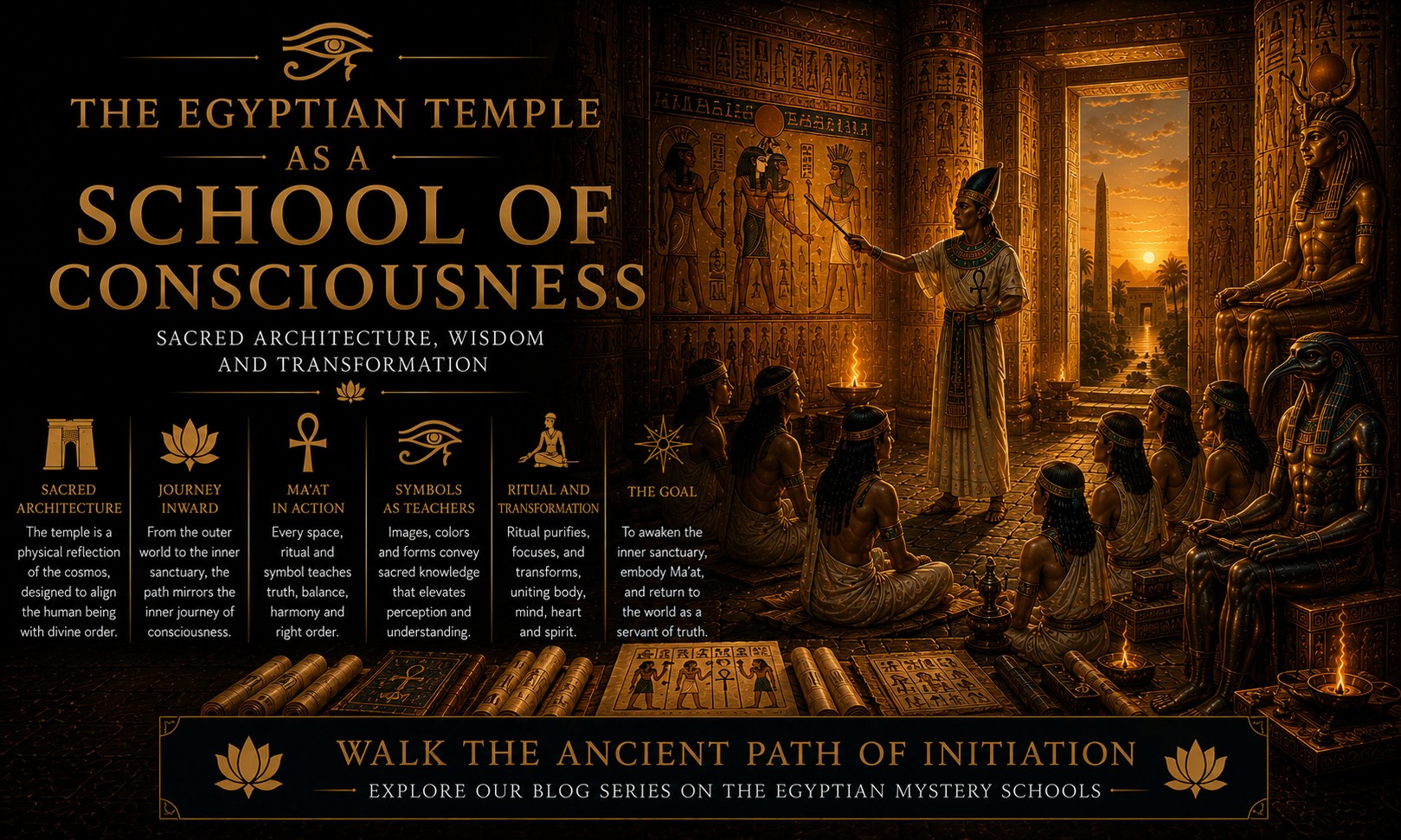
The temple itself was structured through thresholds.
Outer court.
Hypostyle hall.
Inner chambers.
Sanctuary.
Access became increasingly restricted toward the centre.
Priests were guardians of these thresholds.
But the principle was deeper than physical access.
Knowledge also had thresholds.
Responsibility had thresholds.
Understanding had thresholds.
The priesthood stood between the outer world and the inner sanctuary.
It therefore became a symbol of mediation.
Tehuti and the Priesthood
Tehuti holds a natural place within any discussion of priestly knowledge.
Known to the Greeks as Thoth, he was associated with:
- Wisdom.
- Writing.
- Divine speech.
- Measure.
- Time.
- Sacred knowledge.
Priests who worked with texts, ritual formulas, calendars, and sacred speech operated within domains strongly associated with Tehuti.
The principle of Tehuti reminds us that priestly knowledge required precision.
Wisdom was not vague.
It had measure.
Order.
Language.
Structure.
The Priesthood as Keeper of Memory
Civilizations depend upon memory.
The Egyptian priesthood preserved memory through:
- Ritual repetition.
- Sacred texts.
- Temple inscriptions.
- Festivals.
- Myths.
- Divine names.
- Ceremonial traditions.
Every ritual repeated today connected the present with the ancestors.
Every copied text extended knowledge into another generation.
Every preserved divine name resisted forgetting.
The priesthood therefore stood as guardian of sacred memory.
The Priesthood as Living Tradition
A tradition cannot survive through books alone.
Texts require readers.
Rituals require practitioners.
Symbols require interpreters.
Wisdom requires teachers.
The priesthood transformed preserved knowledge into living tradition.
This is the essential link connecting everything we have explored throughout this cluster.
The temple created sacred space.
The Per Ankh preserved sacred knowledge.
The priesthood gave both living expression.
What Did the Priesthood Ultimately Serve?
The priesthood served neither knowledge nor ritual for their own sake.
Both served Ma’at.
Knowledge without order could become dangerous.
Ritual without integrity could become empty.
Authority without service could become corruption.
The Egyptian ideal demanded alignment.
The true priest served:
- The Neteru.
- The temple.
- The community.
- Sacred knowledge.
- Cosmic order.
This is why service, rather than personal power, stands at the heart of the priestly ideal.
Why the Egyptian Priesthood Still Fascinates Us
Modern seekers continue to be fascinated by Egyptian priests because they appear to embody something largely absent from contemporary culture.
The integration of:
- Knowledge and spirituality.
- Science and sacred meaning.
- Learning and ethical responsibility.
- Ritual and consciousness.
- Service and wisdom.
The priest was expected not merely to know something sacred.
The priest had to become capable of carrying it.
That distinction remains profound.
The Inner Meaning of Priesthood
Historically, the Egyptian priesthood was a real social and religious institution.
Yet its symbolism also offers a deeper initiatory teaching.
What does it mean to become a guardian of the sacred?
To protect truth within oneself?
To speak carefully?
To preserve wisdom?
To maintain order?
To serve rather than possess?
In this deeper sense, priesthood becomes an inner responsibility.
The sacred is not merely something one approaches.
It is something one learns to serve.
The Temple, the House of Life and the Priesthood
These final three articles form a single architecture.
The Temple
Sacred space.
The ordered cosmos made visible.
The House of Life
Sacred knowledge.
The memory of wisdom preserved.
The Priesthood
Sacred service.
The living human transmission of the tradition.
Together they reveal how Ancient Egyptian wisdom endured.
Space.
Knowledge.
Embodiment.
This was not merely a system of belief.
It was a civilization structured around sacred order.
Conclusion
The role of the priesthood in Ancient Egypt was vast.
Priests served the Neteru.
Maintained temple ritual.
Preserved Ma’at.
Used sacred speech.
Copied texts.
Observed the heavens.
Practised healing.
Administered temples.
Educated future generations.
Guarded sacred knowledge.
And carried the traditions of Ancient Egypt across centuries.
Their significance cannot be reduced to ceremony.
They stood at the meeting point between temple, knowledge, society, kingship, and divine order.
Above all, the Egyptian priesthood embodied a timeless principle:
Sacred knowledge carries sacred responsibility.
To receive wisdom is not merely to possess it.
It is to serve it.
Related Articles
- Ancient Egyptian Initiation: Meaning and Practice
https://mysteryschooloftehuti.com/ancient-egyptian-initiation-meaning-and-practice/ - The Purpose of the Egyptian Mystery Schools
https://mysteryschooloftehuti.com/the-purpose-of-the-egyptian-mystery-schools/ - What Did the Priests of Ancient Egypt Teach?
https://mysteryschooloftehuti.com/what-did-the-priests-of-ancient-egypt-teach/ - The House of Life (Per Ankh): Ancient Egypt’s Centre of Sacred Learning
https://mysteryschooloftehuti.com/house-of-life-per-ankh/ - The Role of the Priesthood in Ancient Egypt
https://mysteryschooloftehuti.com/role-of-the-priesthood-in-ancient-egypt/ - Who Is Tehuti?
https://mysteryschooloftehuti.com/who-is-tehuti/ - What Is Ma’at?
https://mysteryschooloftehuti.com/what-is-maat/ - Heka Explained
https://mysteryschooloftehuti.com/heka-explained/