What Was Initiation in Ancient Egypt?
Understanding the Sacred Journey of Transformation in the Egyptian Mystery Schools
Among the many ideas associated with Ancient Egypt, few are as fascinating or as misunderstood as initiation.
The word itself evokes images of temples, sacred rites, hidden chambers, and ancient wisdom passed from teacher to student.
Yet what did initiation actually mean within the Egyptian tradition?
Was it a secret ceremony?
A religious ritual?
A test of worthiness?
Or was it something far deeper?
To understand initiation in Ancient Egypt, we must first set aside many modern assumptions.
Initiation was not primarily about joining a group.
It was about becoming a different kind of human being.
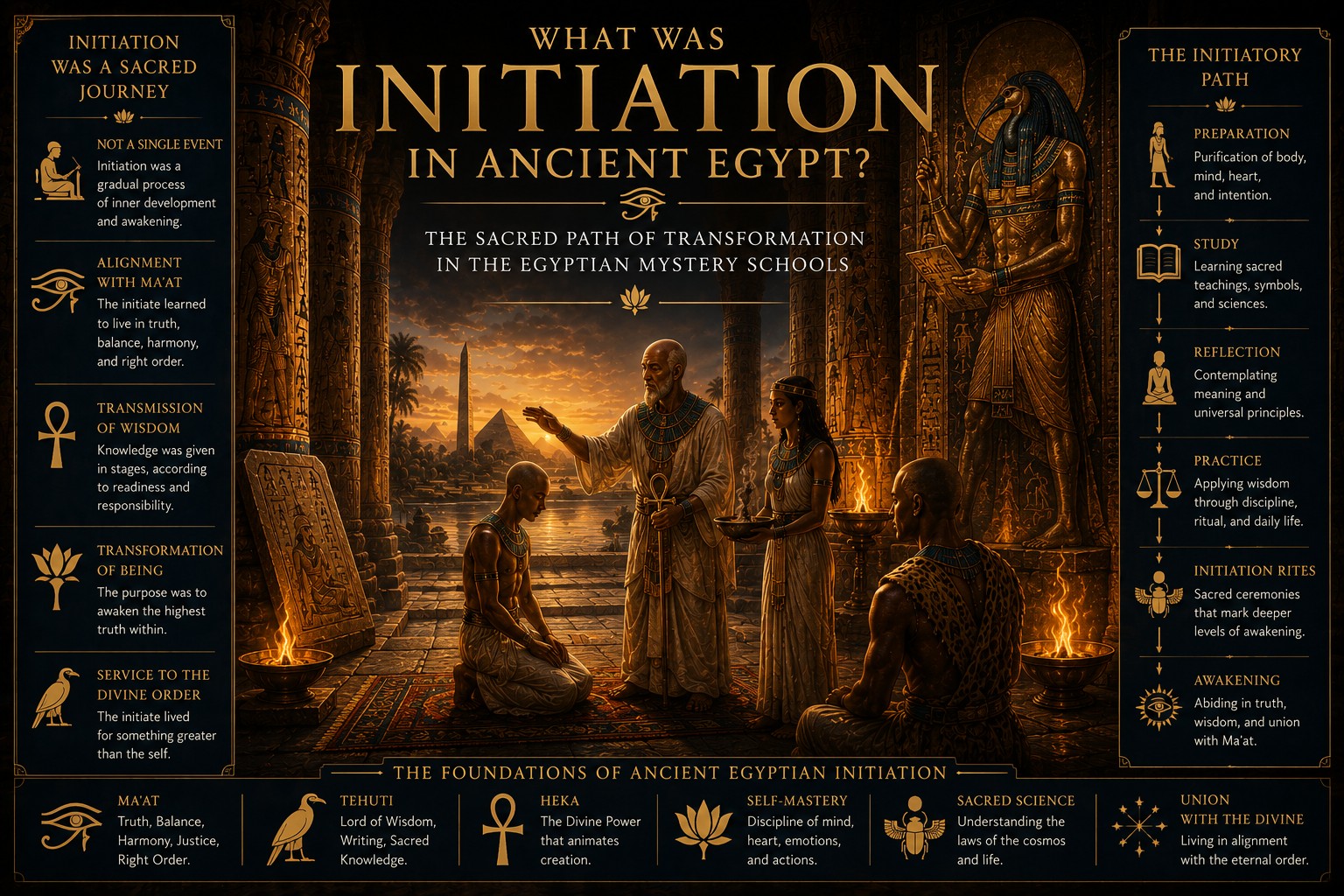
Within the Egyptian Mystery Schools, initiation represented a process of transformation through which the individual gradually aligned with wisdom, truth, and the divine order of existence.
It was a path of becoming.
What Does Initiation Mean?
The word initiation derives from a concept of entering into something new.
In the Egyptian context, initiation signified entry into deeper levels of understanding and responsibility.
It marked a transition.
A movement from one state of awareness to another.
The initiate was not simply given information.
The initiate was changed by the process itself.
Knowledge was considered sacred because genuine understanding carried responsibility.
For this reason, wisdom was revealed progressively rather than all at once.
Why Was Initiation Necessary?
Ancient Egypt understood that knowledge alone does not transform a person.
Many people can possess information while remaining unchanged.
Wisdom, however, requires embodiment.
Initiation existed to bridge the gap between knowing and becoming.
Its purpose was to cultivate:
Self-knowledge
Understanding one’s true nature.
Character
Developing integrity and discipline.
Wisdom
Learning the principles that govern life.
Harmony
Aligning with Ma’at.
Spiritual Awareness
Recognizing one’s place within the cosmos.
Initiation therefore addressed the whole person.
The Foundation of Ma’at
No understanding of initiation is possible without understanding Ma’at.
Ma’at represented:
- Truth.
- Balance.
- Harmony.
- Justice.
- Right Order.
The initiate was expected to embody these principles in daily life.
This was not merely a philosophical ideal.
It was a practical requirement.
The purpose of initiation was not simply to gain access to knowledge.
It was to become increasingly aligned with Ma’at.
The more closely one lived according to truth and harmony, the more capable one became of receiving deeper wisdom.
The Temple Environment
Where Did Initiation Take Place?
The temple formed the heart of Egypt’s sacred tradition.
Within its walls, students encountered an environment specifically designed to support learning and transformation.
Temples served as:
- Centres of worship.
- Schools of wisdom.
- Houses of learning.
- Libraries of sacred knowledge.
- Places of ritual practice.
- Centres of initiation.
The architecture, symbolism, artwork, and ceremonies all contributed to the educational process.
Every aspect of the temple communicated meaning.
Initiation as a Process Rather Than an Event
One of the most important things to understand is that initiation was not a single ceremony.
It was a gradual journey.
The modern mind often imagines initiation as a dramatic event occurring on a specific day.
While ceremonial rites undoubtedly existed, the deeper reality was a long process of preparation and transformation.
This process involved:
Study
Learning sacred teachings.
Reflection
Contemplating their meaning.
Discipline
Developing self-mastery.
Practice
Applying wisdom in daily life.
Service
Contributing to the greater good.
Each stage prepared the initiate for the next.
The Guidance of Tehuti
Within Egypt’s wisdom tradition, Tehuti occupied a central role.
Known to the Greeks as Thoth, he was revered as:
- Lord of Wisdom.
- Master of Sacred Writing.
- Keeper of Knowledge.
- Patron of Scribes.
- Guardian of Divine Speech.
Tehuti symbolized the principle through which wisdom enters human consciousness.
For this reason, he became closely associated with learning, initiation, and sacred knowledge.
Many later traditions regarded him as the archetypal teacher of the mysteries.
The Role of Symbolism
Ancient Egypt taught through symbols as much as through words.
The initiate encountered:
- Sacred myths.
- Temple imagery.
- Ritual drama.
- Hieroglyphic symbolism.
- Sacred architecture.
These symbols communicated multiple layers of meaning.
A novice might perceive one level.
An advanced initiate might perceive another.
The same symbol could reveal deeper truths as consciousness matured.
This made symbolism a powerful tool of initiation.
The Transformation of Consciousness
The ultimate purpose of initiation was not intellectual.
It was transformational.
The initiate sought to move:
From ignorance to wisdom.
From disorder to harmony.
From fragmentation to wholeness.
From unconsciousness to awareness.
From self-centredness to alignment with the divine order.
Initiation therefore concerned the evolution of consciousness itself.
The Human Being as a Sacred Mystery
Ancient Egyptian teachings viewed the human being as possessing multiple dimensions.
Among these were:
Ren
Identity and sacred name.
Sheut
The shadow.
Ib
The heart.
Ka
Vital life force.
Ba
Individual soul expression.
Akh
The luminous spirit.
Initiation involved the gradual harmonization and development of these dimensions.
The goal was not escape from life.
The goal was integration.
Heka and Sacred Power
The initiate also encountered the principle of Heka.
Heka is often translated as magic, although the term carries a much deeper meaning.
Heka referred to the intelligent power that permeates creation.
It represented the relationship between:
- Thought.
- Speech.
- Intention.
- Action.
- Reality.
Understanding Heka formed part of the sacred sciences transmitted within the temple tradition.
What Was the Goal of Initiation?
The ultimate objective was neither status nor privilege.
The goal was transformation.
An initiate sought to become:
Wise
Guided by understanding rather than impulse.
Balanced
Aligned with Ma’at.
Effective
Capable of acting harmoniously within the world.
Integrated
Living in accordance with one’s highest nature.
Spiritually Awake
Conscious of the deeper realities of existence.
The Egyptian path was therefore a path of becoming rather than merely believing.
Why Ancient Egyptian Initiation Still Matters Today
Modern society provides unprecedented access to information.
Yet many people continue to struggle with confusion, fragmentation, and lack of purpose.
Ancient Egyptian initiation addressed these challenges by focusing upon inner development.
Its teachings remind us that wisdom is not measured by what we know.
Wisdom is measured by what we become.
The principles of self-mastery, truth, balance, and conscious transformation remain as relevant today as they were thousands of years ago.
Conclusion
What was initiation in Ancient Egypt?
It was a sacred process of transformation designed to guide individuals toward wisdom, self-mastery, and alignment with the divine order.
Within the Egyptian Mystery Schools, initiation was not merely a ceremony.
It was a lifelong journey of learning, refinement, and awakening.
Through the teachings of Tehuti, the principles of Ma’at, the science of Heka, and the cultivation of the whole human being, initiation sought to awaken the highest possibilities latent within every individual.
Its enduring message is simple yet profound:
The purpose of wisdom is not merely to know more.
The purpose of wisdom is to become more.
Related Articles
- What Were the Egyptian Mystery Schools?
- Did Ancient Egypt Have Mystery Schools?
- The Egyptian Mystery Schools Explained
- How Did the Egyptian Mystery Schools Work?
- What Is Ma’at?
- Who Is Tehuti?
- Heka Explained
- The Seven Parts of the Soul in Ancient Egypt